The best dua for forgiveness is Sayyid al-Istighfar, the master dua taught by the Prophet ﷺ (Sahih al-Bukhari 6306). For a short Dua for Forgiveness, say “Astaghfirullah wa atubu ilayh” (“I seek forgiveness from Allah and turn to Him”). Everyone makes mistakes, but Allah loves those who return to Him, and no sin is too big for His mercy. In this guide, you will find each dua in Arabic, with transliteration and English translation, and the meaning of the words. You will also learn which dua to read after a sin, in prayer, on Laylatul Qadr, and for your parents.
Which Dua to Read for Forgiveness? (Quick Picker)
Wondering which dua is for forgiveness, or what dua to say for forgiveness right now? Find your situation in this table, then read the full dua in the sections below.
| Your situation | Dua to read | Source |
|---|---|---|
| Every morning and evening | Sayyid al-Istighfar | Sahih al-Bukhari 6306 |
| Very short on time | Astaghfirullah wa atubu ilayh | Sahih al-Bukhari 6307 |
| Before the salam in prayer | Allahumma inni zalamtu nafsi | Sahih al-Bukhari 834 |
| After a mistake, feeling ashamed | Rabbana zalamna anfusana (Adam AS) | Quran 7:23 |
| Feeling trapped or in distress | La ilaha illa anta subhanaka (Yunus AS) | Quran 21:87 |
| Laylatul Qadr | Allahumma innaka afuwwun | Jami at-Tirmidhi 3513 |
| For parents and believers | Rabbana ighfir li wa li walidayya | Quran 14:41 |
What Is the Best Dua for Forgiveness? Sayyid al-Istighfar
In Sahih al-Bukhari 6306, the Prophet ﷺ called this the most superior way of asking Allah for forgiveness. The word sayyid means master, so it is also known as the most powerful dua for forgiveness. It is the dua for asking Allah for forgiveness that joins praise, thanks and honest confession in a few lines.
Arabic:
اللَّهُمَّ أَنْتَ رَبِّي لَا إِلَهَ إِلَّا أَنْتَ، خَلَقْتَنِي وَأَنَا عَبْدُكَ، وَأَنَا عَلَى عَهْدِكَ وَوَعْدِكَ مَا اسْتَطَعْتُ، أَعُوذُ بِكَ مِنْ شَرِّ مَا صَنَعْتُ، أَبُوءُ لَكَ بِنِعْمَتِكَ عَلَيَّ، وَأَبُوءُ بِذَنْبِي فَاغْفِرْ لِي، فَإِنَّهُ لَا يَغْفِرُ الذُّنُوبَ إِلَّا أَنْتَ
Transliteration:
Allahumma anta rabbi la ilaha illa anta, khalaqtani wa ana abduka, wa ana ala ahdika wa wa’dika mastata’tu. A’udhu bika min sharri ma sana’tu, abu’u laka bini’matika alayya, wa abu’u bidhanbi faghfir li, fa innahu la yaghfirudh-dhunuba illa anta.
English translation:
O Allah, You are my Lord. None has the right to be worshipped except You. You created me and I am Your servant. I keep Your covenant and promise as much as I can. I seek refuge in You from the evil I have done. I admit Your blessings upon me, and I admit my sins. So forgive me, because no one forgives sins except You.
Word meaning:
Sayyid means master or chief, and istighfar means asking for forgiveness, so the name means “the master of asking forgiveness.” Rabb means Lord: the One who creates you, owns you and takes care of you. An abd is a servant who belongs fully to his master. Ahd is the covenant to worship Allah alone, and wa’d is Allah’s promise of reward. Abu’u means “I admit,” so you admit both Allah’s blessings and your own sin. A dhanb is a sin, and the root of faghfir (forgive me) carries the idea of covering a fault.
The Prophet ﷺ said that whoever says it in the daytime with firm faith and dies that day before evening will be among the people of Paradise. The same is true for the night (Sahih al-Bukhari 6306). The promise is for the one who says it with firm faith, so read it slowly and mean every line.
| Part of the dua | What you are saying | Why it matters |
|---|---|---|
| “You are my Lord… I am Your servant” | Allah alone is God, and I belong to Him | Forgiveness starts with humility |
| “As much as I can” | I will try to keep my promise to You | Allah asks for effort, not perfection |
| “I seek refuge from the evil I have done” | I take responsibility for my mistakes | Excuses block repentance |
| “I admit Your blessings and my sins” | I thank You and I am honest about my faults | Gratitude and honesty go together |
| “No one forgives sins except You” | The actual request for forgiveness | Only Allah can erase a sin |
Short Dua for Forgiveness: Astaghfirullah
Astaghfirullah is the simplest dua for forgiveness you can learn today. The Prophet ﷺ said he asked Allah for forgiveness and turned to Him in repentance more than seventy times a day (Sahih al-Bukhari 6307). If the Prophet ﷺ did this daily, we need it even more.
| Short dua | Best use | Source |
|---|---|---|
| Astaghfirullah wa atubu ilayh | Anytime, in your heart or on your tongue | Sahih al-Bukhari 6307 |
| Astaghfirullah al-Azeem alladhi la ilaha illa huwal Hayyul Qayyumu wa atubu ilayh | A fuller version for daily dhikr | Jami at-Tirmidhi 3577 |
Astaghfirullah wa Atubu Ilayh: Short Dua for Forgiveness
Arabic:
أَسْتَغْفِرُ اللَّهَ وَأَتُوبُ إِلَيْهِ
Transliteration:
Astaghfirullah wa atubu ilayh.
English translation:
I seek forgiveness from Allah and I turn back to Him.
Word meaning:
Astaghfiru means “I ask forgiveness.” The verb form itself carries the sense of seeking. Allah is the One you ask. Wa means “and,” and atubu means “I return,” from tawbah, which means returning. Ilayh means “to Him.” So you are not only asking Allah to forgive you, you are also saying that you are going back to Him.
Astaghfirullah al-Azeem: Longer Dua for Forgiveness
Arabic:
أَسْتَغْفِرُ اللَّهَ الْعَظِيمَ الَّذِي لَا إِلَهَ إِلَّا هُوَ الْحَيُّ الْقَيُّومُ وَأَتُوبُ إِلَيْهِ
Transliteration:
Astaghfirullah al-Azeem alladhi la ilaha illa huwal Hayyul Qayyumu wa atubu ilayh.
English translation:
I seek forgiveness from Allah the Mighty, none is worthy of worship but Him, the Ever-Living, the Self-Sustaining, and I turn to Him.
Word meaning:
Al-Azeem means The Mighty, the One whose greatness has no limit. Alladhi means “the One who.” Al-Hayy means Ever-Living, whose life never ends. Al-Qayyum means Self-Sustaining, the One who keeps everything standing while needing nothing. You ask forgiveness while naming Allah’s greatness, life and strength, which reminds you whom you are standing before. In Jami at-Tirmidhi 3577, the Prophet ﷺ said Allah forgives the one who says it, even if he ran away from battle. This shows how wide Allah’s forgiveness is.
Final Dua for Forgiveness: Before the Salam and the End of Surah Al-Baqarah
People mean two things by a final dua for forgiveness: the last dua inside your prayer, and the closing verse of Surah Al-Baqarah. Both are below.
| Final dua | When to read it | Key meaning |
|---|---|---|
| Allahumma inni zalamtu nafsi zulman kathiran | After the tashahhud, before the salam | “I have wronged myself greatly, so forgive me” |
| Wa’fu anna waghfir lana warhamna (Quran 2:286) | At the end of Surah Al-Baqarah | “Pardon us, forgive us and have mercy on us” |
Final Dua for Forgiveness in Prayer (Abu Bakr’s Dua)
Abu Bakr as-Siddiq asked the Prophet ﷺ for a dua to read in his prayer, and this is what he was taught (Sahih al-Bukhari 834). Even one of the most righteous Companions was taught to admit his faults, so none of us is above this dua.
Arabic:
اللَّهُمَّ إِنِّي ظَلَمْتُ نَفْسِي ظُلْمًا كَثِيرًا، وَلَا يَغْفِرُ الذُّنُوبَ إِلَّا أَنْتَ، فَاغْفِرْ لِي مَغْفِرَةً مِنْ عِنْدِكَ، وَارْحَمْنِي، إِنَّكَ أَنْتَ الْغَفُورُ الرَّحِيمُ
Transliteration:
Allahumma inni zalamtu nafsi zulman kathiran, wa la yaghfirudh-dhunuba illa anta, faghfir li maghfiratan min indika, warhamni, innaka antal-Ghafurur-Rahim.
English translation:
O Allah, I have wronged myself greatly, and none forgives sins except You. So grant me forgiveness from You and have mercy on me. You are the Forgiving, the Merciful.
Word meaning:
Zalamtu nafsi means “I wronged myself.” Every sin first harms the person who commits it, which is why the dua says “myself.” Zulman kathiran means “a great wrong.” Min indika means “from You,” so you ask for a forgiveness that comes from Allah’s own generosity, not because you deserve it. Warhamni means “and have mercy on me.” Al-Ghafur is the Oft-Forgiving and Ar-Rahim is the Most Merciful, two names of Allah that fit the request perfectly.
End of Surah Al-Baqarah: Final Dua for Forgiveness
Arabic:
وَاعْفُ عَنَّا وَاغْفِرْ لَنَا وَارْحَمْنَا أَنْتَ مَوْلَانَا
Transliteration:
Wa’fu anna, waghfir lana, warhamna, anta mawlana.
English translation:
Pardon us, forgive us and have mercy on us. You are our Protector.
Word meaning:
Wa’fu means “and pardon,” from the root that means to wipe something away. Waghfir means “and forgive,” from the root that means to cover. Warhamna means “and have mercy on us.” The three requests together ask Allah to wipe the fault away, cover it and treat you with kindness. Mawlana means “our Protector,” the One we turn to for help.
Dua for Forgiveness in Arabic From the Quran
The Quran records each Prophet’s dua for forgiveness. Every one is short, easy to memorise and starts by owning the mistake.
| Prophet | Reference | Best used when |
|---|---|---|
| Adam (AS) and Hawwa | Quran 7:23 | You slipped and feel ashamed |
| Yunus (AS) | Quran 21:87 | You feel trapped or in distress |
| Musa (AS) | Quran 28:16 | You want a very short dua |
| Ibrahim (AS) | Quran 14:41 | You pray for parents and believers |
Hazrat Adam (AS) Dua for Forgiveness
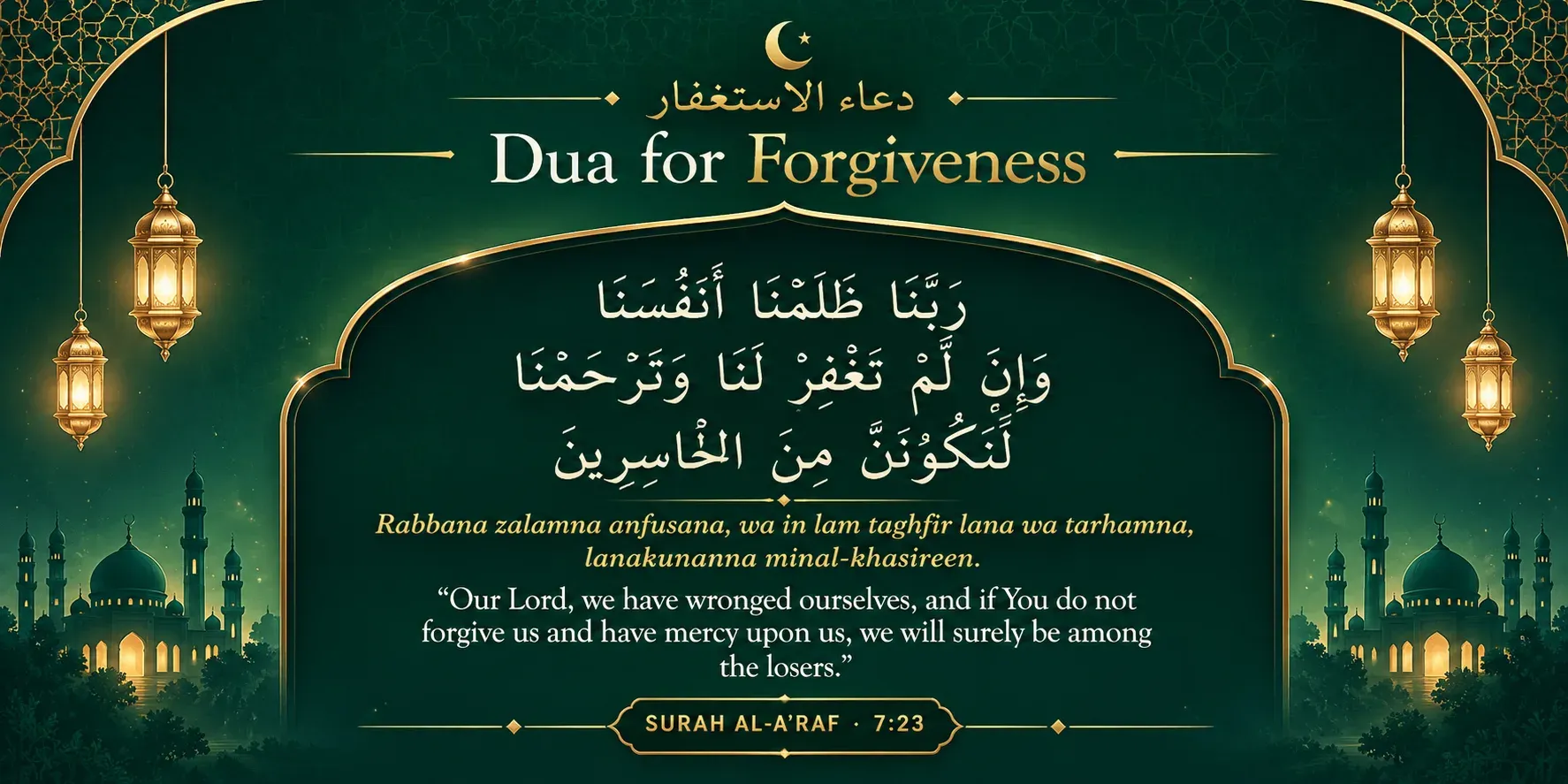
This is the dua Adam (AS) and Hawwa made after their mistake (Quran 7:23). It does not make excuses. It simply says, “We have wronged ourselves,” and begs for mercy. That makes it a good first dua for forgiveness after a slip.
Arabic:
رَبَّنَا ظَلَمْنَا أَنفُسَنَا وَإِن لَّمْ تَغْفِرْ لَنَا وَتَرْحَمْنَا لَنَكُونَنَّ مِنَ الْخَاسِرِينَ
Transliteration:
Rabbana zalamna anfusana wa in lam taghfir lana wa tarhamna lanakunanna minal-khasirin.
English translation:
Our Lord, we have wronged ourselves. If You do not forgive us and have mercy on us, we will surely be among the losers.
Word meaning:
Rabbana means “our Lord.” Anfusana means “ourselves,” so zalamna anfusana is “we wronged ourselves.” Lam taghfir means “if You do not forgive.” Lanakunanna means “we will surely be,” and al-khasirin means “the losers,” like a trader who loses everything. The dua shows that without Allah’s forgiveness and mercy, a person is truly at a loss.
Yunus (AS) Dua for Forgiveness
Yunus (AS) called out this dua in the darkness of the whale’s belly (Quran 21:87).
Arabic:
لَا إِلَٰهَ إِلَّا أَنتَ سُبْحَانَكَ إِنِّي كُنتُ مِنَ الظَّالِمِينَ
Transliteration:
La ilaha illa anta subhanaka inni kuntu minaz-zalimin.
English translation:
There is no god but You. Glory be to You. I was among the wrongdoers.
Word meaning:
La ilaha illa anta means “there is no god but You.” Subhanaka means “glory be to You,” which says that Allah is far above any fault. Before admitting his own mistake, Yunus first cleared Allah of any blame. Inni kuntu means “I was,” and az-zalimin means “the wrongdoers.” It is a dua of distress, so this dua for forgiveness fits both guilt and hardship.
Musa (AS) Dua for Forgiveness
Arabic:
رَبِّ إِنِّي ظَلَمْتُ نَفْسِي فَاغْفِرْ لِي
Transliteration:
Rabbi inni zalamtu nafsi faghfir li.
English translation:
My Lord, I have wronged myself, so forgive me.
Word meaning:
Rabbi means “my Lord,” a personal call. Inni zalamtu nafsi means “I have wronged myself.” Fa means “so,” and ghfir li means “forgive me.” It is a very short dua for forgiveness, which makes it easy to say in any moment of regret.
Ibrahim (AS) Dua for Forgiveness for Parents and Believers
Arabic:
رَبَّنَا اغْفِرْ لِي وَلِوَالِدَيَّ وَلِلْمُؤْمِنِينَ يَوْمَ يَقُومُ الْحِسَابُ
Transliteration:
Rabbana ighfir li wa li walidayya wa lil-mu’minina yawma yaqumul-hisab.
English translation:
Our Lord, forgive me, my parents and the believers on the Day when the reckoning is established.
Word meaning:
Ighfir li means “forgive me.” Walidayya means “my two parents.” Al-mu’minin means “the believers.” Yawma yaqumul-hisab means “the day the reckoning stands,” the Day of Judgment. This dua teaches that you can ask forgiveness for yourself and for others in the same breath.
Dua for Forgiveness of All Sins and Major Sins
No sin is too big for Allah’s mercy. The Prophet ﷺ said that when Allah completed creation, He wrote in His Book that His mercy prevails over His wrath (Sahih al-Bukhari 3194). The way you ask depends on the kind of sin.
| Category | Minor sins | Major sins |
|---|---|---|
| Examples | Cursing, acting immodestly, praying carelessly | Shirk, murder, zina, disrespecting parents |
| How they are forgiven | Good deeds wipe them away (Quran 11:114) | Sincere repentance with the steps shown below |
| Warning | Do not take them lightly, because small sins add up | Never lose hope in Allah’s mercy |
For every dua for forgiveness of sins, big or small, read Sayyid al-Istighfar, Abu Bakr’s dua above, or the verse below. Allah also says He forgives all sins (Quran 39:53).
Arabic:
رَبَّنَا إِنَّنَا آمَنَّا فَاغْفِرْ لَنَا ذُنُوبَنَا وَقِنَا عَذَابَ النَّارِ
Transliteration:
Rabbana innana amanna faghfir lana dhunubana wa qina adhaban-nar.
English translation:
Our Lord, we believe, so forgive our sins and protect us from the punishment of the Fire.
Word meaning:
Innana amanna means “we have believed,” so you start by naming your faith. Dhunubana means “our sins.” Qina means “protect us,” and adhab an-nar means “the punishment of the Fire.” The dua asks for two things together: forgiveness now and safety in the Hereafter.
Dua for Forgiveness of Zina
Zina is a major sin, but the door of tawbah is open. The Quran says that those who repent, believe and do good deeds will have their evil deeds replaced with good by Allah (Quran 25:70). Sincere repentance has five conditions: regret, giving up the sin, resolving never to return, sincerity to Allah, and repenting before it is too late. When these are met, Allah erases earlier sins, even zina.
| What to do | Why |
|---|---|
| Read Sayyid al-Istighfar and Abu Bakr’s dua | They admit the wrong and ask Allah directly |
| Keep the sin private | Telling others spreads sin and removes the chance of quiet repentance |
| Reject Shaytan’s “you will repeat it” whisper | Despair is his trick, and Allah’s mercy is greater |
If your situation involves another person, marriage or legal matters, speak to a trusted scholar, because the answer depends on the details.
Shab e Barat Dua for Forgiveness
Shab e Barat is the night of 15 Sha’ban. In Pakistan the exact date follows the Sha’ban moon sighting, so confirm it with the official announcement. Scholars hold two views about this night.
| View | Reason |
|---|---|
| The night has virtue | Several hadiths about mid-Sha’ban support each other, so these scholars accept personal worship on this night |
| No authentic hadith proves it | These scholars say the narrations about the night are weak, so they do not give it special virtue |
Both views agree on one point: no special group ritual is needed to receive forgiveness. The safe way is simple.
| Safe to do | Better to avoid |
|---|---|
| Personal istighfar and Sayyid al-Istighfar | Salat al-Alfiyyah, a 100-rakah prayer with no basis in the Quran or Sunnah |
| Night prayer and Quran recitation, as on any night | Treating group rituals as compulsory |
| Forgiving people who wronged you | Calling it the night of destiny, because most scholars say the “blessed night” in Surah Ad-Dukhan (44:3) is Laylatul Qadr |
You also do not have to wait for one night. Every night Allah descends to the lowest heaven in the last third and asks, “Who seeks forgiveness so that I may forgive him?” (Sahih al-Bukhari and Sahih Muslim). That makes any night a good time for dua for forgiveness.
Laylatul Qadr Dua for Forgiveness: Allahumma Innaka Afuwwun
Aisha (RA) asked the Prophet ﷺ what to say if she found Laylatul Qadr. He told her to say this (Jami at-Tirmidhi 3513, which Imam Tirmidhi called Hasan Sahih):
Arabic:
اللَّهُمَّ إِنَّكَ عَفُوٌّ تُحِبُّ الْعَفْوَ فَاعْفُ عَنِّي
Transliteration:
Allahumma innaka afuwwun tuhibbul-afwa fa’fu anni.
English translation:
O Allah, You are Most Forgiving, and You love forgiveness, so forgive me.
Word meaning:
Allahumma means “O Allah.” Afuwwun comes from a root that means to wipe away, so Allah is the One who erases faults, not only the One who withholds punishment. Tuhibbu means “You love,” and al-afwa means “pardon.” Fa’fu anni means “so pardon me.” The dua gives a reason and then a request: You love to pardon, so pardon me.
| Detail | Note |
|---|---|
| When to read it | The last ten nights of Ramadan |
| Where it is recorded | Jami at-Tirmidhi 3513 and Sunan Ibn Majah 3850 |
| Who asked | Aisha (RA) |
This is the best dua for forgiveness from Allah on that night, because it is the exact dua the Prophet ﷺ taught for it. Read the meaning of the night in ourguide to Surah Qadr in English.
How to Ask Allah for Forgiveness: Dua Plus 4 Steps
Words matter, but so does the heart behind them. Repentance has four steps.
| Step | What to do | Why it matters |
|---|---|---|
| 1. Remorse | Feel regret straight after the sin | Guilt is a sign of faith in your heart |
| 2. Repent | Say “Astaghfirullah” or any dua above | You ask Allah directly |
| 3. Resolve | Decide not to return to the sin | Repentance needs a real change of direction |
| 4. Repair | Return rights and ask forgiveness from anyone you wronged | Some sins also harm people |
After the sin, follow it with a good deed, because good deeds do away with misdeeds (Quran 11:114).
FAQs About Dua for Forgiveness
Can I make dua for forgiveness for my parents and for those who have died?
Yes. The Quran teaches, “Our Lord, forgive me, my parents and the believers” (14:41), and “Our Lord, forgive us and our brothers who came before us in faith” (59:10).
How many times should I say Astaghfirullah?
There is no fixed number you must reach. The Prophet ﷺ sought forgiveness more than seventy times a day (Sahih al-Bukhari 6307), so choose a number you can keep every day.
What should I say right after committing a sin?
Say Astaghfirullah wa atubu ilayh at once, feel regret, and then do a good deed.