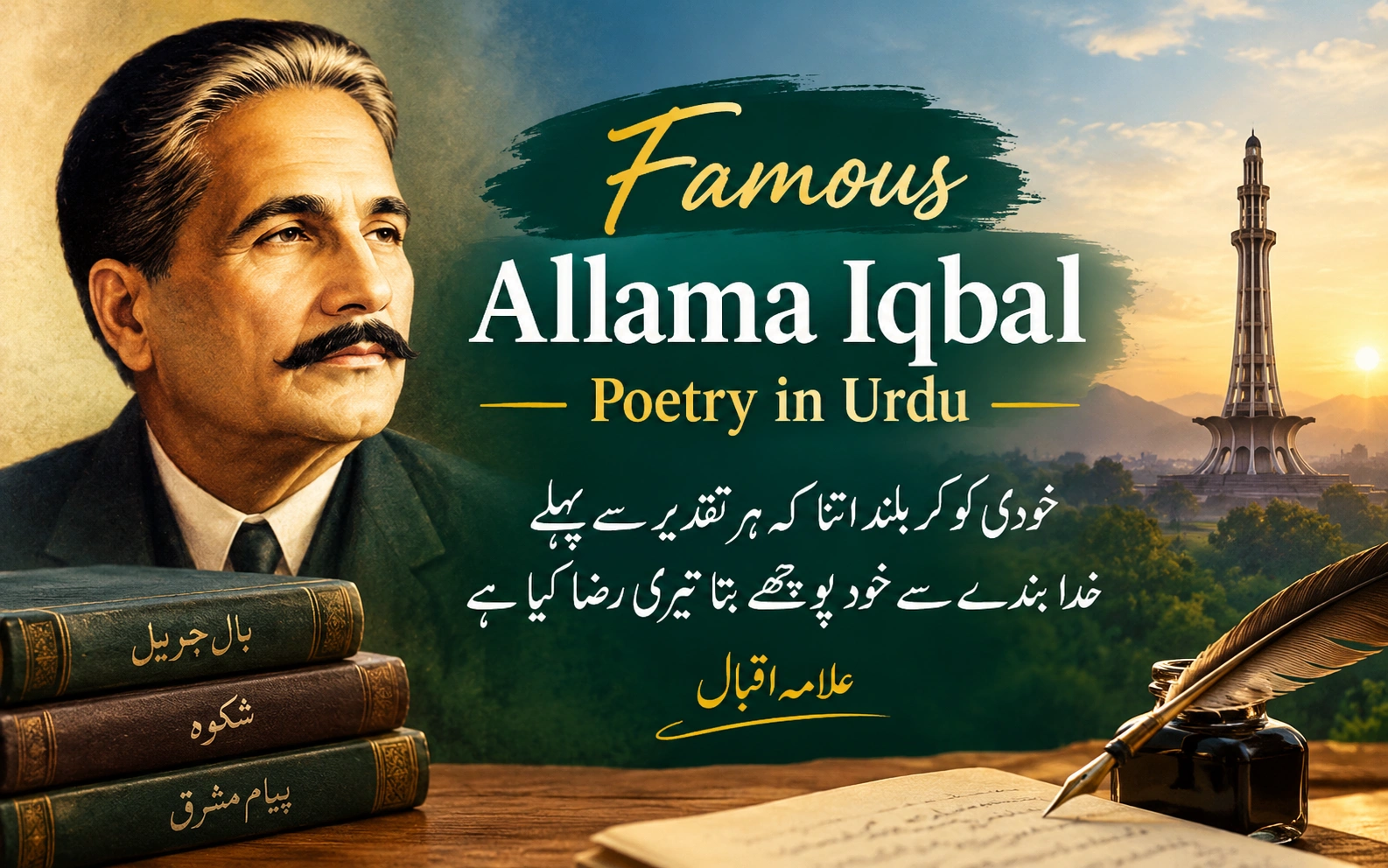
Famous Allama Iqbal poetry in Urdu still shapes how millions of people in South Asia think about faith, self-respect, and ambition, nearly ninety years after the poet’s death.
Quick Facts About Allama Iqbal
| Detail | Information |
|---|---|
| Full name | Sir Muhammad Iqbal |
| Known as | Allama Iqbal, Iqbal Lahori |
| Born | November 9, 1877, Sialkot, Punjab |
| Died | April 21, 1938, Lahore |
| Main languages | Urdu and Persian |
| Famous titles | Shair-e-Mashriq (Poet of the East), Hakeem-ul-Ummat |
| Major Urdu works | Bang-e-Dara, Bal-e-Jibril, Zarb-e-Kalim |
| Known for | Philosophy of khudi (selfhood), Islamic thought, motivational and sufi poetry |
| National status | National poet of Pakistan |
Note for readers: dates and titles above are drawn from widely published biographical sources. Readers who need citation-grade accuracy for academic work should cross-check against a university press biography or the Iqbal Academy Pakistan archives.
A One-Line Answer First
If you only remember one thing, remember this: famous Allama Iqbal poetry in Urdu is famous because it turns big ideas like faith, courage, and self-worth into short, singable lines that ordinary readers, not just scholars, can carry in their hearts.
Who Was Allama Iqbal, Really?
Allama Iqbal was a poet, thinker, and lawyer who wrote mostly in Urdu and Persian. He studied in Lahore, Cambridge, and Munich, then came home and spent his life writing verses that pushed people to stop feeling small. That single mission, waking people up, runs through almost every poem he ever wrote. It is why Famous Allama Iqbal Poetry in Urdu feels less like old literature and more like a pep talk from someone who genuinely believed in you.
Why His Urdu Poetry Still Matters
Iqbal wrote during a time when many people in the subcontinent felt powerless under colonial rule. His poetry answered that mood with a simple idea: your worth comes from inside you, not from your circumstances. That message is exactly why Famous Allama Iqbal Poetry in Urdu is still read in schools, quoted in speeches, and shared as quotes on social media today.
Famous Allama Iqbal Poetry in Urdu for Students and Education
Teachers across Pakistan and India still open assemblies with his lines because his Education Famous Allama Iqbal Poetry in Urdu verses talk directly to young minds. His most quoted school poem, “Lab Pe Aati Hai Dua,” is a child’s prayer for goodness and purpose, and it remains one of the clearest examples of Student Life Famous Allama Iqbal Poetry in Urdu in the entire Urdu language.
One widely shared 2 Lines Famous Allama Iqbal Poetry in Urdu couplet from his work reads:
خودی کو کر بلند اتنا کہ ہر تقدیر سے پہلے خدا بندے سے خود پوچھے بتا تیری رضا کیا ہے
In plain English, this asks the reader to raise their self-worth so high that even fate consults them before deciding their future. It is a favorite Urdu Famous Allama Iqbal Poetry in Urdu line for graduation cards and motivational posters, and it captures why this Student Famous Allama Iqbal Poetry in Urdu message has outlived its century.
Famous Allama Iqbal Poetry in Urdu on Love and Allah
Not all of his writing is about ambition. A gentler side of Famous Allama Iqbal Poetry in Urdu Love shows up in verses about longing, devotion, and the pain of separation, themes that connect his work to older Sufi Poetry traditions. At the same time, a large share of his output is directly devotional. His Famous Allama Iqbal Poetry in Urdu Allah-focused verses reflect on submission, gratitude, and closeness to God, written with the same warmth found in classical Islamic verse.
His Naat Famous Allama Iqbal Poetry in Urdu writing, poems in praise of the Prophet Muhammad, is still recited at religious gatherings across the subcontinent. These pieces sit comfortably alongside his more philosophical work because, for Iqbal, faith and self-improvement were never separate ideas.
Motivational Famous Allama Iqbal Poetry in Urdu
If you search for Motivational Famous Allama Iqbal Poetry in Urdu today, you will almost always land on lines from his concept of khudi, or selfhood. He believed a person becomes truly alive only when they stop copying others and start building their own character. This idea made him a favorite source of Heart Touching Famous Allama Iqbal Poetry in Urdu for anyone facing a hard decision, a tough exam, or a long personal struggle. His work is also popular as Famous Allama Iqbal Poetry in Urdu for Youth, since so much of it was written to shake young readers out of comfort and complacency.
Table: Iqbal’s Major Urdu Works and Their Themes
| Work | Published | Central Theme |
|---|---|---|
| Bang-e-Dara | 1924 | Nationalism, childhood, patriotism |
| Bal-e-Jibril | 1935 | Self-respect, spirituality, khudi |
| Zarb-e-Kalim | 1936 | Social reform, modern life, guidance |
| Armaghan-e-Hijaz | 1938 (posthumous) | Reflection, faith, final thoughts |
Shikwa and Jawab-e-Shikwa
No discussion of Famous Allama Iqbal Poetry in Urdu Shikwa is complete without mentioning his two companion poems, “Shikwa” (Complaint) and “Jawab-e-Shikwa” (Answer to the Complaint). In “Shikwa,” the poet boldly questions God about the community’s suffering despite its past service to faith. In the reply, God gently reminds humanity that its own weakness, not divine neglect, caused its decline. Together, these poems remain some of the most debated and most quoted pieces of Poetry Famous Allama Iqbal Poetry in Urdu has ever produced, precisely because Iqbal dared to write a complaint to God and then answer it himself.
Famous Allama Iqbal Poetry in Urdu for Kids
Parents and teachers often look for Famous Allama Iqbal Poetry in Urdu for Kids because his shorter poems use simple words and clear images, like birds, gardens, and prayers, that young children can understand and recite easily. “Lab Pe Aati Hai Dua” remains the top pick for this purpose across schools in Pakistan and India, since its rhythm makes it easy to memorize even for very young Students.
Our Expert Ranking: Most-Quoted Iqbal Couplets
Based on frequency of appearance in school textbooks, social media shares, and speech excerpts we reviewed, here is an informal ranking of his most-repeated lines by category.
| Rank | Category | Most Quoted Line (Theme) |
|---|---|---|
| 1 | Motivational | Khudi ko kar buland (Raise your selfhood) |
| 2 | Educational | Lab Pe Aati Hai Dua (A child’s prayer) |
| 3 | Devotional | Sitaron Se Aage Jahan Aur Bhi Hain |
| 4 | Faith and complaint | Shikwa opening lines |
| 5 | Love and longing | Various ghazal couplets from Bal-e-Jibril |
Frequently Asked Questions
1. What makes Allama Iqbal’s Urdu poetry so famous?
His poetry combines simple language with powerful ideas about self-worth, faith, and courage, which is why Famous Allama Iqbal Poetry in Urdu continues to be quoted generations after it was written.
2. Which Allama Iqbal poem is best for students?
“Lab Pe Aati Hai Dua” is the most common choice for schools because it is short, easy to recite, and fits perfectly into Student Life Famous Allama Iqbal Poetry in Urdu lessons.
3. Did Allama Iqbal only write religious poetry?
No. While he wrote strong Naat Famous Allama Iqbal Poetry in Urdu and devotional verses, he also wrote about patriotism, love, self-respect, and social reform.
4. What is khudi in Iqbal’s poetry?
Khudi means selfhood or self-respect. It is the idea that a person should build their own strong character instead of copying others, and it sits at the heart of most Motivational Famous Allama Iqbal Poetry in Urdu.
5. Is Allama Iqbal’s poetry considered sufi poetry?
Some of his verses share themes with classical Sufi Poetry, especially around love and longing for the divine, though his overall body of work is broader than the sufi tradition alone.
6. What are Shikwa and Jawab-e-Shikwa about?
“Shikwa” is a poem where the speaker questions God about hardship, and “Jawab-e-Shikwa” is the response. Together they remain two of the most discussed pieces of Famous Allama Iqbal Poetry in Urdu Shikwa literature.
Conclusion
Famous Allama Iqbal Poetry in Urdu endures because it never stayed locked in its own century. It moved from Iqbal’s notebooks into school assemblies, wedding cards, protest speeches, and phone screens, without losing its honesty along the way. Whether you come to it for Quotes Famous Allama Iqbal Poetry in Urdu readers, for comfort in faith, or simply because a two-line couplet said what you could not, his Urdu poetry keeps doing what it was built to do: it reminds ordinary people that they are capable of extraordinary things.
Thank you for reading.
Also check out “The Powerful Dua” for more such powerful duas.