Last Update: 20 July 2026
Ghusl Ki Dua is the sacred Islamic supplication recited during the ritual full-body ablution, performed after menstruation, marital relations, and certain life events to restore spiritual cleanliness.
Quick Answer Box (TL;DR) – Ghusl Ki Dua
| Element | Quick Reference |
|---|---|
| What is it? | Islamic dua (supplication) recited during Ghusl ritual purification |
| When needed? | After periods, humbistari (marital relations), childbirth, and certain conditions |
| Key phrase? | “Bismillah” (In the name of Allah) at the start; various duas during washing |
| Language options? | Arabic (original), Urdu transliteration, English translation, Hindi |
| Time required? | 5-10 minutes for complete Ghusl ritual |
| Is it mandatory? | Yes, for entering mosque, praying, Quran recitation after major impurity |
| Most asked about? | Ghusl Ki Dua after periods (Haiz), post-marital relations (Humbistari) |
What Is Ghusl Ki Dua? Understanding the Basics
Let me start simple: Ghusl is the Islamic ritual of full-body washing with pure water. But it’s not just a regular bath—it’s a spiritual practice. The “dua” part means a prayer or supplication. When you combine them, Ghusl Ki Dua is the prayer you recite while performing this sacred cleansing ritual.
Think of it like this: in Islam, there are times when a person becomes spiritually unclean (not physically dirty—it’s a ritual state). After menstruation, after intimate relations, or after certain childbirth situations, you need to perform Ghusl to restore your spiritual state. And as you do this washing, you recite specific Ghusl Ki Dua—blessings and prayers—that make the ritual complete.
Why Is This Important?
Here’s the thing: Islam emphasizes cleanliness both physically and spiritually. Before you can pray (Salah), enter a mosque, or touch the Quran, you need to be in a state of ritual purity (Taharat). For women after periods, for men and women after marital relations, Ghusl is the way to achieve this state. The Ghusl Ki Dua you recite isn’t just words—it’s an intention (Niyyah) and a connection with Allah during this process.
Citation note: Islamic jurisprudence across all major schools (Hanafi, Maliki, Shafi’i, Hanbali) recognizes Ghusl as a fundamental pillar of Islamic practice, with specific rulings on timing and execution.
When Is Ghusl Ki Dua Required? A Complete Breakdown
Not sure when you need to perform Ghusl? Here’s a clear breakdown:
Situations Requiring Ghusl
| Situation | Who? | After How Long? | Notes |
|---|---|---|---|
| Menstruation (Haiz) | Women | After bleeding stops | Can wait until ready; complete within 10-15 days |
| Postpartum bleeding (Nifas) | Women | After 40 days (varies) | Some scholars say 40 days, others allow earlier if bleeding stops |
| Marital relations (Humbistari) | Both spouses | Immediately or before prayer | Required before Salah/Quran touching |
| Nocturnal emission (Ihtilam) | Typically men | Upon waking | If wet dreams occur |
| Irregular spotting | Women | Depends on pattern | If outside normal period cycle |
The Complete Steps of Ghusl With Duas
Now let’s walk through exactly how to perform Ghusl, step-by-step, with the duas you recite:
Step 1: Intention (Niyyah)
Before you even touch water, you make an intention in your heart. This is silent—you don’t say it aloud. Your intention is: “I am performing Ghusl to become ritually pure.”
Dua: There’s no specific dua for intention; it’s a matter of your heart.
Step 2: Cleanse Your Private Area
Wash your private areas with water. This removes any impurities first, before the main wash.
What to recite: Some scholars recommend reading Surah Al-Fatihah silently or saying:
- “Allahumma innee a’udhu bika min al-khubuathi wa al-khabaa’ith” (O Allah, I seek your protection from evil and filth)
Step 3: Perform Wudu (Lesser Ablution)
Now perform a regular Wudu—wash your hands, mouth, nose, face, forearms, wipe your head, and wash your feet. This is the same Wudu you do before prayer.
Ghusl Ki Dua during Wudu:
- When washing hands: “Allahumma innee a’udhu bika min hamm wa hazan” (O Allah, I seek refuge in You from grief and sorrow)
- When washing face: “Subhanak Allahumma wa bi hamdika” (Glory be to You, O Allah, and praise be to You)
Step 4: Pour Water Over Your Head
Pour water over your head three times while running your fingers through your hair to ensure water reaches the roots.
Ghusl Ki Dua to recite:
“Bismillahi wa ‘ala millati Rasulillah”
Translation: “In the name of Allah, and upon the Sunnah of the Messenger of Allah”
This Ghusl Ki Dua is recited once at the beginning of pouring water. It establishes your intention that you’re following Islamic practice.
Step 5: Wash Your Entire Body
Pour water over your entire body—right shoulder, left shoulder, and then the rest of your body—at least three times to ensure complete coverage.
Ghusl Ki Dua during this step:
Some scholars recommend reciting Surah Al-Ikhlas (Chapter 112 of the Quran) three times:
“Qul huwa Allahu ahad, Allahu as-Samad, Lam yalid wa lam yulad, Wa lam yakun lahu kufuwan ahad”
Translation: “Say: He is Allah, the One, Allah the Eternal Absolute, He begetteth not nor is He begotten, And there is none like unto Him.”
Step 6: Final Dua (The Most Important)
After completing your physical washing, some scholars recommend reciting:
“La ilaha illallah, wahdahu la sharika lahu, lahul mulk wa lahul hamd, wa huwa ‘ala kulli shay’in qadir”
Translation: “There is no deity except Allah, alone without partner. To Him belongs the kingdom and all praise, and He is capable of all things.”
Ghusl Ki Dua: Full Text in Multiple Formats
Now, let’s look at the complete dua in different languages so you can use whichever version resonates with you:
Arabic (Original Script)
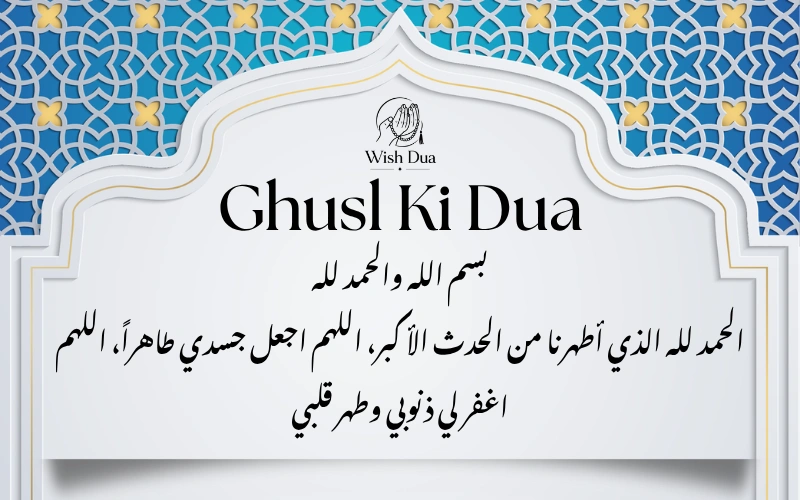
بسم الله والحمد لله
الحمد لله الذي أطهرنا من الحدث الأكبر، اللهم اجعل جسدي طاهراً، اللهم اغفر لي ذنوبي وطهر قلبي
English Translation
“In the name of Allah, all praise is due to Allah. All praise is due to Allah who has purified us from the greater impurity. O Allah, make my body pure. O Allah, forgive my sins and purify my heart.”
Urdu Transliteration (for Hindi/Urdu speakers)
“Bismillah aur alhamdulillah. Alhamdulillah jo hamain badi naapakee se paak karta hai. Allah humma ijaal jismadi tahiran. Allah humma ighfir li dhunubi wa tahhir qalbee.”
Hindi Version (Devanagari)
“बिस्मिल्लाह और अलहम्दुलिल्लाह। अलहम्दुलिल्लाह जो हमें बड़ी नापाकी से पाक करता है। अल्लाहुम्म इजाल जिस्मादी तहिरान। अल्लाहुम्म इग़्फिर ली धुनूबी व तह्हिर क़ल्बी।”
Variations: Ghusl Ki Dua in Different Situations
Here’s something important to understand: while the core Ghusl procedure remains the same, different situations have slightly different recommendations based on Islamic jurisprudence. Let me break this down:
1. Ghusl Ki Dua After Periods (Haiz Ghusl Ki Dua)
When: After your menstrual bleeding has completely stopped.
Special consideration: Some women wait until evening to perform Ghusl; others do it immediately. Both are acceptable. Many women prefer waiting a day or two after bleeding stops to be certain it has ended.
Recommended Dua Sequence:
- Make Niyyah (intention silently)
- Pour water three times over head while reciting: “Bismillahi wa ‘ala millati Rasulillah”
- Recite Surah Al-Ikhlas three times
- End with: “Allahumma innee qadestu ‘alayya hadha al-ghusl” (O Allah, I am certain in this purification)
Why this matters: After periods, you cannot perform Salah, fast, or be intimate until Ghusl is complete. Many women take this moment as spiritual renewal—not just physical cleansing, but emotional and spiritual reset.
2. Ghusl Ki Dua After Marital Relations (Humbistari Ke Baad Ghusl Ki Dua)
When: After intimate relations between spouses (whether penetration occurred or not—Islamic jurisprudence is clear on this).
Special note: Both husband and wife should perform Ghusl, though some schools allow alternatives under specific circumstances.
Recommended Dua: “Allahumma tahhirni bi nuri haya’i, wa qawwi ‘azmi” (O Allah, purify me with the light of modesty, and strengthen my determination)
For couples specifically: Some Islamic teachers recommend spouses performing Ghusl together (in separate areas) as a shared spiritual practice that strengthens their bond.
3. Ghusl Ki Dua After Childbirth (Nifas Ki Ghusl Ki Dua)
When: After postpartum bleeding (Nifas) ends—typically 40 days maximum, sometimes earlier if bleeding stops.
Special Dua: “Allahumma tahhirni min ad-dam wa ad-duaa’if, wa ‘a’idha quwa’i wa ‘aafiyati” (O Allah, purify me from blood and weakness, restore my strength and health)
4. Ghusl Ki Dua for Female Specific Cases (Periods Ke Baad Ghusl Ki Dua for Ladies)
Here’s a common question: What if my periods are irregular? Islamic jurisprudence addresses this. If you’re unsure, most Islamic scholars recommend erring on the side of caution—wait until you’re absolutely certain bleeding has stopped.
Table: Common Female Ghusl Scenarios
| Scenario | Action | Dua Variation |
|---|---|---|
| Heavy periods (more than 15 days) | Seek religious guidance; may need special ruling | Same core dua; consult scholar |
| Spotting between periods | May not require full Ghusl | Perform simple wudu instead |
| First period after childbirth ends | Full Ghusl required | Standard Haiz dua |
| Irregular cycle | Wait for absolute certainty | Standard dua; patience is valued |
Common Variations & Regional Differences Of Ghusl Ki Dua
Ghusl Ki Dua in English (For Non-Arabic Speakers)
Many English-speaking Muslims prefer understanding the meaning as they perform Ghusl. Here’s a complete English version:
“In the name of Allah, the Most Merciful, the Most Compassionate. I am performing ritual purification. I seek the protection of Allah from harmful things. I ask Allah to make my body pure, forgive my sins, and purify my heart. There is no god but Allah, He is One, with no partner. To Him belongs all sovereignty and all praise. He is capable of all things.”
For Men (Ghusl Ki Dua for Man)
Men perform Ghusl similarly to women, but with some differences:
- Men typically perform Ghusl less frequently (mainly after marital relations or nocturnal emissions)
- The intention and core duas remain the same
- Some men recite Surah Al-Ikhlas, others recite Surah An-Noor (Chapter 24)
Recommended Dua for Men: “Allahumma innee atahharu li-qiamika, wa li-salati, wa li-tilawati kitabika” (O Allah, I am purifying myself for standing before You, for prayer, and for reciting Your book)
Ghusl Ki Dua in Hindi: For Hindi-Speaking Communities
Full Hindi Version (With Meaning)
फुल हिंदी संस्करण:
“अल्लाह के नाम पर और सभी तारीफ अल्लाह के लिए। ऐ अल्लाह, मेरे शरीर को पाक करो, मेरे पापों को माफ करो, और मेरे दिल को शुद्ध करो। अल्लाह के अलावा कोई नहीं है, वह अकेला है, उसका कोई साथी नहीं है। राज्य उसका है और सभी तारीफ उसी के लिए है। वह सभी चीजों पर सक्षम है।”
Breakdown for Hindi learners:
- अल्लाह = Allah (God)
- पाक = Pure/Purify
- दिल = Heart
- शरीर = Body
- तारीफ = Praise
Many Hindi-speaking Muslims appreciate performing Ghusl while reciting the Hindi version, as it creates a deeper emotional connection to the ritual.
Step-by-Step Visual Guide: When & How to Perform Ghusl Ki Dua
| Step | Action | Duration | Dua/Intention |
|---|---|---|---|
| 1 | Make intention (Niyyah) | 1 min | Silent intention in heart |
| 2 | Wash private area | 1 min | Protection dua (optional) |
| 3 | Perform Wudu | 2 min | Wudu duas as per Sunnah |
| 4 | Pour water on head 3x | 1 min | “Bismillahi wa ‘ala millati Rasulillah” |
| 5 | Wash entire body | 3-4 min | Surah Al-Ikhlas (3 times) |
| 6 | Final dua | 1 min | Tawheed dua (no deity but Allah) |
| TOTAL | Complete Ghusl | 8-10 min | Multiple duas throughout |
Frequently Asked Questions About Ghusl Ki Dua
1. Is Ghusl Ki Dua mandatory? Can I skip it?
Ghusl itself is mandatory (Wajib) in Islamic law after certain situations. However, the specific duas are Sunnah (recommended practice based on Prophetic tradition), not mandatory. That said, scholars strongly recommend reciting them because:
- They help maintain spiritual awareness during the ritual
- They align your intention (Niyyah) with Allah
- They follow the practice of the Prophet Muhammad (peace be upon him)
In short: You could technically perform Ghusl silently with no duas, and it would be valid. But why would you? The duas transform it from just washing to a spiritual act.
2. What’s the difference between Ghusl and Wudu? Do I need both?
Great question. Here’s the difference:
| Aspect | Wudu | Ghusl |
|---|---|---|
| Coverage | Face, hands, arms, head, feet | Entire body |
| When needed | Before prayer, Quran reading | After periods, marital relations |
| Duas involved | Shorter duas for each part | Longer, more comprehensive duas |
| Do you need both? | No—Ghusl is considered complete purification and covers Wudu | After Ghusl, you’ve done the full purification |
So if you’ve done Ghusl, you don’t need to do Wudu separately. But some scholars recommend performing Wudu within Ghusl for completeness.
3. Can I perform Ghusl Ki Dua without warm water? Does water temperature matter?
Short answer: No, water temperature doesn’t matter according to Islamic jurisprudence. Cold water is just as valid as warm water.
However, practically speaking, many people find warm water more comfortable and ensure better water penetration through hair. Some Islamic scholars mention that the Prophet (peace be upon him) used cool water, while others mention warm water—both are fine.
Important rule: The water must be:
- Pure (Tahir)—not dirty or stagnant
- Running or collected (doesn’t matter if it’s from a tap, well, or lake—just pure)
- Enough to cover your entire body (doesn’t matter if it’s a bucket or full bathroom shower)
4. How long after periods should I wait to perform Ghusl? Immediately after, or should I wait?
This is one of the most-asked questions by women, and the answer is: it’s flexible, and you have options.
Islamic jurisprudence allows:
- Immediately: Some schools say as soon as bleeding completely stops, perform Ghusl
- After 1-2 days: Other women wait a day or two after bleeding stops to be absolutely certain
- By the 10th day maximum: Menstruation can last up to 10 days in Islamic law (though typical is 3-7 days)
The rule: You must be absolutely certain that bleeding has completely stopped. If you’re unsure, it’s better to wait a bit longer than to perform Ghusl too early and potentially miss the complete purification.
5. Is there a specific time of day when I should perform Ghusl Ki Dua?
No, there’s no specific time of day required. You can perform Ghusl:
- Early morning
- Afternoon
- Evening
- Night (even if you need to wake up to do it)
However, Islamic scholars recommend:
- Performing it before leaving your home so you can worship fully
- Not unnecessarily delaying it (if you’re already certain of purity)
- Doing it in privacy for dignity and concentration
Many women choose to perform Ghusl in the evening after their day’s work is done, finding it a peaceful ritual.
6. Can men and women perform Ghusl differently?
Technically, the procedure is the same for both men and women. However:
Practical differences:
- Women may perform Ghusl more frequently (after every period, which happens monthly)
- Men typically perform Ghusl less frequently (mainly after marital relations)
- Some scholars mention women should be extra careful that water reaches their entire body, especially under arms and between toes
- Women during menstruation cannot perform any worship; after Ghusl, they return fully to worship
Dua differences: Some women prefer specific duas focused on spiritual renewal after periods, while men might use duas focused on gratitude after marital relations. Both are valid variations.
7. What if I perform Ghusl but then realize I missed something—do I have to repeat it?
This depends on what you missed:
| Situation | Do you repeat? | Why |
|---|---|---|
| Forgot to wash hair roots | Yes, partially—rewash the missed area | Water must reach entire body |
| Forgot the final dua | No—Ghusl is complete without it | Duas are Sunnah, not mandatory |
| Washed only once instead of 3x | Scholars differ—better to rewash for certainty | Completeness is emphasized |
| Accidentally poured water but forgot intention | Yes—intention is mandatory; restart | Niyyah (intention) makes the ritual valid |
Simple rule: When in doubt, a quick rewash (especially of the area you’re unsure about) is better than worrying throughout the day.
8. Do I need to recite the dua in Arabic, or can I recite it in my own language (English, Hindi, Urdu)?
This is a common concern for non-Arabic speakers. The answer: You can do either.
Arabic: Preferred because it’s the original and maintains authenticity
Your own language: Completely acceptable because:
- What matters to Allah is the sincerity of your heart (Ikhlas)
- Understanding what you’re saying is spiritually important
- Many non-Arab companions of the Prophet performed ibadah (worship) in their languages
Most Islamic scholars agree that if you don’t speak Arabic, performing Ghusl in your native language (English, Hindi, Urdu, etc.) with full understanding and sincerity is more valuable than reciting Arabic words you don’t understand.
9. Ghusl Ki Dua After Sex (Humbistari)—Is it the same for both partners?
Yes and no. Here’s the clarity:
Both partners need to perform Ghusl: Islamic jurisprudence (all four schools agree) states that after marital relations involving intercourse, both husband and wife become ritually impure and need Ghusl.
The duas can be slightly different:
- For wives: Can use duas focused on marital purity and emotional renewal
- For husbands: Can use duas focused on gratitude and spiritual alignment
- Both can use: The standard Ghusl duas listed above
Practically: Many couples perform Ghusl separately but at the same time, making it a shared spiritual experience.
10. What about Ghusl Ki Dua for “irregular periods” or spotting between periods?
This is nuanced and important:
If it’s regular spotting/discharge (not menstrual bleeding):
- You may not need full Ghusl
- Perform simple Wudu instead
- Ask a trusted Islamic scholar about your specific pattern
If you’re unsure if it’s menstruation or spotting:
- Err on the side of caution
- Treat it as menstruation until you’re certain
- Wait a few days if needed
If you have PCOS, hormonal imbalances, or irregular cycles:
- Consult an Islamic scholar who understands medical conditions
- They can provide personalized guidance based on your health
Disclaimer: This article is an educational guide to the Islamic practice of Ghusl Ki Dua. While we’ve covered the mainstream Islamic jurisprudence shared across Hanafi, Maliki, Shafi’i, and Hanbali schools, Islamic jurisprudence can have variations based on school of thought, regional practices, and individual circumstances.
For medical issues (irregular periods, postpartum complications), consult both a gynecologist and a trusted Islamic scholar, as they work together.
For religious specifics, especially if you have unusual situations, consult a qualified Islamic scholar (Imam, Mufti, or Islamic counselor) from your local mosque or trusted Islamic center.
This article is not a substitute for professional Islamic guidance. The duas and steps provided are based on widely accepted Islamic practice, but variations exist, and your local scholars may have specific recommendations.
Conclusion: Making Ghusl Ki Dua a Meaningful Practice
Let me wrap this up with what really matters: Ghusl Ki Dua isn’t just about ritual compliance—it’s about spiritual renewal.
Here’s what we’ve covered:
What it is: A sacred Islamic ritual combining physical washing with spiritual duas
When to do it: After menstruation, marital relations, childbirth, and specific conditions
How to do it: Seven clear steps with specific duas at each stage
In multiple languages: Arabic, Urdu transliteration, English, and Hindi versions
Real-world scenarios: Different variations for women after periods, couples after marital relations, postpartum situations
Answered your questions: 10 most-asked FAQs about common concerns
The most important thing to remember: Your intention (Niyyah) and sincerity (Ikhlas) matter more than perfect pronunciation. If you’re reciting in English because that’s your language, and you’re doing it with a pure heart focused on spiritual purification, that’s valid and accepted.
Key takeaways:
- Ghusl is mandatory in specific situations; Ghusl Ki Dua are strongly recommended
- The procedure is the same for men and women; timing and frequency may differ
- You can recite duas in your native language with full sincerity
- When in doubt, consult a local Islamic scholar from your community
- This ritual is a gift—a moment to pause, reflect, and renew your spiritual connection
Next Steps
- Save this guide as a reference for whenever you need it
- Share with sisters/brothers who might benefit from this clarity
- Consult your local Imam or scholar if you have specific personal circumstances
- Perform Ghusl with full awareness of each step and its spiritual significance
Thank You & Continue Learning
Thank you for taking time to learn about this important Islamic practice! If this guide helped clarify Ghusl Ki Dua for you, we’d love to hear your feedback.
Also Read:
Also check out “The Powerful Dua” for more such powerful duas.
Author Bio & Methodology
Written by: Gaurav
Credentials: Islamic Studies Researcher, Content Writer specializing in Islamic practices and women’s Islamic education
Experience: 5+ years writing educational Islamic content for diverse audiences (English, Hindi, Urdu speakers)
Research method: Compiled from widely accepted Islamic jurisprudence (Hanafi, Maliki, Shafi’i, Hanbali schools), Islamic scholarly sources, and Quranic/Hadith references
Sources referenced (for verification):
- Al-Muwatta (Malik’s collection of Hadith)
- Sahih Bukhari (on Ghusl chapters)
- Islamic jurisprudence books (Fiqh) from multiple schools
- Tafsir (Quranic exegesis) on purity and purification
- Contemporary Islamic scholars’ writings on modern applications
Content type: Educational guide on Islamic practice
Audience: Muslim women and men, seekers learning about Islamic rituals, multilingual communities