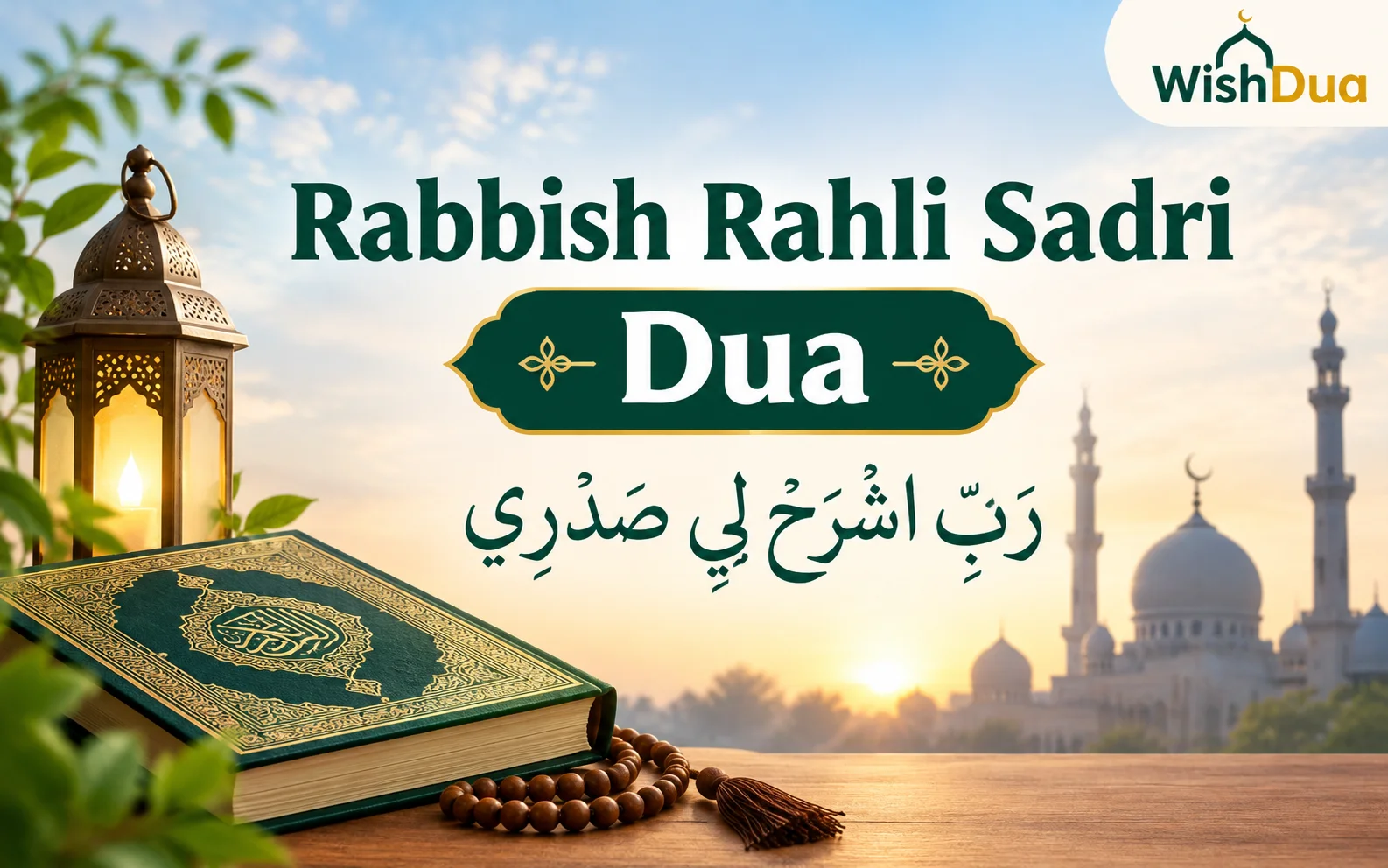
Quick answer: Rabbish Rahli Sadri Dua is the four-line prayer of Prophet Musa (peace be upon him) from Surah Taha 20:25-28, in which he asks Allah to open his heart, ease his task, loosen his tongue and help people understand his words.
That is the short version. The longer version is a story about a nervous man, a very big job and a very smart request. If you have an exam, an interview, a speech or a hard conversation coming up, this dua is a gentle companion. Let’s walk through it properly, without fluff.
Rabbish Rahli Sadri Dua in Arabic Text, Roman English and English Translation
Here is everything you need in one place.
| Format | Text |
|---|---|
|
Arabic text |
رَبِّ اشْرَحْ لِي صَدْرِي وَيَسِّرْ لِي أَمْرِي وَاحْلُلْ عُقْدَةً مِّن لِّسَانِي يَفْقَهُوا قَوْلِي |
|
Roman English |
Rabbish rahli sadri, wa yassir li amri, wahlul uqdatam min lisani, yafqahu qawli |
|
English translation |
My Lord, open my chest for me, make my task easy for me, untie the knot from my tongue, so they may understand my speech |
You will often see people write it as “Qala Rabbish Rahli Sadri Dua” or “Kala Rabbish Rahli Sadri Dua”. That first word, Qala (قَالَ), simply means “he said.” It is the Quran narrating, not part of Musa’s words. So the dua itself begins at Rabbi. Reciting with Qala is common and harmless, but knowing the difference shows you understand the verse, not just the sound.
Another small tip: Rabbish is really Rabbi + ishrah joined together. Say it as “Rab-bish-rah-li” and it flows. Say “Rabbi… ishrah…” with a gap and it sounds like a stuck zipper.
Rabbish Rahli Sadri Dua Meaning in English, Urdu, Hindi and Tamil
Most people memorize the sound first and the meaning later. Flip that order. The meaning is what calms you down.
Word-by-Word Breakdown
| Arabic word | Roman | Meaning |
|---|---|---|
|
رَبِّ |
Rabbi |
My Lord |
|
اشْرَحْ |
ishrah |
Expand, open up |
|
لِي |
li |
For me |
|
صَدْرِي |
sadri |
My chest, my heart |
|
وَيَسِّرْ |
wa yassir |
And make easy |
|
أَمْرِي |
amri |
My task, my affair |
|
وَاحْلُلْ |
wahlul |
And untie |
|
عُقْدَةً |
uqdatan |
A knot |
|
لِسَانِي |
lisani |
My tongue |
|
يَفْقَهُوا |
yafqahu |
So they understand deeply |
|
قَوْلِي |
qawli |
My speech |
See yafqahu? It comes from the same root as fiqh, which means deep understanding. Musa did not ask for “let them hear me.” He asked for “let them truly get me.” That is a much bigger request, and a much more useful one.
Rabbish Rahli Sadri Dua Meaning in Urdu (With Urdu Translation)
اے میرے رب! میرا سینہ میرے لیے کھول دے، اور میرا کام میرے لیے آسان کر دے، اور میری زبان کی گرہ کھول دے، تاکہ لوگ میری بات سمجھ سکیں۔
Rabbish Rahli Sadri Dua Meaning in Hindi
ऐ मेरे रब! मेरा सीना मेरे लिए खोल दे, मेरा काम मेरे लिए आसान कर दे, मेरी ज़बान की गिरह खोल दे, ताकि लोग मेरी बात समझ सकें।
Rabbish Rahli Sadri Dua Meaning in Tamil
என் இறைவா! என் நெஞ்சத்தை எனக்கு விசாலமாக்குவாயாக. என் காரியத்தை எனக்கு எளிதாக்குவாயாக. என் நாவிலுள்ள முடிச்சை அவிழ்ப்பாயாக. அவர்கள் என் பேச்சைப் புரிந்துகொள்ளட்டும்.
Publishing note: these Urdu, Hindi and Tamil lines are plain renderings of the Arabic. Before you publish, compare them with a recognized translation in each language.
Rabbish Rahli Sadri Dua in Quran: Which Surah, Which Para?
If someone asks “Rabbish Rahli Sadri Dua in which para?”, here is the answer in one glance.
| Detail | Answer |
|---|---|
| Surah | Taha (the 20th chapter of the Quran) |
| Verses | 25 to 28 |
| Para (Juz) | 16 |
| Total verses in Surah Taha | 135 |
| Revealed in | Makkah |
Source for the surah number, verse count and juz: the Ta-Ha entry on Wikipedia, which matches standard Quran references.
The Story Behind the Dua
Picture Musa standing by a burning bush, hearing Allah call his name. Then comes the job: go to Pharaoh, the most powerful man in the land, and speak the truth. Musa was not a confident public speaker. He knew it. And he did not pretend otherwise.
He did not say “I’ve got this.” He said, in effect, “Lord, I need help with my nerves, my workload and my words.” Then he asked for his brother Harun as a helper (Surah Taha 20:29-35). Allah replied with a clear yes: “You have been granted your request, O Musa” (20:36).
That reply is the real anchor for anyone who recites this dua. The prayer was heard.
Why Rabbish Rahli Sadri Dua Works: The 4-Line Prep Framework
Here is the part most articles skip. The dua is not four random wishes. It is a tidy preparation plan in the right order. I call it the 4-Line Prep Framework.
| Line | What Musa asked for | The real-life need | Your 10-second action |
|---|---|---|---|
| 1. Rabbish rahli sadri | An open, calm heart | Nerves and fear | Breathe out slowly twice |
| 2. Wa yassir li amri | An easy task | Overwhelm | Write the first small step |
| 3. Wahlul uqdatam min lisani | A loosened tongue | Blanking, stammering | Say your opening line out loud once |
| 4. Yafqahu qawli | Being understood | Fear of being misread | Decide your one key message |
Why the order matters: you cannot think clearly while your chest feels tight. So the heart comes first. Once calm, the task shrinks. Once the task shrinks, speech flows. And only then do you worry about the audience. Anxiety research follows the same logic: reduce arousal first, then perform.
Rabbish Rahli Sadri Dua Benefits: What Is Solid and What Is Custom
Let’s keep this honest. Some benefits come straight from the verses. Others come from tradition and personal practice.
Benefits grounded in the verses:
- A calmer, more confident heart before a difficult task
- Ease in the work you are about to do
- Clearer, smoother speech
- A reminder that asking for help is not weakness, it is the Prophet’s own example
Benefits people report from practice:
- Less panic before exams and interviews
- A steadier voice during presentations
- A moment of pause that stops rushed decisions
No authentic text promises a specific result from a set number of recitations. Treat the dua as sincere asking, not a magic formula. That is exactly how Musa used it.
The Facts Behind the Fear
Why does this dua resonate with so many people today? Because speaking under pressure is a very common struggle.
| Fact | Figure | Source |
|---|---|---|
| Adults with some fear of public speaking | About 77% | Crown Counseling, 2025 |
| Americans afraid or very afraid of public speaking | 33.7% (ranked 46th of 65+ fears) | Chapman University Survey of American Fears, 2025 |
| Social anxiety patients who fear public speaking | 89.4% | Cross River Therapy, 2025 |
| People with this fear who seek structured help | Only about 8% | Novoresume, 2025 |
Notice the gap between 77% and 33.7%. Surveys define “fear” differently. A mild flutter and strong dread are not the same thing. The safe takeaway: nerves before speaking are normal, and you are in very good company, starting with a Prophet.
Rabbish Rahli Sadri Dua for Exam: A Workflow You Can Copy
This dua suits exams well, because an exam is a hard task plus a need to express yourself clearly. But the dua is a partner to your preparation, never a replacement for it.
The 60-Second Pre-Exam Routine (Template)
- Wudu or a quick wash, if you can. It resets your body.
- Sit still for 10 seconds. Breathe out slowly.
- Recite the dua once with full attention. Think about each line as you say it.
- Make a personal request in your own words. Ask for focus and recall.
- Read the first question calmly. Start with what you know.
Before and After: A Mini Case Study
Here is an illustrative scenario, built from a very common pattern, not a real named person.
Before: Sara, a final-year student, wakes up on exam day, scrolls her phone and mutters the dua 20 times at top speed while her heart races. She walks in tense and blanks on the first question.
After: The next paper, Sara follows the 60-second routine. She recites the dua once, slowly, thinking about “ease my task.” Then she writes the first step of the first answer, however small.
The difference is not the number of recitations. It is attention. Fast repetition keeps the mind in panic mode. Slow, meaningful recitation signals safety. That is the why behind the routine.
Author’s note: if you publish this under your own name, swap the scenario for a real student or reader story. Real stories earn more trust.
Rabbish Rahli Sadri Dua How Many Times Should You Recite It?
There is no fixed number in the Quran or in authentic hadith for this dua. Many people recite it once, three times or seven times as a personal habit. That is fine, but it is a custom, not a rule.
My suggestion: choose a small number you can say with presence. One mindful recitation beats ten distracted ones.
Common Mistakes When Reciting Rabbish Rahli Sadri Dua
- Rushing. Speed removes the meaning.
- Skipping preparation. Dua and effort go together.
- Mispronouncing sadri and uqdatan. Listen to a trusted qari and repeat slowly.
- Treating it as a guaranteed formula. It is a request, not a vending machine.
- Stopping at verse 28. The story continues with the request for Harun. Asking for good people around you is part of the lesson.
- Reading only the Roman text. Learn the Arabic when you can. The Roman spelling is a bridge, not the destination.
Quick Checklist Before You Recite
- I know what each of the four lines means
- I have prepared for the task as best I can
- I am reciting slowly and clearly
- I have added a personal request in my own words
- I trust that I was heard
Conclusion
Rabbish Rahli Sadri Dua has lasted for centuries because it is honest. A Prophet, facing a giant task, admitted he needed help with his heart, his work and his words. You can do the same, whether you are facing a viva, a boardroom or a wedding toast. Learn the Arabic, understand the meaning, recite with presence and then go do your best.
Key Takeaways
- Rabbish Rahli Sadri Dua comes from Surah Taha 20:25-28, in Para 16.
- It has four requests: an open heart, an easy task, a loosened tongue and being understood.
- “Qala” or “Kala” is the narrator’s word meaning “he said,” not part of the dua.
- There is no fixed count for recitation; mindful beats fast.
- Use it alongside real preparation, especially for exams.
Summary
This article covered the Arabic text, Roman English, English meaning and Urdu, Hindi and Tamil renderings of the dua, where it sits in the Quran, the story behind it and a simple 4-Line Prep Framework. It also gave a copyable exam routine, a before and after example, a checklist and common mistakes to avoid.
FAQs
1. What is the Rabbish Rahli Sadri Dua meaning in English?
The meaning is: “My Lord, open my chest for me, make my task easy for me, untie the knot from my tongue, so they may understand my speech.”
2. Rabbish Rahli Sadri Dua is in which para of the Quran?
It is in Para (Juz) 16, in Surah Taha, verses 25 to 28.
3. How many times should I read Rabbish Rahli Sadri Dua?
There is no fixed number in the Quran or authentic hadith. Many people read it once, three times or seven times. Focus on reciting with attention and understanding.
4. Can I read Rabbish Rahli Sadri Dua for exam success?
Yes, it is a fitting dua for ease and clarity of speech. Pair it with proper study and trust that Allah hears sincere requests. Do not treat it as a guaranteed result.
5. Is it Kala or Qala Rabbish Rahli Sadri Dua?
The correct spelling is Qala (قَالَ), meaning “he said.” It introduces the verse. The dua itself begins with Rabbi, so you can recite it with or without Qala.
Thank you for Reading
Also check out “The Powerful Dua” for more such powerful duas.