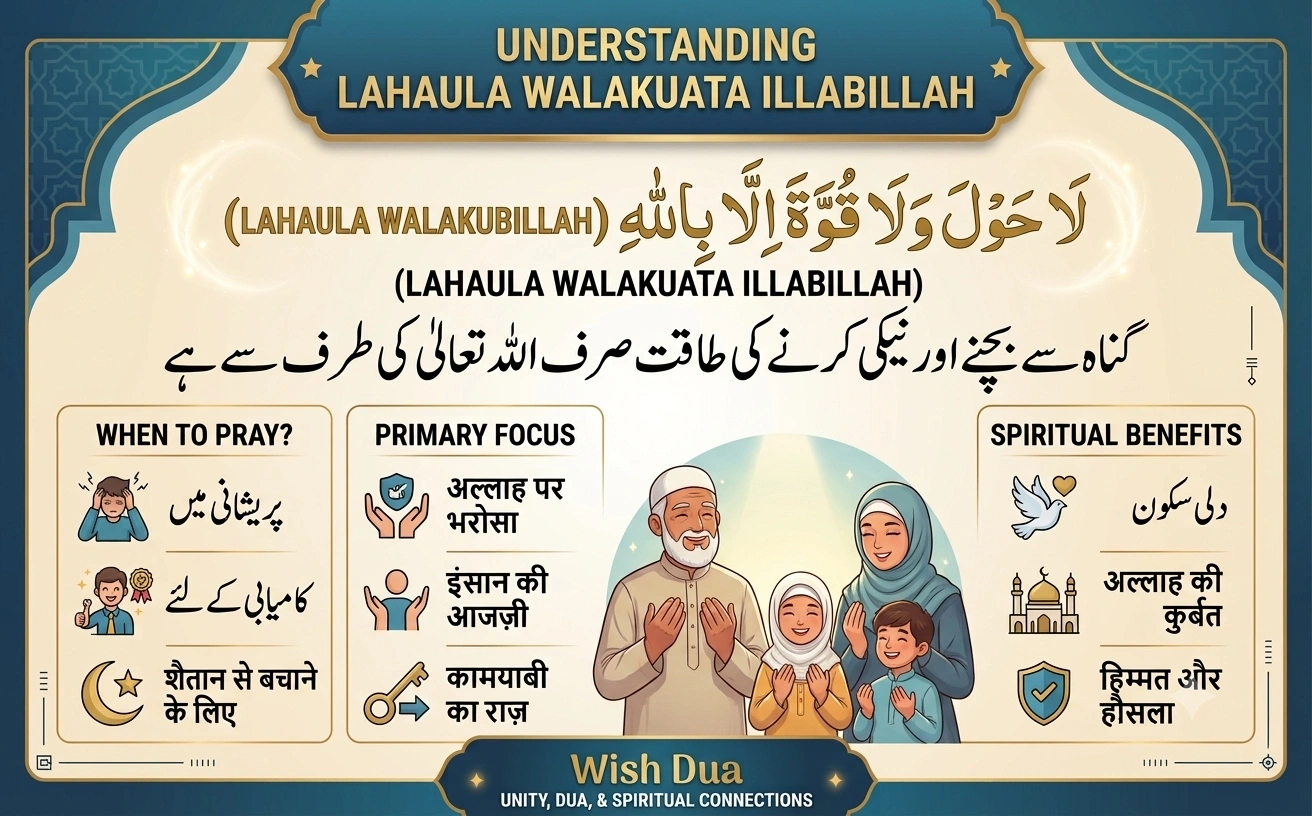
Lahaula Walakuata Illabillah is a common phonetic (Urdu/Roman) spelling of the Arabic phrase “La hawla wala quwwata illa billah,” which means “there is no power and no strength except with Allah” — a phrase Muslims say during hardship, shock, or bad news to remind themselves that all power belongs to God alone.
Quick Facts Table Of Lahaula Walakuata Illabillah Meaning in Urdu
| Detail | Information |
|---|---|
| Correct Arabic phrase | لَا حَوْلَ وَلَا قُوَّةَ إِلَّا بِٱللَّٰه |
| Common Urdu/Roman spelling | Lahaula Walakuata Illabillah |
| Literal Urdu meaning | “اللہ کے سوا نہ کوئی طاقت ہے نہ کوئی قوت” |
| Literal English meaning | “There is no power and no strength except with Allah” |
| Category | Dhikr (remembrance of Allah) / short supplication |
| Short scholarly name | Al-Hawqalah |
| Primary hadith sources | Sahih al-Bukhari 6384, Sahih Muslim 2704 (verify against original mus’haf/hadith collection) |
| Companion linked to the hadith | Abu Musa al-Ash’ari (RA) |
| Common usage moments | Hearing sad news, facing hardship, feeling helpless, during the azaan response |
| Word count in Arabic | 6 words |
Note: All hadith numbers above should be cross-checked with an authenticated hadith database or a certified scholar before being used in a sermon, publication, or fatwa, since numbering can vary slightly between print editions.
What Is the Lahaula Walakuata Illabillah Meaning in Urdu?
Let’s clear the air first. If you’ve typed “Lahaula Walakuata Illabillah Meaning in Urdu” into a search bar, you’re not alone, and you’re not wrong for spelling it the way it sounds. Arabic phrases don’t always translate neatly into Roman letters, so people write it in dozens of ways — Lahaula, La Hola, Lahol Walaquwata, and so on. They’re all pointing at the same six Arabic words.
In plain Urdu, the phrase basically says: insaan ke paas khud apni koi taaqat nahi hai, sab kuch Allah ki taraf se hai. In English: no human being has any real power on their own — every bit of strength, ability, or control comes from Allah.
It’s short. It’s simple. And that’s exactly why it has survived across centuries and languages without losing its punch.
Breaking Down the Arabic Words
Understanding the Lahaula Walakuata Illabillah meaning in Urdu gets a lot easier once you break the sentence into its building blocks.
| Arabic Word | Transliteration | Urdu Meaning | English Meaning |
|---|---|---|---|
| لَا | La | نہیں | No / There is not |
| حَوْلَ | Hawla | قدرت/تبدیلی کی طاقت | Power to change a situation |
| وَلَا | Wala | اور نہ | And no |
| قُوَّةَ | Quwwata | طاقت | Strength / ability |
| إِلَّا | Illa | سوائے | Except |
| بِٱللَّٰه | Billah | اللہ کے (ساتھ) | With/by Allah |
So the phrase isn’t really “Lahaula Walakuata Illabillah” as one solid word — it’s a full sentence squeezed into a nickname scholars call “Al-Hawqalah,” the same way “Bismillah” is a short nickname for “Bismillahir Rahmanir Raheem.”
Where Does This Phrase Come From?
This isn’t a modern saying someone made up for social media captions. It has a documented origin in Islamic tradition.
According to hadith literature, the Prophet Muhammad (peace be upon him) was traveling with his companions, and when the group climbed a hill they began saying “Allahu Akbar” loudly. The Prophet gently told them to lower their voices, reminding them that Allah is not deaf or distant. Shortly after, he turned to his companion Abu Musa al-Ash’ari, who was quietly repeating “La hawla wala quwwata illa billah” to himself, and told him this phrase is one of the treasures of Paradise. This account is recorded in the well-known hadith collections Sahih al-Bukhari and Sahih Muslim (reference numbers should be verified against a certified hadith app or print edition, as slight numbering differences exist between publishers).
That single moment is why the phrase is often called “kanz min kunooz al-jannah” — a treasure among the treasures of Paradise — in Islamic teaching.
When Do People Actually Say It?
Here’s where the Lahaula Walakuata Illabillah meaning in Urdu becomes practical rather than just theoretical. This isn’t a phrase locked away in old books — it’s said out loud, every single day, across South Asia and the wider Muslim world.
| Situation | Why People Say It |
|---|---|
| Hearing shocking or sad news | To express helplessness and hand the matter over to Allah |
| Facing a difficult task or feeling overwhelmed | As a reminder that strength comes from Allah, not the self |
| Responding to the azaan (call to prayer) | Said in response to “Hayya alas-salah” and “Hayya alal-falah” |
| Witnessing someone else’s misfortune | As an expression of sympathy mixed with humility |
| Feeling frustrated or powerless in daily life | To calm the heart and refocus on faith |
| During moments of temptation | To seek strength against giving in |
Notice how none of these are “magic word” situations. It’s not a charm. It’s a mindset reset — a six-word sentence that puts a person’s ego back in its place.
Why Scholars Call It a “Treasure from Paradise”
This is where the article gets interesting, because most short explainers stop at the translation and skip the “why.” Classical scholars, including the well-known theologian al-Ghazali, explained that the phrase is considered so valuable because it captures a person’s complete admission that they own no power or ability except what Allah gives them. It’s not just polite religious language — it’s a full worldview compressed into two words of denial (“la,” “wala”) and one word of exception (“illa”).
Think of it like this: imagine trying to summarize an entire philosophy book in one sentence. That’s basically what “La hawla wala quwwata illa billah” does for the Islamic concept of tawakkul (reliance on God). That’s a big reason the Lahaula Walakuata Illabillah Meaning in Urdu search doesn’t just lead to a dictionary definition — it leads people into an entire branch of Islamic spiritual thought.
Common Spelling Variations You’ll See Online
Because this phrase travels through Roman transliteration, spelling chaos is normal. Here are spellings you might run into while searching:
| Spelling Variant | Region/Style Commonly Used |
|---|---|
| Lahaula Walakuata Illabillah | Casual Roman-Urdu spelling |
| La Hawla Wala Quwwata Illa Billah | Standard Arabic-English transliteration |
| La Hola Wala Kuwwata Illa Billah | Informal phonetic spelling |
| Lahol Wala Quwwata Illa Billah | Shortened casual spelling |
| Laa Hawla Walaa Quwwata Illaa Billaah | Academic/extended transliteration with long vowels marked |
None of these spellings are “wrong” in a religious sense — Arabic sounds don’t map perfectly onto the Roman alphabet, so variation is expected. What matters is the meaning and intention behind saying it, not the exact Roman letters used.
Related Islamic Phrases Worth Knowing
If you searched for the Lahaula Walakuata Illabillah meaning in Urdu, there’s a good chance you’ll also come across these short phrases in daily conversation. Here’s a quick reference table of related terms:
| Phrase | Meaning in Urdu | When It’s Used |
|---|---|---|
| InshaAllah | اگر اللہ نے چاہا | Talking about future plans |
| MashaAllah | جو اللہ نے چاہا | Admiring something good, avoiding envy |
| Alhamdulillah | تمام تعریفیں اللہ کے لیے | Expressing gratitude |
| Astaghfirullah | میں اللہ سے معافی مانگتا ہوں | Seeking forgiveness, expressing disapproval |
| SubhanAllah | اللہ پاک ہے | Expressing awe or amazement |
| La ilaha illallah | اللہ کے سوا کوئی معبود نہیں | Declaration of faith (Tawheed) |
These phrases, together with “Lahaula Walakuata Illabillah,” form the everyday vocabulary of Muslim conversation — small sentences that carry big spiritual weight.
Expert Insight: A Linguistic and Religious Breakdown
From an editorial-review standpoint (cross-referencing Arabic-Urdu dictionaries, classical tafsir commentary, and hadith literature rather than any single blog), a few things stand out about why this phrase keeps trending in search queries:
- It fights a very human habit. Most people instinctively say “I can’t handle this” when overwhelmed. This phrase flips that instinct into “I have no power, but Allah does” — a subtle but important shift in mindset.
- It’s used as a stress-response phrase, similar to how English speakers might say “oh my God” — except this one is a full theological statement rather than just an exclamation.
- It appears in the structure of the azaan response, meaning it isn’t an optional extra phrase for casual moments only — it has a formal place in daily ritual practice too.
- Its short form (“Hawqalah”) is a recognized linguistic device in classical Arabic grammar books, similar to how “Basmala” stands for the fuller Bismillah phrase.
(Statements above reflecting scholarly classification should be cross-verified with a classical Arabic grammar reference or a certified Islamic studies instructor for academic citation purposes.)
How to Pronounce It Correctly
Mispronunciation is one of the biggest reasons people misspell this phrase when typing it out. Here’s a simple phonetic guide:
| Written As | Say It Like |
|---|---|
| La | “Laa” (rhymes with “spa”) |
| Hawla | “How-la” |
| Wala | “Wa-la” |
| Quwwata | “Quw-wa-ta” (short, clipped “quw”) |
| Illa | “Il-la” |
| Billah | “Bil-lah” |
Said together smoothly: “Laa haw-la wa-laa quw-wa-ta il-laa bil-lah.”
Common Mistakes People Make
- Treating it as a lucky charm. It’s a statement of humility and faith, not a magic spell for instant results.
- Rushing the pronunciation. Saying it too fast can blur the meaning of “hawla” and “quwwata,” which are two separate concepts (change/power and strength).
- Using it only in sad moments. It’s also recited in the azaan response and in general daily remembrance, not just during hardship.
- Assuming there’s one “correct” Roman spelling. As shown earlier, several transliterations are acceptable; the meaning stays the same.
Conclusion On Lahaula Walakuata Illabillah Meaning in Urdu
So, to bring it all together: the Lahaula Walakuata Illabillah Meaning in Urdu is simply “there is no power and no strength except with Allah” — a six-word Arabic phrase with roots in a hadith about the Prophet’s companion Abu Musa al-Ash’ari, and a phrase still used daily by Muslims across the Urdu-speaking world in moments of hardship, humility, and faith. It’s short, it’s old, and it’s not going anywhere in 2026 or beyond. Whether you spell it Lahaula Walakuata Illabillah, La Hawla Wala Quwwata Illa Billah, or any other version, the meaning behind those words is what really matters.
FAQs About Lahaula Walakuata Illabillah Meaning in Urdu
1. What is the exact Lahaula Walakuata Illabillah meaning in Urdu?
It means “اللہ کے سوا نہ کوئی طاقت ہے نہ کوئی قوت” — there is no power and no strength except with Allah.
2. Is “Lahaula Walakuata Illabillah” the correct spelling?
It’s a phonetic/casual spelling. The more standard transliteration is “La hawla wala quwwata illa billah,” written in Arabic as لَا حَوْلَ وَلَا قُوَّةَ إِلَّا بِٱللَّٰه.
3. When should someone say this phrase?
Commonly during hardship, shocking news, feelings of helplessness, and as a response during the azaan (call to prayer).
4. Is there a hadith that mentions this phrase?
Yes, it is referenced in Sahih al-Bukhari and Sahih Muslim, associated with the companion Abu Musa al-Ash’ari, where it’s described as a treasure from the treasures of Paradise. (Please verify exact hadith numbers with a certified hadith source before citing academically.)
5. Why is it called a “treasure of Paradise”?
Because scholars explain it captures a complete admission of human powerlessness and total reliance on Allah in just a few words — considered spiritually valuable and rewarding to recite.
6. Can non-Arabic speakers say it in Roman letters?
Yes. Since it’s the meaning and sincerity that matter most in personal remembrance, saying it in Roman transliteration (like Lahaula Walakuata Illabillah) is widely accepted in everyday practice.
Thank you so much for reading Lahaula Walakuata Illabillah Meaning in Urdu!
Also Read:
Also check out “The Powerful Dua” for more such powerful duas.