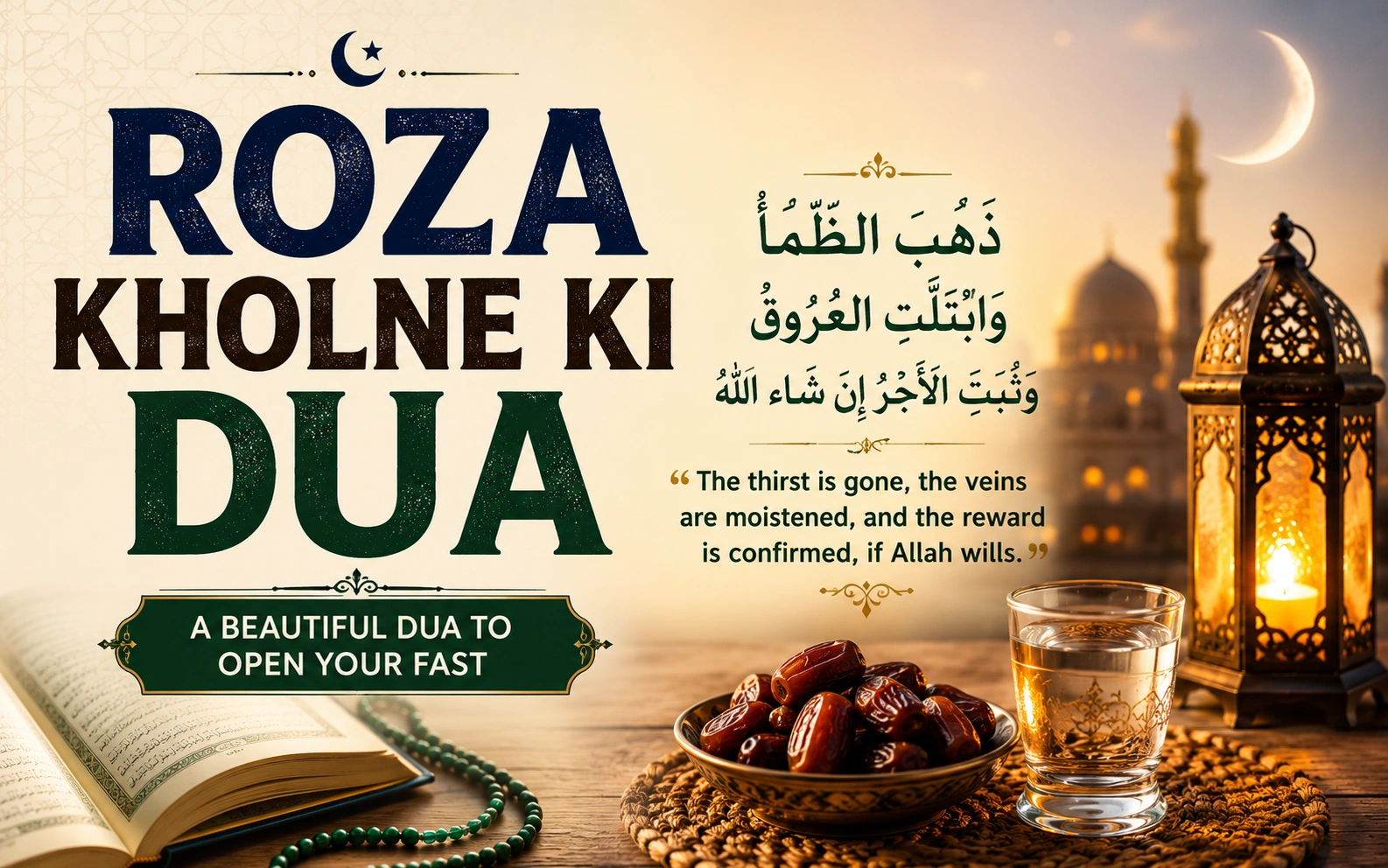
Roza Kholne Ki Dua is the short prayer a fasting Muslim reads at sunset, right before taking the first sip of water or bite of food, to thank Allah for the strength to complete the fast.
Quick Facts Table
| Detail | Information |
|---|---|
| Also called | Iftar Dua, Roza Iftar Ki Dua |
| Best time to read | Right at sunset, before eating |
| Original language | Arabic |
| Common translations | Hindi, English, Urdu, Bangla |
| Source | Hadith collections (Abu Dawood, Ibn Majah) |
| Who reads it | Every fasting Muslim, young or old |
What Is Roza Kholne Ki Dua?
Every day of Ramzan, a Muslim wakes up before sunrise, eats Sehri, and then keeps a fast till the sun goes down. The moment the Azaan for Maghrib is called, the fast is broken. But before biting into a date or drinking water, most people pause for a few seconds to say a short prayer. That short prayer is the Roza Kholne Ki Dua.
It is not a long or complicated prayer. It is short, simple, and comes straight from the words the Prophet Muhammad (peace be upon him) himself used to say. That is exactly why it carries so much weight for people who fast.
Think of it like this: after running a long race, most of us take a breath and say a quiet “thank god” before drinking water. The Roza Kholne Ki Dua is that same instinct, just given proper words that have been passed down for over a thousand years.
Roza Kholne Ki Dua In Arabic
The most well-known version of the Roza Kholne Ki Dua in Arabic is:
اللَّهُمَّ إِنِّي لَكَ صُمْتُ وَبِكَ آمَنْتُ وَعَلَيْكَ تَوَكَّلْتُ وَعَلَى رِزْقِكَ أَفْطَرْتُ
This is one of the two most quoted versions found in hadith books, and it forms the base for almost every translation used around the world.
Roza Kholne Ki Dua In Roman English
For people who cannot read Arabic script, the Roza Kholne Ki Dua in Roman English looks like this:
“Allahumma inni laka sumtu wa bika aamantu wa alayka tawakkaltu wa ala rizq-ika aftartu.”
A second short line that many people add right after taking the first bite is:
“Dhahaba adh-dhama’u wabtallatil-‘urooqu wa thabatal-ajru inshaAllah.”
Reading it in Roman letters is a common starting point for children and new reciters before they move on to memorising the Arabic.
Roza Kholne Ki Dua In Hindi
Many families in India and Pakistan prefer reading the Roza Kholne Ki Dua in Hindi, especially with elders at home. Written in Devanagari script, it reads:
अल्लाहुम्मा इन्नी लका सुम्तु व बिका आमन्तु व अलैका तवक्कल्तु व अला रिज़्क़िका अफ्तर्तु
The meaning stays the same across scripts: “O Allah, I fasted for You, I believe in You, I put my trust in You, and I break my fast with the food You have given me.”
Roza Kholne Ki Dua In English
For anyone who wants the meaning first and the words later, the Roza Kholne Ki Dua in English translation is:
“O Allah, I fasted for You alone, and I believe in You, and I put my trust in You, and I break my fast with the sustenance You have given me.”
This English version does not replace the Arabic during actual worship, but it helps people understand exactly what they are saying and why.
Roza Kholne Ki Dua In Urdu
The Roza Kholne Ki Dua Urdu version, written in the Nastaliq script, is:
اے اللہ! میں نے تیرے لیے روزہ رکھا، تجھ پر ایمان لایا، تجھ پر بھروسہ کیا اور تیرے رزق سے روزہ افطار کیا
Urdu readers usually pair this with the Arabic original during the actual moment of Iftar, since both are read together in many South Asian households.
Shia Roza Kholne Ki Dua
The Shia Roza Kholne Ki Dua carries small wording differences compared to the more commonly circulated Sunni version, though the core meaning of gratitude and trust in Allah remains identical. A frequently used line in Shia households is:
“Allahumma laka sumna wa ala rizqika aftarna, fataqabbal minna, innaka antas Sami’ul Alim.”
Which means: “O Allah, we fasted for You and we break our fast with what You provided, so accept it from us, You are the All-Hearing, the All-Knowing.”
Muharram Ka Roza Kholne Ki Dua
Fasting is not limited to Ramzan alone. The Muharram Ka Roza Kholne Ki Dua is read the same way as the regular Iftar dua, since the act of breaking a fast follows the same tradition regardless of the month. The 9th and 10th of Muharram (Ashura) are common days for this voluntary fast, and the same Arabic words used at Ramzan Iftar apply here too.
Arafat Ka Roza Kholne Ki Dua
For pilgrims and those observing the Day of Arafat fast (a day before Eid-ul-Adha), the Arafat Ka Roza Kholne Ki Dua again follows the standard Iftar wording. There is no separate or special dua text reserved only for Arafat; what changes is the intention (niyyah) behind the fast, not the closing prayer.
Nafil Roza Kholne Ki Dua
Voluntary fasts, known as Nafil fasts, are kept outside the compulsory month of Ramzan, such as on Mondays and Thursdays. The Nafil Roza Kholne Ki Dua uses the exact same Arabic wording as any other fast-breaking prayer. This is one of the most common questions people search for, and the simple answer is: one dua works for every type of fast.
Roza Kholne Ki Dua Bangla
For Bangla-speaking households, the Roza Kholne Ki Dua Bangla transliteration reads: “Allahumma inni laka sumtu wa bika aamantu wa alaika tawakkaltu wa ala rizqika aftartu,” followed by the Bangla meaning:
“হে আল্লাহ, আমি তোমার জন্য রোজা রেখেছি, তোমার প্রতি বিশ্বাস স্থাপন করেছি এবং তোমার দেওয়া রিজিক দিয়ে ইফতার করছি।”
Roza Rakhne Ki Dua Aur Roza Kholne Ki Dua: What’s The Difference?
A lot of people search for Roza Rakhne Ki Dua Roza Kholne Ki Dua together, thinking they are one and the same. They are not. One is read at Sehri, before the fast starts, and the other is read at Iftar, after the fast ends.
| Point | Roza Rakhne Ki Dua | Roza Kholne Ki Dua |
|---|---|---|
| When read | Before sunrise, at Sehri | After sunset, at Iftar |
| Purpose | Stating the intention (niyyah) to fast | Thanking Allah for completing the fast |
| Length | One short line | One or two short lines |
| Mood | Setting the intention for the day | Gratitude at the end of the day |
Best Time To Read Roza Kholne Ki Dua
Timing matters more than people realise. The correct moment is right when the sun sets and the fast officially ends, ideally just before or while taking the first date or sip of water. Reading it too early, before sunset, technically breaks the fast early, and reading it too late means missing the exact moment of gratitude it is meant for.
Common Mistakes People Make
Most mistakes with the Roza Kholne Ki Dua are small and easy to fix.
People often rush through the words without pausing to understand the meaning, which turns a meaningful prayer into a quick habit. Others mix up the Sehri dua and the Iftar dua, reading the wrong one at the wrong time. A good number of people also stop reading it altogether once they memorise the general routine of breaking fast, treating the words as optional rather than part of the moment itself.
Expert Insight
Religious teachers who guide Ramzan classes often point out one thing: the words of the Roza Kholne Ki Dua Kya Hai question matter less than the sincerity behind them. A person reading a shorter, imperfectly pronounced version with full attention is considered better off than someone reciting a longer version on autopilot. This is a recurring theme across Islamic teaching on all forms of dua, not just this one.
[Note for citation: exact hadith grading (sahih/hasan/da’if) for each wording variant should be verified against a scholar-reviewed hadith source before publishing, since wording varies slightly across Abu Dawood and Ibn Majah collections.]
Conclusion
The Roza Kholne Ki Dua is a short, simple prayer that carries centuries of meaning behind it. Whether someone reads it in Arabic, Hindi, English, Urdu, or Bangla, the heart of it stays the same: gratitude to Allah for the strength to complete a fast and trust in the sustenance provided. From daily Ramzan fasts to Muharram, Arafat, and Nafil fasts, one dua covers them all, making it one of the easiest parts of fasting to get right, once the words and their meaning are understood.
FAQs
1. What is the Roza Kholne Ki Dua?
It is the short prayer read at sunset, right before eating or drinking, to thank Allah for completing the day’s fast.
2. Is the Roza Kholne Ki Dua the same for every fast?
Yes. The same dua applies to Ramzan, Muharram, Arafat, and Nafil fasts. Only the intention behind the fast changes.
3. Can I read the Roza Kholne Ki Dua in English instead of Arabic?
Reading the English translation helps with understanding, but the Arabic version is the one traditionally recited during actual worship.
4. What is the difference between Roza Rakhne Ki Dua and Roza Kholne Ki Dua?
Roza Rakhne Ki Dua is read at Sehri before the fast begins, while Roza Kholne Ki Dua is read at Iftar after the fast ends.
5. Is the Shia Roza Kholne Ki Dua different from the Sunni version?
The wording differs slightly, but the meaning of gratitude and trust in Allah remains the same across both.
6. What happens if I forget to read the dua before eating?
Most scholars agree the fast still counts; the dua is a recommended practice, not a compulsory condition for the fast to be valid.
Disclaimer: This article is for general informational purposes only and is not a substitute for guidance from a qualified Islamic scholar. Exact wording, pronunciation, and religious rulings can vary by school of thought (madhab), so readers are encouraged to confirm details with their local imam or a trusted scholar before relying on this content for religious practice.
About the Author: This article was compiled by our in-house content team with reference to widely circulated hadith-based sources on Ramzan and fasting practices, cross-checked for consistency across Hindi, Urdu, English, and Bangla translations. For matters of religious ruling, please consult a certified Islamic scholar.
Thank you for reading-
0Also check out “The Powerful Dua” for more such powerful duas.