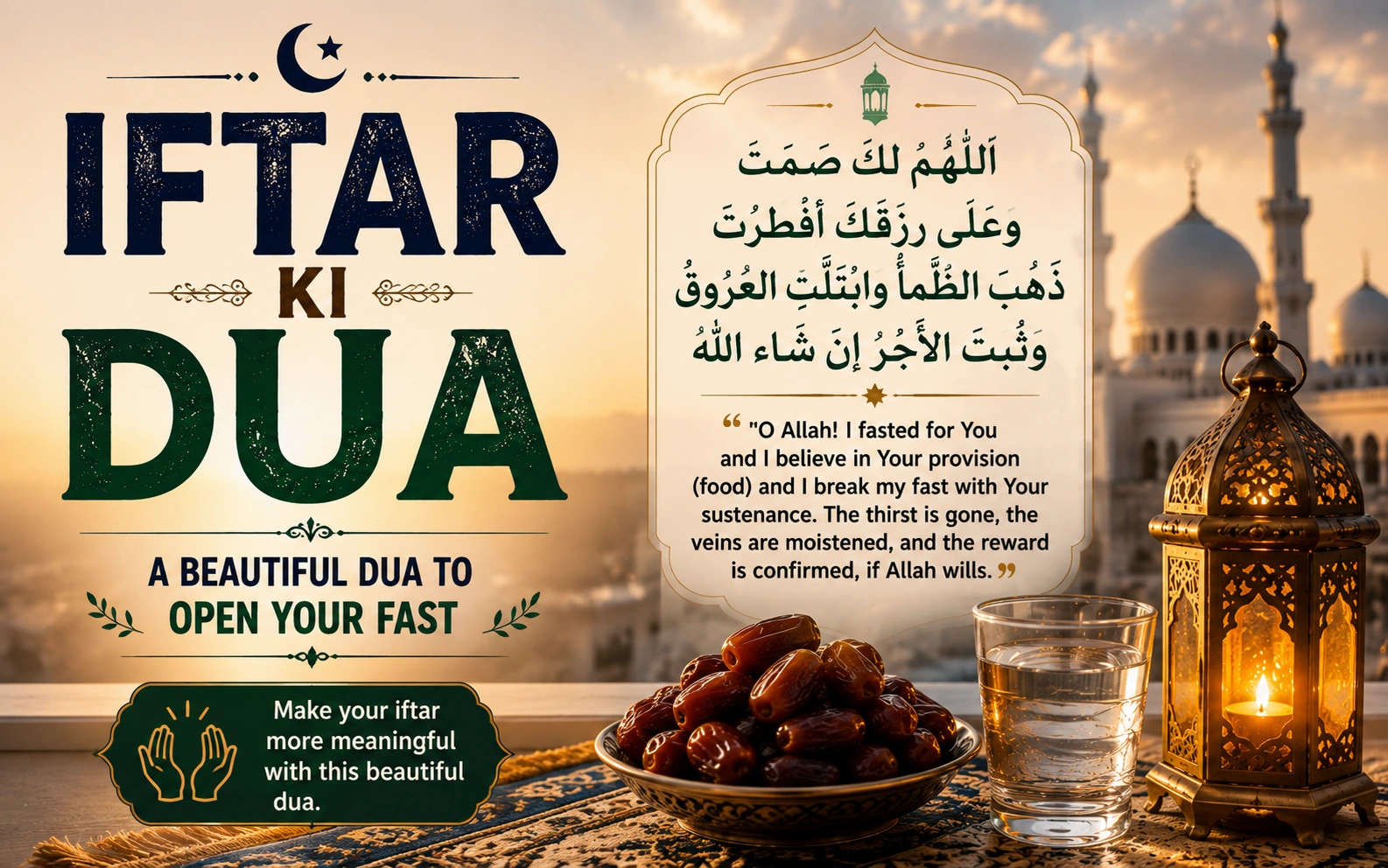
Direct Answer: The most authentic Iftar Ki Dua is “Allahumma laka sumtu wa ‘ala rizqika aftartu,” meaning “O Allah, I fasted for You, and I break my fast with Your provision,” said the moment the sun sets and the roza ends.
Ramzan evenings have a rhythm of their own. The plate is ready, the water glass is full, the clock is ticking down to sunset, and everyone at the table goes quiet for a second. That second belongs to the Iftar Ki Dua. It is short, it is simple, and yet it carries the weight of a full day of hunger, thirst, and patience. If you have ever wondered what to actually say at that moment, or whether you are saying it correctly, this article walks you through it, calmly and honestly.
What Exactly Is Iftar Ki Dua
Iftar Ki Dua is the prayer a Muslim recites at the exact moment of breaking the Ramzan fast, right after the Maghrib azan. Iftar means “breaking the fast,” and dua means “supplication.” So Iftar Ki Dua literally means the words spoken to Allah while ending the roza for the day. It is not a long ritual. It is a few lines, often said quietly, sometimes out loud with family gathered around the table.
Scholars note that this is one of the most accepted moments for dua in the entire day. A fasting person has spent hours holding back hunger, thirst, and anger, purely out of devotion. That effort is believed to make the heart softer and the prayer more sincere right before the first sip of water.
The Authentic Iftar Ki Dua in Arabic
There are two duas commonly linked to this moment, and it helps to know which one is stronger in terms of hadith authenticity.
Dua 1 (graded authentic, from Sunan Abu Dawood 2358):
اللَّهُمَّ لَكَ صُمْتُ وَعَلَىٰ رِزْقِكَ أَفْطَرْتُ
Transliteration: Allahumma laka sumtu wa ‘ala rizqika aftartu.
Meaning: O Allah, I fasted for You, and I break my fast with Your provision.
Dua 2 (graded hasan, from Sunan Abu Dawood 2357):
ذَهَبَ الظَّمَأُ وَابْتَلَّتِ الْعُرُوقُ وَثَبَتَ الْأَجْرُ إِنْ شَاءَ اللَّهُ
Transliteration: Dhahaba al-zama’u wa abtallatil ‘urooqu wa thabatal ajru in sha Allah.
Meaning: The thirst has gone, the veins are moistened, and the reward is confirmed, if Allah wills.
A third, longer version, “Allahumma inni laka sumtu, wa bika aamantu, wa ‘alayka tawakkaltu, wa ‘ala rizqika aftartu,” is widely shared online and is perfectly fine to recite, but Hadith scholars generally rate its chain as weaker than the two above. Either dua is acceptable, and many families simply recite both.
Iftar Ki Dua in Roman English (For Easy Reading)
Not everyone reads Arabic script comfortably, especially children learning the dua for the first time. Here is the Iftar Ki Dua in Roman English:
Allahumma laka sumtu wa ala rizqika aftartu.
Say it slowly, break it into three small parts if needed, and the rhythm becomes easy to remember within a few tries.
Iftar Ki Dua in Hindi
For Hindi-speaking readers, here is the Iftar Ki Dua in Hindi with meaning:
अल्लाहुम्मा लका सुम्तु व अला रिज़्क़िका अफ़्तरतु
अर्थ: ऐ अल्लाह! मैंने तेरे लिए रोज़ा रखा और तेरे रिज़्क़ से इफ़्तार किया।
This is the exact Roza Iftar Ki Dua in Hindi that most Hindi-medium Islamic books and Ramzan calendars print, so it lines up with what your local masjid or family elders may have taught you.
Iftar Ki Dua in Urdu
The Iftar Ki Dua in Urdu reads:
اللّٰہُمَّ لَکَ صُمْتُ وَعَلٰی رِزْقِکَ اَفْطَرْتُ
میں نے تیرے لیے روزہ رکھا اور تیرے دیے ہوئے رزق سے روزہ کھولا۔
Urdu readers will notice the script is nearly identical to the original Arabic, since Urdu borrows heavily from Arabic script and vocabulary for religious terms.
Iftar Ki Dua in Bangla
For readers searching Iftar Ki Dua Bangla, the meaning translates as:
“হে আল্লাহ, আমি তোমার জন্য রোজা রেখেছি এবং তোমার দেওয়া রিজিক দিয়ে ইফতার করছি।”
This carries the same core message as the Hindi and Urdu versions: gratitude for the day’s fast and the food now in front of you.
Sehri Aur Iftar Ki Dua: The Two Halves of a Roza
Many readers search for Sehri or Iftar Ki Dua together, since both mark the start and end of the fast. The Sehri (pre-dawn meal) dua expresses the intention to fast, called niyyah, while the Iftar Ki Dua closes it out with gratitude. Below is a quick comparison table.
| Aspect | Sehri Dua | Iftar Ki Dua |
|---|---|---|
| Time | Before Fajr azan | Right after Maghrib azan |
| Purpose | Intention (niyyah) to fast | Gratitude for completing the fast |
| Common Arabic phrase | Wa bisawmi ghadin nawaytu min shahri Ramadan | Allahumma laka sumtu wa ‘ala rizqika aftartu |
| Length | One short line | One to two short lines |
| Hadith status | Widely practiced, based on general niyyah rulings | Two versions graded sahih and hasan |
When Exactly Should You Recite It
The Roza Iftar Ki Dua is said right at the moment of breaking the fast, ideally just before or while taking the first date, sip of water, or bite of food. The Prophet Muhammad (peace be upon him) is reported to have broken his fast with fresh dates, dry dates, or water first, and the dua fits naturally into that same short window. You do not need to wait until the plate is finished. Say it, then eat.
Why This Particular Dua Matters So Much
There is a well-known hadith stating that a fasting person’s supplication at the time of breaking the fast is among the prayers that are rarely turned away. This is one reason the Iftar Ki Dua is treated as more than a formality. It is also a moment to add your own personal requests, in your own words and language, right after reciting the traditional Arabic lines. Many scholars encourage exactly this: recite the sunnah dua first, then speak to Allah about whatever is on your heart.
Iftar Ki Dua Card and PDF: Keeping It Handy
Families often print the Iftar Ki Dua Card or keep an Iftar Ki Dua PDF on their phone during Ramzan, especially for children who are still memorizing it. A simple card with the Arabic text, Roman English transliteration, and Hindi or Urdu meaning side by side works well for this. You are welcome to copy the versions above onto a card of your own.
Frequently Asked Questions
1. What is the most authentic Iftar Ki Dua?
“Allahumma laka sumtu wa ‘ala rizqika aftartu” is generally considered the most authentic, based on its hadith grading in Sunan Abu Dawood.
2. Can I recite Iftar Ki Dua in Hindi or Urdu instead of Arabic?]
Yes. Reciting the Arabic is preferred since it matches the original wording, but understanding the Hindi or Urdu meaning helps you connect with what you are saying.
3. Is it necessary to say the dua before eating anything?
It is recommended but not compulsory. Your fast remains valid either way; the dua is a sunnah, not an obligation.
4. What is the difference between Sehri Ki Dua and Iftar Ki Dua?
Sehri Ki Dua marks the intention to begin the fast before dawn, while Iftar Ki Dua marks gratitude at the moment the fast ends.
5. Can I make personal duas along with the traditional Iftar Ki Dua?
Yes, and it is encouraged. This moment is considered especially favourable for personal supplications in any language.
6. Where can I find Iftar Ki Dua in Roman English for kids?
Use “Allahumma laka sumtu wa ala rizqika aftartu,” written phonetically, and repeat it slowly with your child until they memorize it naturally.
Conclusion
The Iftar Ki Dua is a small set of words that carries an entire day’s worth of patience and gratitude. Whether you say it in Arabic, Hindi, Urdu, Bangla, or Roman English, the meaning stays the same: thanking Allah for the strength to complete the roza and for the food now in front of you. Keep the Arabic version close to your heart, but never hesitate to add your own words in your own language once the traditional dua is done.
Disclaimer: This article is for general Islamic educational purposes. Every effort has been made to present the Arabic text, transliteration, and meanings accurately, sourced from Sunan Abu Dawood and related hadith literature. For matters of religious practice, please consult a qualified local scholar or imam.
Note on sourcing: The hadith gradings mentioned above (sahih, hasan) are cited from Sunan Abu Dawood 2357 and 2358 as commonly referenced by Islamic scholars; readers seeking a formal ruling should verify with a local scholar or a primary hadith reference such as Sunan Abu Dawood or an authenticated hadith app.
Thank you for reading-
Also check out “The Powerful Dua” for more such powerful duas.