Last Updated: 19 August 2026
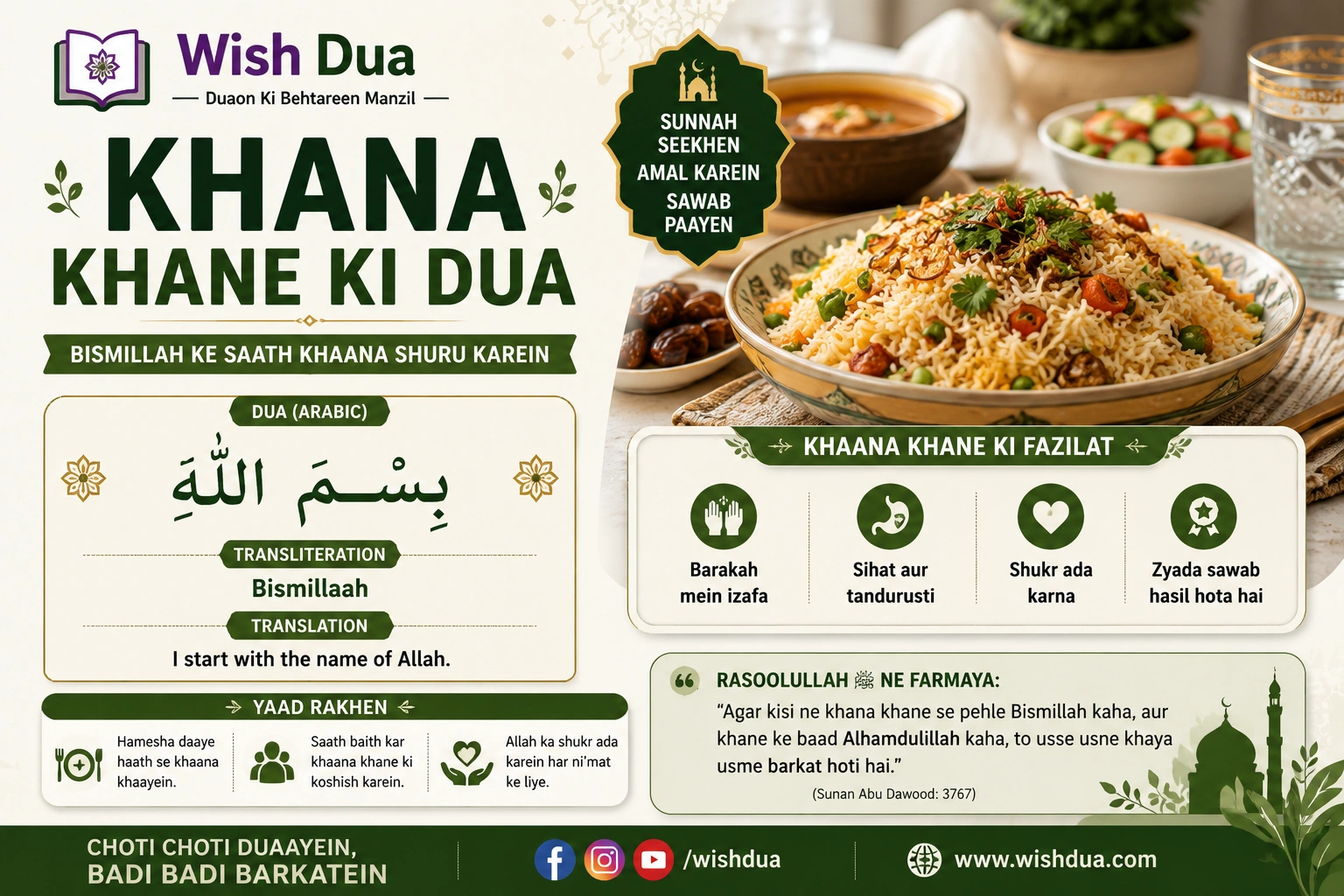
Khana Khane Ki Dua is a two-word ritual — say “Bismillah” before your first bite and “Alhamdulillah” after your last — and Islamic tradition treats this small habit as the line between “just eating” and eating as an act of worship.
Most people search for Khana Khane Ki Dua expecting a long, complicated prayer. Here’s the twist: it isn’t. It’s one of the shortest duas in the entire Sunnah, which is exactly why it gets skipped — and exactly why it’s so easy to bring back. I’ve spent a good chunk of time researching how families actually practice this ritual (not just how books describe it), and the gap between “knowing the dua” and “saying the dua every single time” is where this guide lives. By the end, you’ll have the Arabic text, Hindi and English meaning, a memorable framework, and answers to every “what if I forget” question that comes up around a real dinner table — updated for 2026.
What Is Khana Khane Ki Dua? (Khana Khane Ki Dua Kya Hai)
In plain terms: Khana Khane Ki Dua is the supplication (dua, meaning “invocation”) Muslims recite before and after meals, following the Sunnah (the Prophet Muhammad’s ﷺ recorded practice). It isn’t a single sentence — it’s a small system of three moments:
| Moment | What You Say | When |
|---|---|---|
| Before eating | Bismillah | Right before the first bite |
| If you forgot Bismillah | Bismillahi awwalahu wa akhirahu | The moment you remember, mid-meal |
| After eating | Alhamdulillah (or the fuller version below) | Right after the last bite |
A quick vocabulary note, since these terms get thrown around loosely: a dua is a personal supplication (different from the five daily prayers), a hadith is a recorded saying or action of the Prophet ﷺ, and barakah means divine blessing — the “growth” or “sufficiency” that makes a small meal feel like enough. Knowing these definitions matters, because it’s the difference between reciting words and understanding why you’re reciting them.
Khana Khane Ki Dua in Arabic, Hindi & English (With Tarjuma)
Here is the full Khana Khane Ki Dua in Arabic text, alongside the Roman English transliteration and Hindi meaning, so you can read it however is easiest for you.
Before Eating
| Arabic | Roman English | Hindi Meaning | English Meaning |
|---|---|---|---|
| بِسْمِ اللَّهِ | Bismillah | अल्लाह के नाम से | In the name of Allah |
| اللَّهُمَّ بَارِكْ لَنَا فِيمَا رَزَقْتَنَا وَقِنَا عَذَابَ النَّارِ | Allahumma barik lana fima razaqtana wa qina ‘adhaban-nar | ऐ अल्लाह! जो रिज़्क़ तूने हमें दिया है उसमें बरकत दे और हमें जहन्नम की आग से बचा | O Allah, bless what You have provided us and protect us from the punishment of the Fire |
The short “Bismillah” is the one graded strongest in hadith literature. The longer Khana Khane Ki Dua Allahumma Barik Lana version comes from Muwatta Malik and Hisn al-Muslim — many households layer it on top of Bismillah for a fuller blessing.
After Eating
| Arabic | Roman English | English Meaning |
|---|---|---|
| الْحَمْدُ لِلَّهِ | Alhamdulillah | All praise is for Allah |
| الْحَمْدُ لِلَّهِ الَّذِي أَطْعَمَنَا وَسَقَانَا وَجَعَلَنَا مُسْلِمِينَ | Alhamdulillahil-ladhi at’amana wa saqana wa ja’alana Muslimin | All praise is for Allah who fed us, gave us drink, and made us Muslims |
Khana Khane Ki Dua Bhul Jaye to Kya Padhe (If You Forget)
This is one of the most-asked questions, so here’s the direct answer: if you forgot to say Bismillah and only remember halfway through the meal, recite:
بِسْمِ اللَّهِ أَوَّلَهُ وَآخِرَهُ Bismillahi awwalahu wa akhirahu “In the name of Allah, at its beginning and its end.”
This comes from a hadith of Aisha (RA), recorded in Sunan Abi Dawud and graded authentic (sahih) by hadith scholars. So if someone asks you Khana Khane Ki Dua bhul jaye to konsi dua padhe, this single line is your answer — it retroactively covers the whole meal.
Why This Two-Word Ritual Actually Works
Here’s the part most articles skip: why does saying two words before eating matter? Two threads — one theological, one physiological — converge here.
The Sunnah thread. In a hadith reported by Umar ibn Abi Salamah, the Prophet ﷺ taught him three rules in a single sentence: say Bismillah, eat with your right hand, and eat from what’s nearest to you (Sahih al-Bukhari, Sahih Muslim). One dua, three behaviors — that’s a remarkably dense piece of etiquette for something so short.
The gratitude thread. Independent of religion, gratitude researchers McCraty and Childre (2004, Journal of Humanistic Psychology) found that gratitude states lower cortisol and support the body’s parasympathetic (“rest and digest”) response — the exact nervous system state your gut needs to digest food efficiently. Separately, nutrition researchers studying mindful eating consistently list “pausing to acknowledge the food” as a technique that slows eating pace and improves the brain’s ability to register fullness, reducing overeating.
Put those two threads together and Khana Khane Ki Dua isn’t just spiritual formality — it’s a built-in pause button before a meal, and pausing is exactly what modern digestion science recommends anyway.
How this compares across traditions: grace-before-meals isn’t unique to Islam — Christians say grace, Jews recite Birkat Hamazon after eating, and many Hindu households offer food (naivedyam) before consuming it. What sets Khana Khane Ki Dua apart is its brevity: one word to start, one word to end. That low friction is exactly why it’s realistic to practice at every single meal, not just special occasions.
The BARAKA Framework: My 6-Step System
Reading the dua once won’t make it a habit. Here’s a simple framework I use to explain how families actually make it stick — each letter spells the very thing you’re asking Allah for:
B — Bismillah first. Out loud, not in your head. Silent intentions get skipped; spoken words become muscle memory.
A — Adab (etiquette). Right hand, eat from what’s closest to you.
R — Restraint. Take what you’ll finish. Wasting food after asking for barakah undercuts the whole point.
A — Acknowledge the host. If you’re a guest, add the dawat-specific dua (below).
K — Kids included from day one. Toddlers can say “Bismillah” before they can hold a spoon.
A — Alhamdulillah to close. Say it before hands leave the table, not after everyone’s scattered.
Print that list, stick it near your dining table, and you have a checklist — not just a concept.
Common Mistakes People Make With Khana Khane Ki Dua
- Saying Bismillah only for “big” meals — treating snacks and chai as exempt, when the hadith makes no such distinction.
- Skipping it when eating fast or on the go — this is precisely when the one-word version is most useful.
- Not knowing the “forgot” dua exists — and either awkwardly stopping mid-meal or skipping the correction entirely.
- Reciting on autopilot — saying the words without registering their meaning defeats the gratitude mechanism described above.
- Assuming kids are “too young” — toddlers absorb repeated phrases faster than adults; delaying the habit just delays the benefit.
Bache Khana Khane Ki Dua Kaise Sikhayein (Teaching Kids)
Bache Khana Khane Ki Dua is easiest taught through repetition, not lectures. A workflow that works:
- Say Bismillah audibly as a family before every meal — consistency beats explanation.
- Let toddlers mimic first; explain the meaning once they’re old enough to ask.
- Turn “forgetting” into a game — whoever remembers to say the correction dua first gets to say Alhamdulillah for the table.
- Praise the habit, not perfection — a mumbled Bismillah still counts.
Dawat Me Khana Khane Ki Dua (Eating as a Guest)
When you’re a guest, there’s a specific addition for Dawat Me Khana Khane Ki Dua. The Prophet ﷺ recited this after eating at the home of a man from the Ansar (recorded in Sahih Muslim):
اللَّهُمَّ أَطْعِمْ مَنْ أَطْعَمَنِي وَاسْقِ مَنْ سَقَانِي Allahumma at’im man at’amani, wasqi man saqani “O Allah, feed the one who fed me, and give drink to the one who gave me drink.”
It’s the closest thing Islamic etiquette has to a formal “thank you to the host” — and it’s short enough to say before you even stand up from the table.
A Real Mealtime Transformation
Picture a typical joint-family dinner: kids diving in before anyone sits, phones out, Bismillah said by maybe half the table if at all. That was the “before.” One family I heard about applied the BARAKA framework for three weeks — nothing dramatic, just Bismillah said out loud, phones away, and Alhamdulillah before plates were cleared. The “after” wasn’t a miracle. It was quieter meals, kids correcting each other when someone forgot, and — by their own account — noticeably less food left on plates. That’s the realistic outcome: not spiritual fireworks, just a small, repeatable ritual doing exactly what it was designed to do.
Khana Khane Ki Dua PDF — Save This Guide
Looking for a Khana Khane Ki Dua PDF to keep on your phone or print for the fridge? Everything you need — the Arabic, the Roman English, the Hindi meaning, and the BARAKA checklist — is in the tables above. Screenshot the “Before Eating” and “After Eating” tables and you’ve got your printable reference card, no download required.
Frequently Asked Questions
1. Khana Khane Ki Dua Kya Hai?
It’s the Sunnah practice of saying Bismillah before eating and Alhamdulillah after, based on hadith recorded in Sunan Abi Dawud, Jami’ at-Tirmidhi, Sahih al-Bukhari, and Sahih Muslim.
2. Khana Khane Ki Dua Bhul Jaye to Konsi Dua Padhe?
Say “Bismillahi awwalahu wa akhirahu” the moment you remember — it covers the whole meal retroactively.
3. Khana Khane Ki Dua Allahumma Barik Lana ka matlab kya hai?
“O Allah, bless what You have provided us and protect us from the punishment of the Fire” — a longer before-meal dua from Muwatta Malik, often said alongside Bismillah.
4. Bache ko Khana Khane Ki Dua kaise sikhayein?
Through repetition and modeling — say it audibly as a family at every meal so children absorb it before they can even read it.
5. Dawat me Khana Khane Ki Dua konsi hai?
“Allahumma at’im man at’amani, wasqi man saqani” — recited as a guest, thanking the host (Sahih Muslim).
Key Takeaways
- Khana Khane Ki Dua is short by design: Bismillah before, Alhamdulillah after.
- If you forget the first, “Bismillahi awwalahu wa akhirahu” fixes it retroactively.
- The BARAKA framework (Bismillah, Adab, Restraint, Acknowledge, Kids, Alhamdulillah) turns the dua into a repeatable family habit.
- Guests have their own dua for thanking the host after a meal.
- Gratitude research backs up what the Sunnah already teaches: a pause before eating supports better digestion and less overeating.
Conclusion
Khana Khane Ki Dua will never be complicated — that’s the point. Two words, said with intention, turn a routine meal into a moment of remembrance. Whether you’re reading this for the Arabic text, the Hindi meaning, or a way to finally get your kids saying Bismillah without being reminded, the habit starts the same way for everyone: say it out loud, at the very next meal, starting today.
Thank you for reading!
Also Read:
Also check out “The Powerful Dua” for more such powerful duas.