Last Update: 1 August 2026
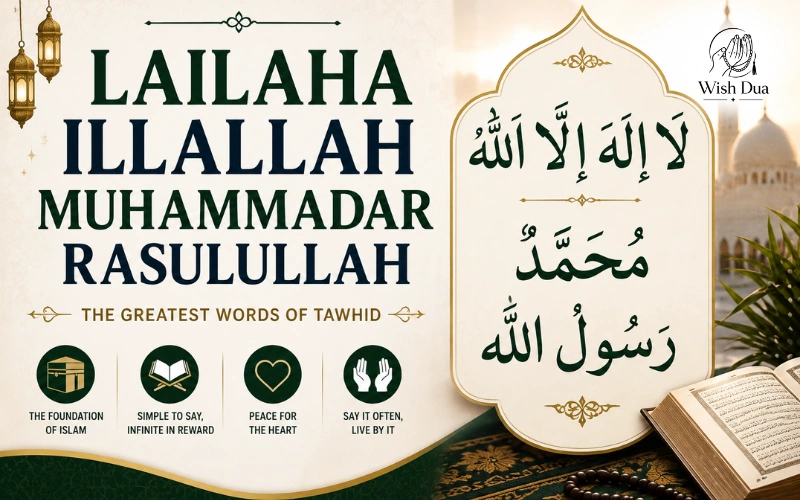
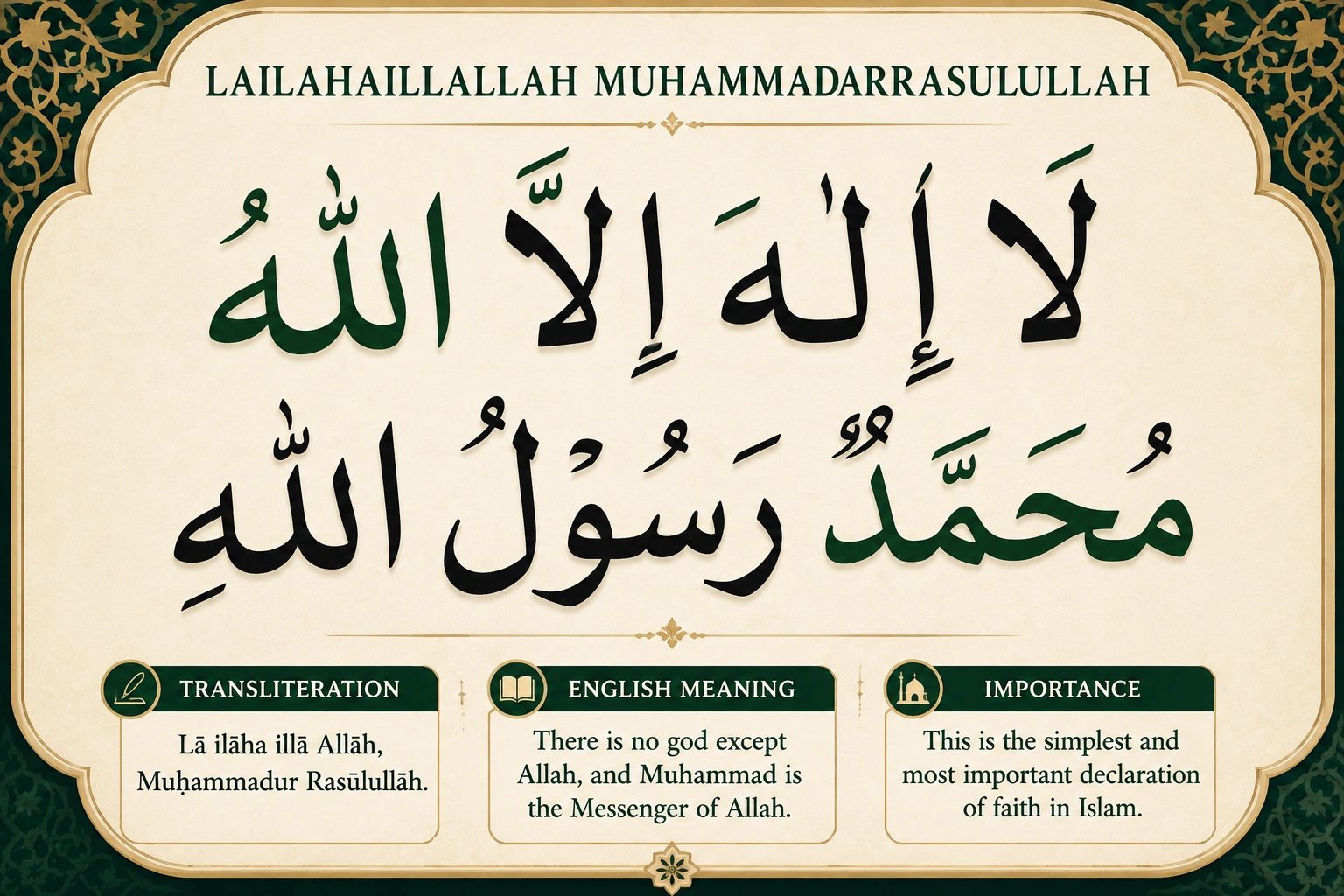
Lailahaillallah Muhammadarrasulullah in Arabic is written as لَا إِلٰهَ إِلَّا اللَّهُ مُحَمَّدٌ رَسُولُ اللَّهِ and means, “There is no deity worthy of worship except Allah, and Muhammad is the Messenger of Allah.”
If you searched for this phrase, you may want the Arabic writing, English meaning, Roman transliteration, pronunciation, Islamic significance, Qur’anic references, and the correct form of the Shahada. This guide covers all of them, while also clearing up a common confusion: the phrase لا إله إلا الله محمد رسول الله is widely used as a concise expression of the testimony of faith, while the fuller verbal form begins with أشهد (“I bear witness”).
Lailahaillallah Muhammadarrasulullah in Arabic
The commonly written Arabic form is:
لَا إِلٰهَ إِلَّا اللَّهُ مُحَمَّدٌ رَسُولُ اللَّهِ
Without diacritical marks:
لا إله إلا الله محمد رسول الله
Roman transliteration:
Lā ilāha illā Allāh, Muḥammadur Rasūlullāh
A simple English rendering is:
“There is no deity worthy of worship except Allah, and Muhammad is the Messenger of Allah.”
The expression contains two foundational beliefs: Tawhid, the absolute oneness of Allah, and belief in Muhammad ﷺ as Allah’s Messenger.
Quick reference
| Form | Text |
|---|---|
| Arabic | لَا إِلٰهَ إِلَّا اللَّهُ مُحَمَّدٌ رَسُولُ اللَّهِ |
| Simple Arabic | لا إله إلا الله محمد رسول الله |
| Roman | Lā ilāha illā Allāh, Muḥammadur Rasūlullāh |
| Meaning | There is no deity worthy of worship except Allah, and Muhammad is the Messenger of Allah |
| Religious concept | Shahada / testimony of faith |
| First major concept | Tawhid — oneness of Allah |
| Second major concept | Risalah — Muhammad ﷺ as Allah’s Messenger |
What Does Lailahaillallah Muhammadarrasulullah in Arabic Mean?
“Lā ilāha illā Allāh” means that no one or nothing has the right to be worshipped except Allah.
“Muḥammadur Rasūlullāh” means that Muhammad ﷺ is the Messenger of Allah.
Together, the statement expresses the two central testimonies of Islamic faith:
- Allah alone is worthy of worship.
- Muhammad ﷺ is Allah’s Messenger.
This is more than a sentence to memorize. The first part establishes Tawhid—worshipping Allah alone. The second establishes acceptance of the Messenger through whom Allah’s final revelation was conveyed.
The Qur’an explicitly states, “There is no deity except Allah” in Surah Muhammad 47:19, while Surah Al-Ahzab 33:40 describes Muhammad ﷺ as the Messenger of Allah and the seal of the prophets.
Is Lailahaillallah Muhammadarrasulullah the Shahada?
Yes, it is commonly used as a concise form of the Shahada, or testimony of faith.
However, there is an important linguistic distinction.
The fuller testimony is commonly expressed as:
أَشْهَدُ أَنْ لَا إِلٰهَ إِلَّا اللَّهُ وَأَشْهَدُ أَنَّ مُحَمَّدًا رَسُولُ اللَّهِ
Roman transliteration:
Ashhadu an lā ilāha illā Allāh, wa ashhadu anna Muḥammadan Rasūlullāh.
Meaning:
“I bear witness that there is no deity worthy of worship except Allah, and I bear witness that Muhammad is the Messenger of Allah.”
The word Ashhadu means “I bear witness” or “I testify.”
So, لا إله إلا الله محمد رسول الله expresses the substance of the two testimonies, while adding أشهد explicitly gives the familiar first-person testimony form.
The hadith recorded in Sahih al-Bukhari 8 states that Islam is built upon five, beginning with testifying that none has the right to be worshipped except Allah and that Muhammad is Allah’s Messenger. Sahih Muslim 16c records the same foundational teaching.
Lailahaillallah Muhammadarrasulullah in Arabic With Meaning
Here is the phrase broken into manageable parts:
| Arabic | Transliteration | Meaning |
| لَا | Lā | No / there is no |
| إِلٰهَ | ilāha | deity worthy of worship |
| إِلَّا | illā | except |
| اللَّهُ | Allāh | Allah |
| مُحَمَّدٌ | Muḥammadun | Muhammad |
| رَسُولُ | Rasūlu | Messenger |
| اللَّهِ | Allāh | of Allah |
The natural English meaning is not merely “there is no god anywhere.” In Islamic theology, the statement affirms that Allah alone is worthy of worship.
That distinction matters because ilah refers to a deity or object of worship. The Shahada therefore makes both a rejection and an affirmation: reject worship of anything besides Allah and affirm worship of Allah alone.
Why Is “Muhammadarrasulullah” Written Differently From How It Sounds?
This is one of the most common sources of confusion for people learning the phrase online.
In Arabic writing, the phrase is:
مُحَمَّدٌ رَسُولُ اللَّهِ
When spoken continuously, the grammatical ending of Muḥammadun connects with the following word, producing the familiar pronunciation:
Muḥammadur Rasūlullāh
So:
Muhammadur Rasulullah is a pronunciation/transliteration of the Arabic phrase, not a different statement.
You may also see:
- Muhammad Rasulullah
- Muhammadur Rasulullah
- Muhammad Rasool Allah
- Muhammadur Rasoolullah
- Muhammad is the Messenger of Allah
These represent different transliteration conventions. The Arabic wording remains the clearest reference.
Is Lailahaillallah Muhammadarrasulullah in the Quran?
There is an important distinction here.
The exact combined sentence:
لا إله إلا الله محمد رسول الله
does not appear as one continuous verse in the Qur’an.
But both theological statements are explicitly established in the Qur’an.
“Lā ilāha illā Allāh”
Surah Muhammad 47:19 says:
فَاعْلَمْ أَنَّهُ لَا إِلَٰهَ إِلَّا اللَّهُ
The verse teaches the Prophet ﷺ to know that there is no deity except Allah.
“Muhammad Rasulullah”
Surah Al-Ahzab 33:40 states:
وَلَٰكِن رَّسُولَ اللَّهِ وَخَاتَمَ النَّبِيِّينَ
It identifies Muhammad ﷺ as the Messenger of Allah and the seal of the prophets.
Surah Al-Fath 48:29 also contains the phrase مُحَمَّدٌ رَّسُولُ اللَّهِ (“Muhammad is the Messenger of Allah”) within its description of the Prophet ﷺ and those who accompanied him.
This is why it is inaccurate to claim that the exact combined Shahada must appear as one uninterrupted Qur’anic sentence to be foundational to Islam. Its two core affirmations are clearly established across the Qur’an and Sunnah.
What Is the Shahada?
Shahada comes from the Arabic root associated with witnessing or testifying.
In Islamic practice, it refers to the testimony that:
Allah alone is worthy of worship and Muhammad ﷺ is His Messenger.
The Shahada is the first of the Five Pillars of Islam.
The other four are:
- Salah — obligatory prayer
- Zakat — obligatory almsgiving
- Sawm — fasting during Ramadan
- Hajj — pilgrimage to Makkah for those who are able
This five-pillar framework is explicitly reported in Sahih al-Bukhari 8 and Sahih Muslim 16.
The Five Pillars at a Glance
| Pillar | Basic meaning |
| Shahada | Testimony of faith |
| Salah | Five daily prayers |
| Zakat | Obligatory charitable giving |
| Sawm | Fasting in Ramadan |
| Hajj | Pilgrimage to Makkah when able |
The Shahada comes first because the other acts of worship are performed within the framework of belief in Allah and His Messenger.
The Two Parts of the Shahada Explained
1. Lā ilāha illā Allāh — لا إله إلا الله
This is the declaration of Tawhid.
Tawhid means affirming Allah’s absolute oneness and uniqueness.
The statement begins with lā, meaning “no,” and then uses illā, meaning “except.” Its structure therefore has both a negative and positive dimension:
Lā ilāha — no deity is worthy of worship.
Illā Allāh — except Allah.
The practical consequence is significant. Tawhid is not simply an abstract belief that God exists. It concerns who receives worship, devotion, reliance, obedience, and ultimate submission.
2. Muhammadur Rasulullah — محمد رسول الله
This means:
“Muhammad is the Messenger of Allah.”
Believing in the Messenger means accepting his prophethood and accepting the message he conveyed.
The Qur’an describes Muhammad ﷺ as the Messenger of Allah and the seal of the prophets in Surah Al-Ahzab 33:40.
This second testimony also explains why the Sunnah matters in Islamic practice. Muslims do not simply affirm Muhammad ﷺ as a historical figure; they accept his role as Allah’s Messenger and follow his teachings.
Why Lailahaillallah Muhammadarrasulullah Is So Important
Its importance comes from what it represents, not from the number of times someone types or repeats it.
The phrase connects belief with worship.
A person may know the Arabic words perfectly but still miss their meaning. Conversely, someone learning Islam may initially struggle with Arabic pronunciation while sincerely understanding and accepting the testimony.
The deeper objective is therefore not mechanical repetition. It is faith, understanding, and sincere commitment.
A useful way to remember the structure is:
Allah alone → worship Allah alone → accept His Messenger → follow the guidance he brought.
Three Reliable References Behind the Shahada
The following primary Islamic references establish the central concepts:
| Reference | What it establishes |
| Qur’an 47:19 | “There is no deity except Allah” |
| Qur’an 33:40 | Muhammad ﷺ is the Messenger of Allah and seal of the prophets |
| Sahih al-Bukhari 8 | Testimony of Allah’s oneness and Muhammad’s messengership as the first pillar |
| Sahih Muslim 16c | The same testimony as the foundation of Islam |
These are not modern interpretations created for websites. They are classical primary references used in Islamic scholarship.
How to Pronounce Lailahaillallah Muhammadarrasulullah
For English speakers, a practical approximation is:
Laa ilaaha illallaah, Muhammadur Rasoolullaah.
Break it into two sections:
- Laa ilaaha illallaah
- Muhammadur Rasoolullaah
Do not worry about achieving perfect Arabic pronunciation immediately. If you are learning, focus first on hearing the sounds correctly and then improving your articulation.
A simple pronunciation guide
Lā — “laa”
ilāha — “i-laa-ha”
illā — “il-laa”
Allāh — “Al-laah”
Muḥammadur — “Mu-ham-ma-dur”
Rasūlullāh — “Ra-soo-lul-laah”
The ḥ in Muḥammad represents the Arabic letter ح, a stronger, breathier “h” sound than the ordinary English “h.”
How to Learn the Arabic Correctly
If your goal is to memorize the phrase, use this short workflow rather than trying to memorize the entire sentence at once.
Step 1: Learn the first testimony
لَا إِلٰهَ إِلَّا اللَّهُ
Repeat it slowly while looking at the Arabic.
Step 2: Learn the second testimony
مُحَمَّدٌ رَسُولُ اللَّهِ
Practice the phrase separately.
Step 3: Combine them
لَا إِلٰهَ إِلَّا اللَّهُ مُحَمَّدٌ رَسُولُ اللَّهِ
Step 4: Learn the full testimony
أَشْهَدُ أَنْ لَا إِلٰهَ إِلَّا اللَّهُ وَأَشْهَدُ أَنَّ مُحَمَّدًا رَسُولُ اللَّهِ
Step 5: Learn the meaning
Do not stop at pronunciation. Make sure you understand what each part means.
Step 6: Improve pronunciation
Listen to a reliable Arabic recitation or qualified teacher and compare your pronunciation.
That final step is especially useful because English transliteration can only approximate Arabic sounds.
A Real-Life Example: Why Meaning Matters
Imagine someone has memorized:
لا إله إلا الله محمد رسول الله
They can recite it flawlessly.
Now imagine another person who is still learning Arabic and occasionally mispronounces a letter, but understands that Allah alone deserves worship and that Muhammad ﷺ is His Messenger.
The second person’s learning process is not meaningless because the pronunciation is imperfect.
The purpose of learning the Arabic is to help the believer say, understand, remember, and live by the testimony.
That is the practical lesson: pronunciation matters, but understanding and sincerity cannot be replaced by perfect spelling.
Is Lailahaillallah Muhammadarrasulullah a Dua?
Strictly speaking, it is not primarily a dua.
A dua is a supplication or request made to Allah.
The Shahada is a testimony of faith.
That distinction is useful when organizing Islamic content:
| Phrase/type | Category |
| لا إله إلا الله محمد رسول الله | Shahada / testimony of faith |
| رَبِّ اغْفِرْ لِي | Dua |
| سُبْحَانَ اللَّهِ | Dhikr |
| الْحَمْدُ لِلَّهِ | Dhikr / praise |
| اللَّهُ أَكْبَرُ | Takbir / remembrance |
The Shahada can certainly be remembered and repeated as dhikr, but calling it simply a “dua” misses its primary function.
Can Muslims Repeat Lailahaillallah as Dhikr?
Yes, lā ilāha illā Allāh is a central expression of remembrance and Tawhid.
The phrase appears repeatedly in authentic hadith literature in contexts concerning faith, worship, and remembrance. For example, Sahih Muslim records the Prophet ﷺ emphasizing the testimony lā ilāha illā Allāh in matters of faith.
The key point is not to turn remembrance into a competition over a particular number unless a specific number is established by reliable evidence.
A sound approach is:
Understand it → say it sincerely → remember Allah → allow its meaning to influence your actions.
Common Mistakes About Lailahaillallah Muhammadarrasulullah
Mistake 1: Treating the exact combined phrase as a Qur’an verse
The combined wording is widely recognized as the Shahada, but the exact sentence is not one single Qur’anic verse.
The Qur’an separately establishes its two essential beliefs.
Mistake 2: Assuming transliteration has only one spelling
There is no single universal English transliteration system.
You may see:
Muhammadur Rasulullah
or
Muhammadur Rasoolullah
or
Muhammad Rasul Allah
The Arabic is the stable reference point.
Mistake 3: Thinking “god” and “ilah” are always identical in explanation
A basic translation may say:
“There is no god but Allah.”
For theological precision, many Muslims explain the phrase as:
“There is no deity worthy of worship except Allah.”
The second wording communicates the worship-related meaning more clearly.
Mistake 4: Focusing entirely on pronunciation
Correct pronunciation is valuable, but the Shahada is a testimony of belief, not a pronunciation exercise.
Mistake 5: Treating the phrase like a magical formula
Islam does not reduce faith to mechanically repeating words while ignoring their meaning and implications.
The Shahada expresses a worldview: Allah alone is worshipped, and Muhammad ﷺ is accepted as His Messenger.
Lailahaillallah Muhammadarrasulullah in Arabic vs Full Shahada
| Feature | Short form | Full testimony |
| Arabic | لا إله إلا الله محمد رسول الله | أشهد أن لا إله إلا الله وأشهد أن محمدًا رسول الله |
| Begins with “I bear witness” | No | Yes |
| Expresses Tawhid | Yes | Yes |
| Affirms Muhammad ﷺ as Messenger | Yes | Yes |
| Common use | Concise expression of Shahada | Explicit testimony |
| Main purpose | Statement of Islamic belief | Formal testimony of faith |
The short form is therefore not a completely different belief. It expresses the same two foundational affirmations, while the full form explicitly says “I bear witness.”
What Does “Muhammad Rasulullah” Mean in the Quran?
The phrase مُحَمَّدٌ رَسُولُ اللَّهِ appears in the Qur’an in Surah Al-Fath 48:29.
It means:
“Muhammad is the Messenger of Allah.”
The verse continues by describing those who are with him and their qualities, including strength in faith and mercy among themselves.
This is one reason the phrase has such a prominent place in Islamic calligraphy, teaching, and devotional culture.
What Does the Quran Say About Muhammad ﷺ Being the Messenger?
The Qur’an states directly in Surah Al-Ahzab 33:40 that Muhammad ﷺ is the Messenger of Allah and the seal of the prophets.
This concept is known as the finality of prophethood.
In simple terms, mainstream Islamic belief holds that Muhammad ﷺ is the final prophet. The wording خَاتَمَ النَّبِيِّينَ (khatam an-nabiyyin) is the Qur’anic expression associated with this doctrine.
Historical Context of the Shahada
The Shahada is rooted in the earliest message of Islam.
The Prophet Muhammad ﷺ called people to worship Allah alone and to accept his role as Allah’s Messenger. The Qur’an repeatedly emphasizes Allah’s oneness and the Messenger’s role in conveying revelation.
The formal identification of the Five Pillars comes through hadith, including the famous narration of Ibn Umar recorded in both Sahih al-Bukhari and Sahih Muslim.
That distinction is historically important:
- The belief in Allah’s oneness is a central Qur’anic message.
- The belief in Muhammad ﷺ as Messenger is explicitly Qur’anic.
- The five-pillar formulation is famously articulated in authentic hadith.
So the Shahada should not be treated as merely a slogan developed centuries later. Its theological components are foundational to the earliest Islamic sources.
A Quick Checklist for Learning the Shahada
Use this checklist if you are learning the phrase:
-
I can recognize the Arabic text.
-
I know what Lā ilāha illā Allāh means.
-
I know what Muhammadur Rasūlullāh means.
-
I understand that the phrase is connected to the Shahada.
-
I know the fuller form beginning with Ashhadu.
-
I can pronounce the major Arabic sounds reasonably accurately.
-
I understand that the Shahada is a testimony of faith, not merely a slogan.
-
I know the difference between Shahada, dhikr, and dua.
Frequently Asked Questions About Lailahaillallah Muhammadarrasulullah in Arabic
1. How is Lailahaillallah Muhammadarrasulullah written in Arabic?
Lailahaillallah Muhammadarrasulullah in Arabic is written:
لَا إِلٰهَ إِلَّا اللَّهُ مُحَمَّدٌ رَسُولُ اللَّهِ
Without diacritics:
لا إله إلا الله محمد رسول الله
2. What is the English meaning of Lailahaillallah Muhammadarrasulullah?
It means:
“There is no deity worthy of worship except Allah, and Muhammad is the Messenger of Allah.”
The first part affirms Allah’s oneness, while the second affirms Muhammad ﷺ as Allah’s Messenger.
3. Is Lailahaillallah Muhammadarrasulullah the Shahada?
Yes. It is commonly used as a concise expression of the two testimonies of Islamic faith. The fuller form commonly begins Ashhadu an lā ilāha illā Allāh, wa ashhadu anna Muḥammadan Rasūlullāh. The first pillar of Islam is explicitly described as testimony to Allah’s oneness and Muhammad’s messengership in Sahih al-Bukhari 8 and Sahih Muslim 16.
4. Is Lailahaillallah Muhammadarrasulullah a Quranic verse?
Not as one complete sentence. The Qur’an contains the two core statements separately. Surah Muhammad 47:19 states lā ilāha illā Allāh, while Surah Al-Ahzab 33:40 identifies Muhammad ﷺ as the Messenger of Allah.
5. Can I write Lailahaillallah Muhammadarrasulullah without Arabic diacritics?
Yes. A common undiacritized form is:
لا إله إلا الله محمد رسول الله
Arabic diacritical marks help show pronunciation, but ordinary Arabic writing frequently omits them.
Key Takeaways On Lailahaillallah Muhammadarrasulullah in Arabic
- Lailahaillallah Muhammadarrasulullah is written in Arabic as لَا إِلٰهَ إِلَّا اللَّهُ مُحَمَّدٌ رَسُولُ اللَّهِ.
- It means “There is no deity worthy of worship except Allah, and Muhammad is the Messenger of Allah.”
- It expresses the two central testimonies of the Shahada.
- Lā ilāha illā Allāh affirms Allah’s absolute oneness and exclusive right to worship.
- Muhammadur Rasulullah affirms Muhammad ﷺ as Allah’s Messenger.
- The exact combined sentence is not a single Qur’anic verse, although both components are firmly established in the Qur’an.
- The fuller testimony commonly begins with Ashhadu, meaning “I bear witness.”
- The Shahada is the first of the Five Pillars of Islam, according to authentic hadith recorded in Sahih al-Bukhari and Sahih Muslim.
Short Summary Of Lailahaillallah Muhammadarrasulullah in Arabic
Lailahaillallah Muhammadarrasulullah in Arabic is:
لا إله إلا الله محمد رسول الله
Its meaning is:
“There is no deity worthy of worship except Allah, and Muhammad is the Messenger of Allah.”
The statement summarizes two foundational Islamic beliefs: Tawhid, the oneness of Allah, and acceptance of Muhammad ﷺ as Allah’s Messenger. The Qur’an establishes both concepts, while authentic hadith identify their testimony as the first pillar of Islam.
Conclusion: Lailahaillallah Muhammadarrasulullah in Arabic
If you are learning Lailahaillallah Muhammadarrasulullah in Arabic, do not stop at copying the Arabic letters.
Learn these four things together:
Arabic → pronunciation → meaning → belief.
Start with:
لا إله إلا الله
Then learn:
محمد رسول الله
Finally, learn the fuller testimony:
أشهد أن لا إله إلا الله وأشهد أن محمدًا رسول الله
The goal is not simply to produce a perfect transliteration. The real value of the Shahada lies in understanding what you are affirming: Allah alone is worthy of worship, and Muhammad ﷺ is His Messenger.
Thank you for reading Lailahaillallah Muhammadarrasulullah in Arabic!
Also Read:
Also check out “The Powerful Dua” for more such powerful duas.