Last Update: 30 July 2026
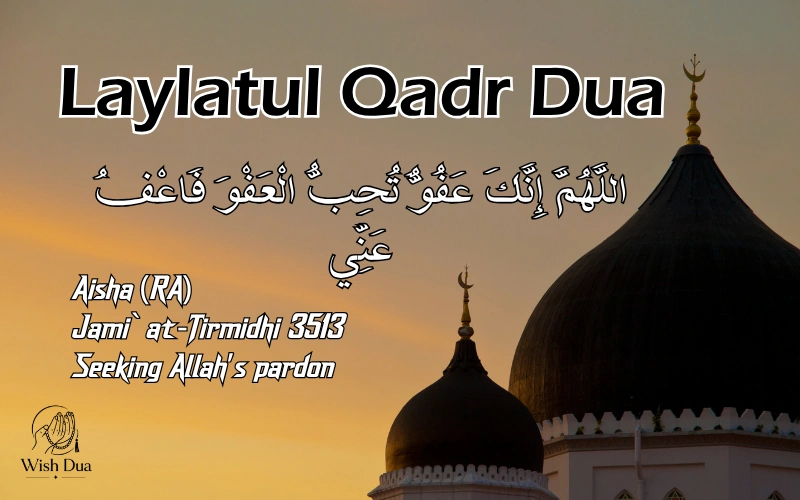
The authentic Laylatul Qadr Dua taught by Prophet Muhammad ﷺ is: “Allahumma innaka ‘afuwwun tuhibbul ‘afwa fa‘fu ‘anni” — a heartfelt prayer asking Allah to pardon you.
If there is one dua you should make a habit of repeating during the last ten nights of Ramadan, this is the one.
Aisha (RA) asked the Prophet Muhammad ﷺ what she should say if she knew which night was Laylatul Qadr. He taught her a short but incredibly meaningful supplication asking Allah for ‘afw — pardon and forgiveness. The narration is recorded in Jami at-Tirmidhi 3513, where Imam al-Tirmidhi graded the hadith Hasan Sahih. [Verification source: Jami at-Tirmidhi 3513.]
The beautiful part? You do not need a long paragraph, complicated Arabic, or a memorised list of dozens of prayers.
You need sincerity.
Laylatul Qadr Dua at a Glance
| Detail | Information |
|---|---|
| Main dua | Allahumma innaka ‘afuwwun tuhibbul ‘afwa fa‘fu ‘anni |
| Arabic | اللَّهُمَّ إِنَّكَ عَفُوٌّ تُحِبُّ الْعَفْوَ فَاعْفُ عَنِّي |
| Meaning | O Allah, You are Pardoning and love to pardon, so pardon me |
| Narrator | Aisha (RA) |
| Hadith | Jami` at-Tirmidhi 3513 |
| Occasion | Laylatul Qadr |
| Main theme | Seeking Allah’s pardon |
| Best period | The last ten nights of Ramadan, especially the odd nights |
| Fixed number of repetitions? | No authentic fixed number is established |
| Language | Arabic is the transmitted wording; personal dua may also be made in a language you understand |
The Prophet ﷺ specifically taught this supplication to Aisha (RA) when she asked what to say on Laylatul Qadr.
What Is the Laylatul Qadr Dua?
When people search What is Laylatul Qadr Dua, they are usually looking for the specific supplication taught by the Prophet ﷺ.
That dua is:
Laylatul Qadr Dua in Arabic
اللَّهُمَّ إِنَّكَ عَفُوٌّ تُحِبُّ الْعَفْوَ فَاعْفُ عَنِّي
Laylatul Qadr Dua in Roman English
Allahumma innaka ‘afuwwun tuhibbul ‘afwa fa‘fu ‘anni.
A simple pronunciation is:
Al-laa-hum-ma in-na-ka ‘a-fuw-wun tu-hib-bul ‘af-wa fa‘-fu ‘an-nee.
Laylatul Qadr Dua in English
“O Allah, You are Pardoning and You love to pardon, so pardon me.”
The wording comes from the hadith of Aisha (RA), in which she asked the Prophet ﷺ what she should say if she knew which night was Laylatul Qadr.
This is important because many websites publish large collections under the heading Laylatul Qadr Dua List, but readers can easily confuse recommended personal supplications with the one dua that has a specific prophetic instruction connected to Laylatul Qadr.
Those are not the same thing.
Why Is This Dua So Important?
The dua is short.
Its meaning is not.
The key word is ‘afuww.
Allah’s pardon is more than simply asking that a mistake be overlooked. The supplication asks Allah to pardon the servant and wipe away the consequences of sin through His mercy.
And notice something striking.
Aisha (RA) did not ask, “What should I request for wealth?”
She did not ask, “What should I request for success?”
She asked what to say on the greatest night of the year.
The Prophet ﷺ directed her towards asking Allah for pardon.
That gives this Laylatul Qadr Dua for Forgiveness extraordinary spiritual importance.
It also gives us a useful priority: before filling the night with requests for worldly things, ask Allah to forgive you.
Laylatul Qadr Dua Meaning
Let us break the dua down simply.
| Arabic phrase | Simple meaning |
| Allahumma | O Allah |
| Innaka | Indeed, You are |
| ‘Afuwwun | Pardoning |
| Tuhibbul ‘afwa | You love to pardon |
| Fa‘fu ‘anni | So pardon me |
The final request is deeply personal:
Fa‘fu ‘anni — so pardon me.
Not merely “pardon people.”
Not merely “grant forgiveness.”
Pardon me.
That makes the supplication direct, humble and personal.
What Does ‘Afuww Mean?
‘Afuww refers to Allah’s quality of pardoning.
The dua therefore asks Allah not only because the worshipper needs forgiveness, but because Allah loves to pardon.
This creates a beautiful balance between humility and hope.
You recognise your shortcomings while still turning confidently towards Allah’s mercy.
That is why the Laylatul Qadr Dua Meaning is worth understanding rather than simply repeating phonetically.
Laylatul Qadr Dua Hadith Reference
The primary hadith for this supplication is narrated by Aisha (RA).
She asked the Prophet ﷺ:
If she knew which night was Laylatul Qadr, what should she say?
He replied with the supplication asking Allah for pardon.
The narration is recorded as Jami` at-Tirmidhi 3513. The page records Imam al-Tirmidhi’s grading as Hasan Sahih, while the same page also displays a Sahih grading from Darussalam. [Verification source: hadith collection and grading should be checked against the edition used by your editorial team.]
Claim: Aisha (RA) asked what to say on Laylatul Qadr, and the Prophet ﷺ taught the supplication “Allahumma innaka ‘afuwwun tuhibbul ‘afwa fa‘fu ‘anni.”
Primary source to verify: Jami` at-Tirmidhi 3513.
This is the strongest source to use when publishing claims about the specific prophetic Ramadan Laylatul Qadr Dua.
When to Recite Laylatul Qadr Dua
One of the most common questions is Laylatul Qadr Dua When to Recite.
The answer is simple:
Recite it throughout the night of Laylatul Qadr, especially while making sincere dua and during moments of worship.
But there is an important correction to a common misconception.
Islamic sources do not establish one publicly guaranteed calendar night every year as Laylatul Qadr.
The Prophet ﷺ instructed Muslims to seek Laylatul Qadr during the last ten nights of Ramadan and specifically highlighted the odd nights.
So rather than gambling everything on one night, treat the last ten nights seriously.
That is the smarter strategy.
Is Laylatul Qadr on the 27th Night?
Searches for 27th Laylatul Qadr Dua are extremely common.
The 27th night is widely considered especially significant in many Muslim communities. However, Muslims should not treat the 27th as a guaranteed date for Laylatul Qadr.
Authentic hadith instruct Muslims to seek the night during the last ten nights, particularly the odd nights.
Therefore:
| Night | Should you worship? |
| 21st | Yes |
| 23rd | Yes |
| 25th | Yes |
| 27th | Yes |
| 29th | Yes |
| Other nights of last ten | Yes |
The lesson is straightforward:
Do not turn Laylatul Qadr into a one-night lottery.
If Allah has given you ten nights to seek something extraordinary, use the opportunity.
How to Make Dua in Laylatul Qadr
The question How to Make Dua in Laylatul Qadr has a simple answer: worship sincerely, ask Allah directly and fill the night with meaningful supplication.
You can structure your dua like this:
1. Begin by praising Allah
Start by acknowledging Allah’s greatness and mercy.
2. Send blessings upon the Prophet ﷺ
Sending salawat upon the Prophet ﷺ is a well-known part of Islamic supplication etiquette.
3. Ask for forgiveness
This is where the authentic Laylatul Qadr Dua belongs.
Repeat:
Allahumma innaka ‘afuwwun tuhibbul ‘afwa fa‘fu ‘anni.
4. Ask for what you genuinely need
Ask Allah for:
- forgiveness
- guidance
- righteous faith
- protection from sin
- good health
- beneficial knowledge
- lawful provision
- family well-being
- mercy
- a good ending
- success in the Hereafter
5. Make personal dua
Speak honestly.
You do not need fancy vocabulary.
Allah knows what is inside your heart.
6. End with hope
Do not make dua as though you are filling out a form.
Ask with humility, hope and trust in Allah.
How to Make Dua on Laylatul Qadr
A practical How to Make Dua on Laylatul Qadr routine could look like this:
| Stage | What to do |
| 1 | Pray Isha |
| 2 | Perform additional night prayer |
| 3 | Recite Quran |
| 4 | Make the authentic Laylatul Qadr supplication |
| 5 | Ask Allah for personal needs |
| 6 | Seek forgiveness |
| 7 | Make dua for family and others |
| 8 | Continue worship until Fajr |
Do not obsess over creating a 50-item checklist.
The purpose is worship, not productivity theatre.
Which Dua to Recite in Laylatul Qadr?
If you are asking Which Dua to Recite in Laylatul Qadr, start with the supplication explicitly taught by the Prophet ﷺ to Aisha (RA):
Allahumma innaka ‘afuwwun tuhibbul ‘afwa fa‘fu ‘anni.
That should be the first dua on your list.
You can then make additional personal supplications.
The important distinction is:
One specific dua is authentically reported as being taught in connection with Laylatul Qadr; that does not mean other permissible duas cannot be made.
You can ask Allah for anything good and lawful.
What Dua to Recite on Laylatul Qadr?
The answer to What Dua to Recite on Laylatul Qadr is therefore:
Arabic
اللَّهُمَّ إِنَّكَ عَفُوٌّ تُحِبُّ الْعَفْوَ فَاعْفُ عَنِّي
Roman English
Allahumma innaka ‘afuwwun tuhibbul ‘afwa fa‘fu ‘anni.
English
O Allah, You are Pardoning and You love to pardon, so pardon me.
This is the central Laylatul Qadr Dua supported by the specific hadith of Aisha (RA).
How Many Times to Recite Laylatul Qadr Dua?
This is where misinformation spreads quickly.
People often ask:
Laylatul Qadr Dua How Many Times?
Or:
How Many Times to Recite Laylatul Qadr Dua?
There is no authentic fixed number in the cited hadith requiring you to recite this dua exactly 3, 7, 27, 100, or 1,000 times.
So do not invent a number and attach it to the Prophet ﷺ.
You can repeat the dua as often as you sincerely wish.
A Simple Approach
Instead of obsessing over a number:
- Recite it slowly.
- Understand the meaning.
- Repeat it with attention.
- Pause and reflect.
- Ask Allah personally for pardon.
- Return to it throughout the night.
The quality of your attention matters more than turning worship into a counting competition.
Dua for Laylatul Qadr: How Many Times?
If your question is Dua for Laylatul Qadr How Many Times, the safest answer is:
There is no authentic fixed repetition count established in the hadith of Aisha (RA).
You may repeat it many times.
But you should not claim that a particular number is a Sunnah unless you have reliable evidence establishing that number.
This distinction matters for an authoritative Islamic website.
Laylatul Qadr Dua in Hindi
For readers searching Laylatul Qadr Dua in Hindi, the meaning can be expressed simply as:
ऐ अल्लाह! बेशक तू बहुत माफ़ करने वाला है और माफ़ करना पसंद करता है, इसलिए मुझे माफ़ कर दे।
The Arabic wording remains:
اللَّهُمَّ إِنَّكَ عَفُوٌّ تُحِبُّ الْعَفْوَ فَاعْفُ عَنِّي
And Roman English:
Allahumma innaka ‘afuwwun tuhibbul ‘afwa fa‘fu ‘anni.
Hindi translation helps readers understand the prayer, but the original Arabic wording should remain clearly identified as the transmitted supplication.
Laylatul Qadr Dua in Urdu
For readers searching Laylatul Qadr Dua in Urdu, a simple meaning is:
اے اللہ! بے شک تو بہت معاف کرنے والا ہے، معافی کو پسند فرماتا ہے، پس مجھے معاف فرما۔
Again, the original Arabic is:
اللَّهُمَّ إِنَّكَ عَفُوٌّ تُحِبُّ الْعَفْوَ فَاعْفُ عَنِّي
The Urdu translation communicates the meaning; it should not be presented as the original hadith wording.
Laylatul Qadr Dua Bangla
For readers searching Laylatul Qadr Dua Bangla, the meaning can be conveyed as:
হে আল্লাহ! নিশ্চয়ই আপনি পরম ক্ষমাশীল, আপনি ক্ষমা করতে ভালোবাসেন; তাই আমাকে ক্ষমা করুন।
The Arabic supplication remains unchanged.
This distinction is important for multilingual Islamic content: translations explain the meaning, while the Arabic text preserves the original transmitted wording.
Laylatul Qadr Dua Namaz: Is There a Special Dua?
Many people search for Laylatul Qadr Dua Namaz because they assume there is one special dua that must be recited inside a specific prayer.
That is not how the hadith should be understood.
The Prophet ﷺ taught Aisha (RA) this supplication when she asked what to say if she knew the night was Laylatul Qadr.
The narration does not establish that the dua must be recited at one specific point in a particular salah.
You can make it during your general supplication and worship throughout the night.
If you are making dua after prayer, during personal worship, or while sitting quietly and asking Allah for forgiveness, you can recite it sincerely.
Laylatul Qadr Dua Inna Anzalna in English
Another common search is Laylatul Qadr Dua Inna Anzalna in English.
Here is where terminology matters.
Inna Anzalna is the beginning of Surah Al-Qadr, not the specific dua taught by the Prophet ﷺ to Aisha (RA).
The opening verse says:
إِنَّا أَنزَلْنَاهُ فِي لَيْلَةِ الْقَدْرِ
Meaning:
“Indeed, We sent the Quran down on the Night of Glory.”
Surah Al-Qadr then describes the extraordinary status of this night and states that it is better than a thousand months.
So:
| Search phrase | What it refers to |
| Laylatul Qadr Dua | The specific prophetic supplication |
| Inna Anzalna | Opening words of Surah Al-Qadr |
| Surah Al-Qadr | Chapter 97 of the Quran |
| Laylatul Qadr Dua for Forgiveness | Usually the Aisha (RA) supplication |
This clarification prevents readers from confusing a Quranic surah with a prophetic dua.
Why Is Laylatul Qadr So Special?
The Quran gives Laylatul Qadr extraordinary status.
Surah Al-Qadr states that the night is better than a thousand months. It also describes angels and the Spirit descending by Allah’s permission and describes the night as peaceful until dawn.
That is why Muslims devote themselves to worship during the last ten nights of Ramadan.
The Core Quranic Facts
| Quranic point | Reference |
| Quran was sent down on this night | Quran 97:1 |
| The night is described as extremely great | Quran 97:2 |
| It is better than a thousand months | Quran 97:3 |
| Angels and the Spirit descend | Quran 97:4 |
| Peace continues until dawn | Quran 97:5 |
[Verification source: Quran 97:1–5.]
Laylatul Qadr Dua List
A useful Laylatul Qadr Dua List should not imply that every item has the same level of evidence.
Here is a better way to organise it.
1. The Prophetic Laylatul Qadr Dua
Allahumma innaka ‘afuwwun tuhibbul ‘afwa fa‘fu ‘anni.
Purpose: asking Allah for pardon.
2. Dua for Forgiveness
You may sincerely ask Allah to forgive your known and unknown sins.
3. Dua for Guidance
Ask Allah to keep your heart firm upon faith and obedience.
4. Dua for Family
Ask Allah to bless, protect and guide your family.
5. Dua for the Hereafter
Ask Allah for mercy, Paradise and protection from punishment.
6. Dua for the Ummah
Pray for Muslims facing hardship, oppression, poverty and difficulty.
7. Personal Dua
Ask Allah for your lawful needs.
The key editorial point is this:
Only label a dua “the prophetic Laylatul Qadr dua” when your source actually supports that claim.
Laylatul Qadr Dua List PDF: What Should It Contain?
People searching for a Laylatul Qadr Dua List PDF often want something they can save and read during Ramadan.
A useful PDF should contain:
- Arabic text
- Roman transliteration
- Clear English meaning
- Hindi meaning where appropriate
- Urdu meaning where appropriate
- Source references
- A distinction between Quranic verses and hadith-based duas
- No invented repetition counts
- No unsupported promises
A pretty PDF is useful.
A pretty PDF containing inaccurate religious claims is not.
If you create a downloadable Laylatul Qadr Dua PDF, source verification should happen before publication.
How to Make Laylatul Qadr Dua
The question How to Make Laylatul Qadr Dua does not require complicated rituals.
Try this simple sequence:
Start with humility
Recognise that you are standing before Allah.
Ask for pardon
Repeat:
Allahumma innaka ‘afuwwun tuhibbul ‘afwa fa‘fu ‘anni.
Speak honestly
Tell Allah what you need.
You can ask for forgiveness from particular sins, strength to change, guidance, protection from temptation and goodness for your family.
Ask for the Hereafter
Do not make the entire night about worldly requests.
Ask for Allah’s mercy and a good ending.
Pray for others
Include your parents, family, friends and the wider Muslim community.
Keep returning to the dua
You do not need to recite it once and move on.
Return to it repeatedly throughout the night.
What to Make Dua for on Laylatul Qadr?
If you are wondering What to Make Dua for on Laylatul Qadr, think beyond material success.
You can ask Allah for:
- sincere repentance
- forgiveness
- stronger faith
- guidance
- protection from sins
- beneficial knowledge
- righteous family
- lawful provision
- good health
- relief from hardship
- protection from future harm
- mercy
- Paradise
- a good ending
- forgiveness for deceased loved ones
And yes, you can ask for lawful worldly needs too.
Islam does not require you to pretend you have no worldly problems.
Bring those problems to Allah.
Which Dua for Laylatul Qadr Should You Prioritise?
If you remember only one, remember the one taught to Aisha (RA):
Allahumma innaka ‘afuwwun tuhibbul ‘afwa fa‘fu ‘anni.
That is the answer to Which Dua for Laylatul Qadr when the question specifically concerns the dua taught by the Prophet ﷺ.
Then make whatever additional sincere, lawful duas you need.
What Is the Dua of Laylatul Qadr?
The question What is the Dua of Laylatul Qadr has a direct answer:
اللَّهُمَّ إِنَّكَ عَفُوٌّ تُحِبُّ الْعَفْوَ فَاعْفُ عَنِّي
Allahumma innaka ‘afuwwun tuhibbul ‘afwa fa‘fu ‘anni.
Meaning: O Allah, You are Pardoning and You love to pardon, so pardon me.
This is the supplication explicitly connected to Laylatul Qadr through the hadith of Aisha (RA).
Laylatul Qadr Dua Quotes
If you want a short Laylatul Qadr Dua Quotes section for sharing, keep the wording accurate.
“Allahumma innaka ‘afuwwun tuhibbul ‘afwa fa‘fu ‘anni.”
O Allah, You are Pardoning and You love to pardon, so pardon me.
A short reminder can be powerful because it sends people back to the actual dua instead of burying it beneath endless text.
Laylatul Qadr Dua in Which Para?
A frequent question is Laylatul Qadr Dua in Which Para.
The specific dua taught to Aisha (RA) is not a Quranic verse, so it does not belong to a Quranic para.
It comes from a hadith recorded in Jami` at-Tirmidhi 3513.
However, Surah Al-Qadr, which discusses Laylatul Qadr, is Surah 97 and appears in Juz 30. Quran.com identifies Surah Al-Qadr as Juz 30.
So do not mix these two:
Dua = hadith
Surah Al-Qadr = Quran
When to Read Laylatul Qadr Dua
If you are asking When to Read Laylatul Qadr Dua, the practical answer is:
During the night of Laylatul Qadr and throughout the last ten nights while seeking Laylatul Qadr.
The Prophet ﷺ instructed Muslims to seek Laylatul Qadr in the last ten nights and particularly the odd nights.
You do not need to wait for a particular minute.
You do not need a special clock.
You do not need to know with certainty that “tonight is definitely Laylatul Qadr” before making the dua.
That would defeat the purpose of seeking it.
Is There a Special Dua for the 27th Night?
The answer is nuanced.
There is a famous practice in many communities of giving special attention to the 27th night. But the authentic evidence does not establish that Laylatul Qadr must occur on the 27th night every year.
The Prophet ﷺ instructed believers to seek it among the last ten nights, with particular emphasis on odd nights.
Therefore, make the 27th Laylatul Qadr Dua if you are worshipping that night—but do not abandon the other nights.
That is the evidence-based approach.
Does Laylatul Qadr Have One Single Dua?
Yes and no.
Yes, if you mean the specific dua taught by the Prophet ﷺ to Aisha (RA) when she asked what to say on Laylatul Qadr.
No, if you mean that Muslims are prohibited from making any other dua.
The prophetic supplication is:
Allahumma innaka ‘afuwwun tuhibbul ‘afwa fa‘fu ‘anni.
But Muslims can also make other sincere and lawful supplications.
That distinction makes the answer much more accurate.
Disclaimer: This article is intended for general Islamic educational and devotional purposes. It is not a fatwa and should not replace qualified scholarly advice on matters requiring a detailed religious ruling.
Arabic transliterations can vary slightly because different systems represent Arabic sounds differently. The Arabic wording and a reliable hadith reference should therefore be prioritised.
Conclusion
Laylatul Qadr is not the night to chase complicated formulas.
It is the night to turn back to Allah.
The authentic Laylatul Qadr Dua taught by the Prophet ﷺ to Aisha (RA) is:
اللَّهُمَّ إِنَّكَ عَفُوٌّ تُحِبُّ الْعَفْوَ فَاعْفُ عَنِّي
Allahumma innaka ‘afuwwun tuhibbul ‘afwa fa‘fu ‘anni.
“O Allah, You are Pardoning and You love to pardon, so pardon me.”
Remember the bigger lesson too.
The Prophet ﷺ instructed Muslims to seek Laylatul Qadr during the last ten nights of Ramadan, particularly the odd nights.
So do not reduce Laylatul Qadr to the 27th night.
Do not worry about hitting an invented number of repetitions.
Do not confuse Surah Al-Qadr with the prophetic dua.
And do not make the night unnecessarily complicated.
Pray.
Recite Quran.
Seek forgiveness.
Make sincere dua.
Repeat the Laylatul Qadr Dua with understanding.
And ask Allah for what your heart genuinely needs.
Sometimes the shortest dua carries the deepest request:
“O Allah, pardon me.”
FAQs About Laylatul Qadr Dua
1. What Dua Do You Say on Laylatul Qadr?
The specific dua taught by Prophet Muhammad ﷺ to Aisha (RA) is:
Allahumma innaka ‘afuwwun tuhibbul ‘afwa fa‘fu ‘anni.
It means: “O Allah, You are Pardoning and You love to pardon, so pardon me.” It is recorded in Jami` at-Tirmidhi 3513.
2. What Is the Best Laylatul Qadr Dua?
The most specifically established Laylatul Qadr Dua is the supplication taught by the Prophet ﷺ to Aisha (RA). You can also make other sincere, lawful personal duas throughout the night.
3. How Many Times Should I Recite Laylatul Qadr Dua?
There is no fixed number established in the hadith of Aisha (RA). You may repeat the dua as often as you wish, but do not claim that a specific number is Sunnah without reliable evidence.
4. Can I Make Laylatul Qadr Dua in English?
Yes, you can make personal supplications in a language you understand. For the specific prophetic dua, it is beneficial to learn and recite the transmitted Arabic wording, while also understanding its meaning.
5. Is Laylatul Qadr Always on the 27th Night?
No certainty should be claimed. The Prophet ﷺ instructed Muslims to seek Laylatul Qadr during the last ten nights of Ramadan, particularly the odd nights.
6. Is Surah Al-Qadr the Laylatul Qadr Dua?
No. Surah Al-Qadr is a Quranic chapter, while the specific prophetic Laylatul Qadr Dua is the supplication narrated by Aisha (RA) in Jami` at-Tirmidhi 3513.
Thank you for reading. May Allah accept your worship, forgive your shortcomings and grant you His mercy.
Also Read:
Also check out “The Powerful Dua” for more such powerful duas.