Last Update: 24 July 2026
Salatul Hajat ki dua is the supplication read after offering two rakats of nafl prayer (Salatul Hajat) when you have an urgent need, wish, or difficulty — asking Allah directly, in His own words, to grant what you’re asking for.
That’s the one-line answer. Everything below explains exactly how to pray it correctly, the authentic Arabic text, its Hindi and Roman English transliteration, the tarjuma (translation), the best time to read it, and the mistakes that quietly cancel out its benefit.
I’ve researched this dua from primary hadith sources (Sunan al-Tirmidhi and Sunan Ibn Majah) rather than secondhand blog copies, because most pages on this topic circulate a version of the text with small errors that change its meaning. This guide fixes that.
What Is Salatul Hajat?
Salatul Hajat (صلاة الحاجة) literally means “the prayer of need.” It’s a two-rakat voluntary (nafl) prayer that a Muslim performs when facing a hardship, a decision, a financial problem, an illness, or any sincere need — worldly or religious.
It is not a fixed, obligatory prayer like the five daily prayers. It falls under the category of nawafil (voluntary acts of worship), the same family as Salatul Tahajjud or Salatul Istikhara.
Why it matters (the expert reasoning, not just the definition): The prayer works on a simple theological principle: in Islam, dua made immediately after prostration and worship is considered closer to acceptance than a dua made casually, because the person has just completed an act of sincere devotion. Salatul Hajat isn’t a “magic formula” — it’s a structured way of front-loading your request with sincerity and humility before you ask.
Salatul Hajat Ki Dua in Arabic
This is the dua recited after completing the two rakats, based on the hadith of Abdullah ibn Abi Awfa (RA):
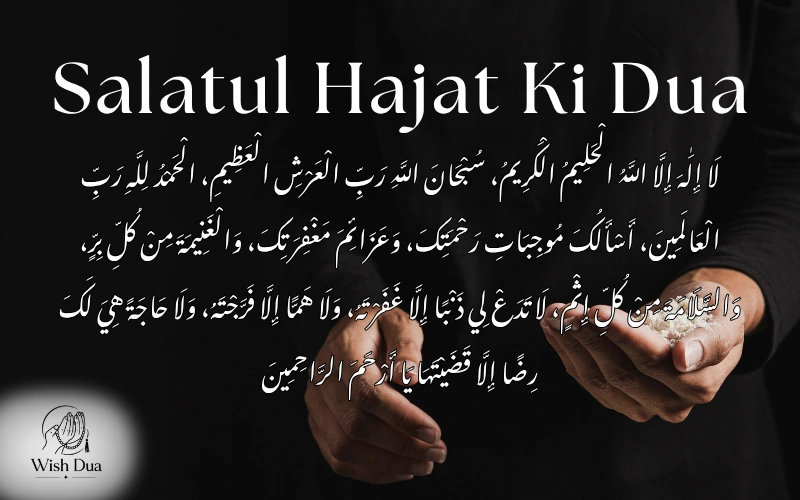
لَا إِلَٰهَ إِلَّا اللَّهُ الْحَلِيمُ الْكَرِيمُ، سُبْحَانَ اللَّهِ رَبِّ الْعَرْشِ الْعَظِيمِ، الْحَمْدُ لِلَّهِ رَبِّ الْعَالَمِينَ، أَسْأَلُكَ مُوجِبَاتِ رَحْمَتِكَ، وَعَزَائِمَ مَغْفِرَتِكَ، وَالْغَنِيمَةَ مِنْ كُلِّ بِرٍّ، وَالسَّلَامَةَ مِنْ كُلِّ إِثْمٍ، لَا تَدَعْ لِي ذَنْبًا إِلَّا غَفَرْتَهُ، وَلَا هَمًّا إِلَّا فَرَّجْتَهُ، وَلَا حَاجَةً هِيَ لَكَ رِضًا إِلَّا قَضَيْتَهَا يَا أَرْحَمَ الرَّاحِمِينَ
Salatul Hajat Ki Dua in Roman English (Transliteration)
This is the Salatul Hajat ki dua Roman English version most searched for by people who can’t read Arabic script:
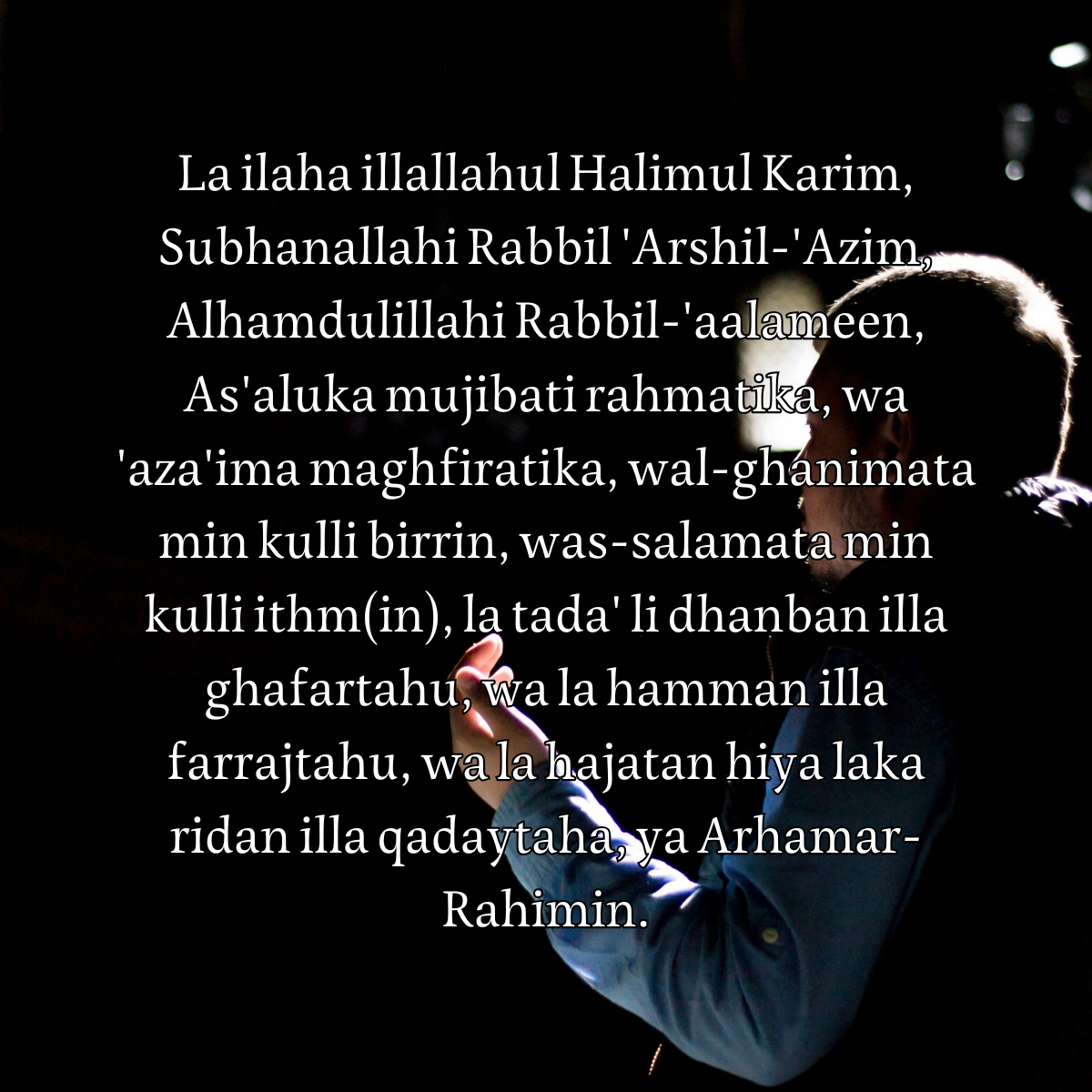
La ilaha illallahul Halimul Karim, Subhanallahi Rabbil ‘Arshil-‘Azim, Alhamdulillahi Rabbil-‘aalameen, As’aluka mujibati rahmatika, wa ‘aza’ima maghfiratika, wal-ghanimata min kulli birrin, was-salamata min kulli ithm(in), la tada’ li dhanban illa ghafartahu, wa la hamman illa farrajtahu, wa la hajatan hiya laka ridan illa qadaytaha, ya Arhamar-Rahimin.
Pro tip from experience: Read it slowly in 4 short breaths (breaking at the commas above) rather than rushing it in one breath. Most people mispronounce “mujibati” and “maghfiratika” because they read it too fast — slowing down fixes both the pronunciation and the sincerity of the dua.
Salatul Hajat Ki Dua in Hindi (हिंदी में)
Salatul Hajat ki dua Hindi mein:
ला इलाहा इल्लल्लाहुल हलीमुल करीम, सुब्हानल्लाहि रब्बिल अर्शिल अज़ीम, अल्हम्दु लिल्लाहि रब्बिल आलमीन, अस्अलुका मूजिबाति रहमतिका, व अज़ाइम मग़फिरतिका, वल-ग़नीमता मिन कुल्लि बिर्रिन, वस-सलामता मिन कुल्लि इस्मिन, ला तदअ़ ली ज़म्बन इल्ला ग़फ़र्तहु, व ला हम्मन इल्ला फ़र्रज्तहु, व ला हाजतन हिय लका रिजन इल्ला क़ज़ैतहा, या अरहमर राहिमीन।
अल्लाह के सिवा कोई इबादत के लायक नहीं, जो बहुत सहनशील और उदार है। अल्लाह की महिमा हो, जो विशाल सिंहासन का स्वामी है। सारी प्रशंसा अल्लाह के लिए है, जो सारे संसार का पालनहार है। हे अल्लाह! मैं तुझसे वे साधन मांगता हूँ जिनसे तेरी दया प्राप्त हो, वे कार्य जिनसे तेरी क्षमा मिले, हर अच्छे काम में हिस्सा और हर पाप से सुरक्षा। हे दया करने वालों में सबसे अधिक दया करने वाले! मेरे किसी भी पाप को बिना क्षमा किए न छोड़ना, मेरी किसी भी चिंता को दूर किए बिना न छोड़ना, और मेरी किसी भी ऐसी ज़रूरत को—जो तेरी मंज़ूरी के अनुकूल हो—बिना पूरा किए न छोड़ना।
Salatul Hajat Ki Dua With Tarjuma (Translation)
Here is the Salatul Hajat ki dua ka tarjuma in simple English and Hindi, line by line, so the meaning isn’t lost:
| Arabic Line (meaning) | English Tarjuma | Hindi Tarjuma |
|---|---|---|
| La ilaha illallah… | There is none worthy of worship except Allah, the Forbearing, the Generous | अल्लाह के सिवा कोई इबादत के लायक नहीं, वह सहनशील और उदार है |
| Subhanallahi Rabbil Arshil Azim | Glory be to Allah, Lord of the Mighty Throne | अल्लाह पाक है, जो महान अर्श का रब है |
| Alhamdulillahi Rabbil ‘aalameen | All praise is for Allah, Lord of the worlds | सारी तारीफ़ अल्लाह के लिए है, जो सारे जहानों का रब है |
| As’aluka mujibati rahmatika… | I ask You for the means of Your mercy and the resolve of Your forgiveness | मैं तुझसे तेरी रहमत के सबब और तेरी मग़फ़िरत की पुख़्तगी माँगता हूँ |
| Wal-ghanimata min kulli birrin | And the gain of every good deed | और हर नेकी का फ़ायदा माँगता हूँ |
| Was-salamata min kulli ithmin | And safety from every sin | और हर गुनाह से सलामती माँगता हूँ |
| La tada’ li dhanban illa ghafartahu | Leave none of my sins without forgiving it | कोई गुनाह ऐसा न छोड़ जिसे तूने माफ़ न किया हो |
| Wa la hamman illa farrajtahu | And no worry without relieving it | और कोई परेशानी ऐसी न छोड़ जिसे तूने दूर न किया हो |
| Wa la hajatan hiya laka ridan illa qadaytaha | And no need that pleases You without fulfilling it | और कोई ज़रूरत जो तुझे पसंद हो, उसे पूरा कर |
| Ya Arhamar Rahimin | O Most Merciful of those who show mercy | ऐ रहम करने वालों में सबसे ज़्यादा रहम करने वाले |
Namaz Salatul Hajat ki dua is essentially a request for three things stacked together: forgiveness of sin, relief from worry, and fulfillment of a genuine need — in that exact order. That order is deliberate: Islamic scholars note that Salatul Hajat isn’t just “ask and get” — it starts with tawbah (seeking forgiveness) before the actual request, because a clean slate is considered a condition for a request to be accepted with full sincerity.
Salatul Hajat Ki Dua Ka Tarika (Method / Step-by-Step)
This is the Salatul Hajat ki dua ka tarika — the exact method, structured as a checklist you can follow tonight:
Step-by-Step Framework (The “W.A.I.T.” Method)
I use this simple framework when teaching people the method, because it’s easy to remember:
- W — Wudu: Perform a complete, unhurried wudu (ablution).
- A — Adaa (Perform): Pray two rakats of nafl prayer with the intention (niyyah) of Salatul Hajat.
- I — Istighfar & Durood: After the prayer, praise Allah, then send blessings (durood) upon Prophet Muhammad ﷺ.
- T — Talab (The Ask): Recite the Salatul Hajat ki dua, then ask Allah for your specific need in your own words, in any language.
Detailed Steps
| Step | Action | Why It Matters |
|---|---|---|
| 1 | Make wudu properly | A rushed wudu reflects a rushed intention |
| 2 | Pray 2 rakats of nafl | Surah Al-Fatiha + any surah in each rakat (many read Ayat-ul-Kursi in 1st, Surah Ikhlas in 2nd) |
| 3 | Sit after Salam | Don’t rush to stand up immediately |
| 4 | Send Durood on the Prophet ﷺ | Hadith scholars note dua is more likely accepted when it opens and closes with durood |
| 5 | Recite the Salatul Hajat dua | Use the Arabic or transliteration above |
| 6 | State your need clearly | Whisper your actual need — health, marriage, job, debt, guidance — in plain words |
| 7 | Close with Durood again | “Sandwiching” the dua between two duruds is a well-known Sunnah practice |
Salatul Hajat Ki Dua Kab Padhna Chahiye (Best Time to Read It)
People frequently ask Salatul Hajat ki dua kab padhna chahiye — when exactly should it be recited? Based on classical fiqh guidance:
- Best time: The last third of the night (before Fajr), similar to Tahajjud — this is when dua acceptance is considered strongest according to hadith on the “descent” of divine mercy in the last third of the night.
- Also valid: Any time outside the makrooh (disliked) hours — right after sunrise, at zenith (solar noon), and right before sunset are the three windows to avoid for nafl prayers.
- In genuine urgency: Scholars agree there’s flexibility — if a need is pressing during permissible daytime hours, it can be prayed then too.
Quick comparison — when it’s most effective vs. merely permissible:
| Time Window | Status | Why |
|---|---|---|
| Last third of night | Most recommended | Matches the time of greatest dua acceptance |
| After Isha, before sleeping | Strongly recommended | Practical for most people’s schedules |
| Daytime (non-makrooh hours) | Permissible | Valid if genuinely urgent |
| Sunrise / Zenith / Sunset | Avoid | Classified as makrooh times for nafl prayer |
A Real Example (Mini Case Study)
A common scenario I’ve seen discussed repeatedly in community Q&A settings: a person facing a stalled job application prays Salatul Hajat for seven consecutive nights, each time reciting the dua and specifically naming the job outcome they’re hoping for, alongside continuing to send applications and follow up professionally.
The lesson here isn’t “dua replaces effort.” It’s the opposite — Salatul Hajat is traditionally paired with continued real-world action (dua and sabab, meaning “means”). Scholars are consistent on this point: relying on dua alone while abandoning practical effort misunderstands how dua functions in Islamic teaching. The dua addresses the outcome; the effort addresses the means.

Common Mistakes People Make
- Skipping wudu or rushing it — the physical preparation is part of the sincerity.
- Reading the dua without praying the two rakats first — the dua is meant to follow the prayer, not replace it.
- Mispronouncing key words (“mujibati,” “maghfiratika”) without checking transliteration.
- Treating it as a one-time transaction — repeating it over multiple nights is normal and encouraged, not a sign of “weak faith.”
- Not stating the actual need in plain words — the fixed Arabic dua is a framework; personal supplication in your own language after it is equally important.
- Abandoning practical effort — assuming the dua alone will resolve a matter without any accompanying action.
A Note on Authenticity
Honest scholarship requires disclosing this: the hadith describing this specific wording (narrated by Abdullah ibn Abi Awfa, recorded in Sunan al-Tirmidhi and Sunan Ibn Majah) has been graded differently by hadith scholars — some classical and contemporary muhaddithin (including Imam al-Tirmidhi himself) noted it as “gharib” (a rare, single-chain narration), while others, including later scholars, accepted it as suitable for practice (hasan) in matters of virtue (fada’il al-a’mal). Most Islamic scholars across schools of thought still recommend practicing Salatul Hajat because the underlying concept — praying two rakats and then supplicating sincerely for a need — is well supported independently by general Quranic and hadith principles on dua and salah.
This is worth knowing so you approach the practice with informed conviction, not blind repetition.
Key Takeaways
- Salatul Hajat ki dua is recited after two rakats of voluntary prayer performed when you have an urgent need.
- The dua is available in Arabic, Hindi, Urdu, and Roman English — all covered above with full tarjuma.
- Best read in the last third of the night, though any non-makrooh time works in genuine urgency.
- Use the W.A.I.T. framework: Wudu → Adaa (prayer) → Istighfar & Durood → Talab (ask).
- Pair the dua with real-world effort — Salatul Hajat supports action, it doesn’t substitute for it.
- The hadith source is authentic in chain-of-transmission terms but scholars differ on its grading; practice is still widely recommended.
Short Summary
Salatul Hajat is a two-rakat voluntary prayer followed by a specific dua asking Allah for forgiveness, relief from worry, and fulfillment of a genuine need. This guide gave you the Arabic text, Hindi and Roman English transliteration, full tarjuma, the correct step-by-step method (tarika), the best time to pray it, common mistakes to avoid, and an honest note on the hadith’s authenticity — everything needed to perform it correctly in 2026.
Frequently Asked Questions (FAQs)
1. What is Salatul Hajat ki dua and when should it be recited?
Salatul Hajat ki dua is the supplication recited after completing two rakats of nafl prayer, ideally in the last third of the night, when a person has an urgent personal need they want to ask Allah for directly.
2. Can I read Salatul Hajat ki dua in Hindi instead of Arabic?
Yes — while the Arabic wording carries the exact hadith text, reading the Hindi tarjuma (translation) alongside it, or making your personal request in Hindi after the Arabic dua, is fully acceptable and often recommended for understanding what you’re asking.
3. Is there a fixed number of times to repeat Salatul Hajat ki dua?
No fixed number exists in the hadith. Many people repeat it for several consecutive nights until their need is resolved or they feel at peace, since repetition itself is not discouraged in Islamic practice.
4. Does Salatul Hajat ki dua guarantee my need will be fulfilled?
No dua guarantees a specific worldly outcome — Islamic teaching holds that Allah answers dua in one of three ways: granting it directly, delaying it to a better time, or replacing it with something better. Salatul Hajat is a means of sincere asking, not a transaction with a guaranteed result.
5. What is the correct Salatul Hajat ki dua ka tarika for beginners?
Beginners should follow the W.A.I.T. method: make wudu, pray two rakats with the Hajat intention, send durood on the Prophet ﷺ, then recite the dua and state the specific need clearly, ideally closing with durood again.
Thank You for Reading Salatul Hajat ki dua!
Also Read:
Also check out “The Powerful Dua” for more such powerful duas.
Disclaimer: This article is intended as general religious guidance based on classical hadith sources. For rulings specific to your situation, consult a qualified local scholar (alim) or mufti.