Last Update: 3 August 2026
Dua e Masura is a short forgiveness-seeking prayer, taught by Prophet Muhammad (peace be upon him) himself, that many Muslims recite in Namaz right after Durood Ibrahim and just before making Salam.
That’s the one-line answer. Now let’s slow down and actually unpack it, because this little dua has a big, beautiful story behind it — and a whole lot of confusion online about what it is, where it comes from, and when to say it.
Quick Facts About Dua e Masura
| Detail | Information |
|---|---|
| Meaning of “Masura” | Narrated, reported, or transmitted (from an authentic saying of the Prophet) |
| Source | Hadith — Sahih al-Bukhari (834, 6326), Sahih Muslim (2705), Riyad as-Salihin (1475) |
| Narrated by | Abu Bakr As-Siddiq (RA), the first Caliph of Islam |
| Recited during | Final sitting (Qa’dah Akhirah) of Namaz, after Durood Ibrahim, before Salam |
| Status | Sunnah (recommended), not compulsory |
| Approx. length | 6 short phrases, easy to memorise in a few days |
| Available in | Arabic, Hindi, Urdu, English, Roman English, Bangla, Gujarati |
What Is Dua e Masura?
So, what is Dua e Masura, really? In simple words, it’s a masnoon (Prophetically-taught) dua — meaning the exact wording didn’t come from a scholar, a book, or a guess. It came straight from the Prophet’s own mouth, in response to a very human, very relatable request.
Here’s the story: Abu Bakr (RA), who later became the first Caliph, once asked the Prophet (peace be upon him) to teach him something to say inside his own Namaz. Not a long speech. Not a fancy poem. Just something honest he could say to Allah, from himself, in his own prayer. And the Prophet gave him exactly that — a short, humble admission that he had wronged himself, followed by a direct plea for forgiveness and mercy.
That’s the heart of Dua e Masura: it’s not decoration. It’s a real conversation with Allah, tucked quietly at the end of your prayer.
Dua e Masura Meaning
The Dua e Masura meaning is simple and deeply personal. In plain English, it says:
“O Allah, I have wronged myself greatly, and none forgives sins except You. So forgive me with forgiveness from Yourself, and have mercy on me. Indeed, You are the Forgiving, the Merciful.”
Notice there’s no blame, no excuses, no “but.” Just an honest admission and a sincere ask. That’s exactly why it’s stayed popular for over 1,400 years.
Dua e Masura in Arabic
Here is Dua e Masura in Arabic, exactly as recorded in the hadith:
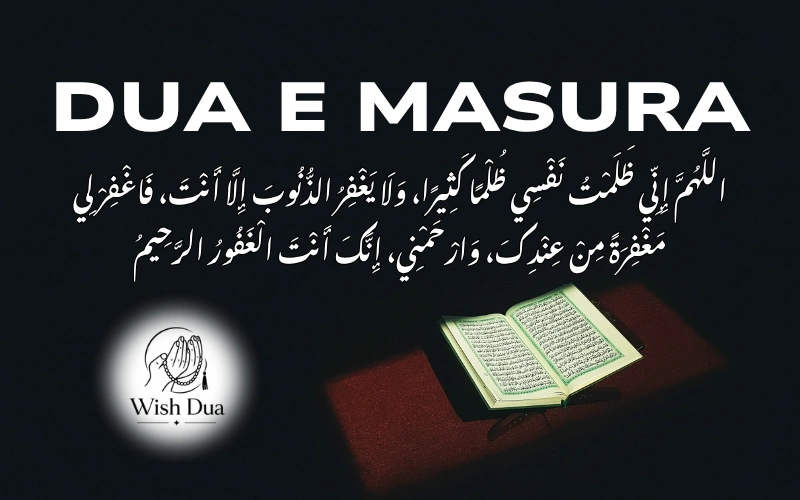
اللَّهُمَّ إِنِّي ظَلَمْتُ نَفْسِي ظُلْمًا كَثِيرًا، وَلَا يَغْفِرُ الذُّنُوبَ إِلَّا أَنْتَ، فَاغْفِرْ لِي مَغْفِرَةً مِنْ عِنْدِكَ، وَارْحَمْنِي، إِنَّكَ أَنْتَ الْغَفُورُ الرَّحِيمُ
If Arabic script feels new to you, don’t worry — most people learn it in Roman English first and move to Arabic once the sound feels familiar.
Dua e Masura in Roman English (Transliteration)
For anyone who can’t yet read Arabic script, Dua e Masura in Roman English looks like this:
“Allahumma inni zalamtu nafsi zulman kathiran, wa la yaghfirudh-dhunuba illa anta, faghfir li maghfiratan min ‘indika, warhamni, innaka antal-Ghafur-ur-Rahim.”
Read it slowly a few times a day, and your tongue picks up the rhythm faster than you’d expect.
Dua e Masura in English (With Tarjuma)
Want the full Dua e Masura with Tarjuma, line by line? Here’s the breakdown:
| Arabic phrase (Roman) | Tarjuma (word-for-word meaning) |
|---|---|
| Allahumma inni zalamtu nafsi zulman kathiran | O Allah, I have wronged myself greatly |
| Wa la yaghfirudh-dhunuba illa anta | And none forgives sins except You |
| Faghfir li maghfiratan min ‘indika | So forgive me with forgiveness from Yourself |
| Warhamni | And have mercy on me |
| Innaka antal-Ghafur-ur-Rahim | Indeed, You are the Forgiving, the Merciful |
This is essentially the Dua e Masura Ka Tarjuma that most Namaz booklets print underneath the Arabic — short, clear, and easy to explain to a child.
Dua e Masura in Hindi (Hindi Mein)
For readers who prefer Dua e Masura in Hindi, here is the Dua e Masura Hindi Mein transliteration:
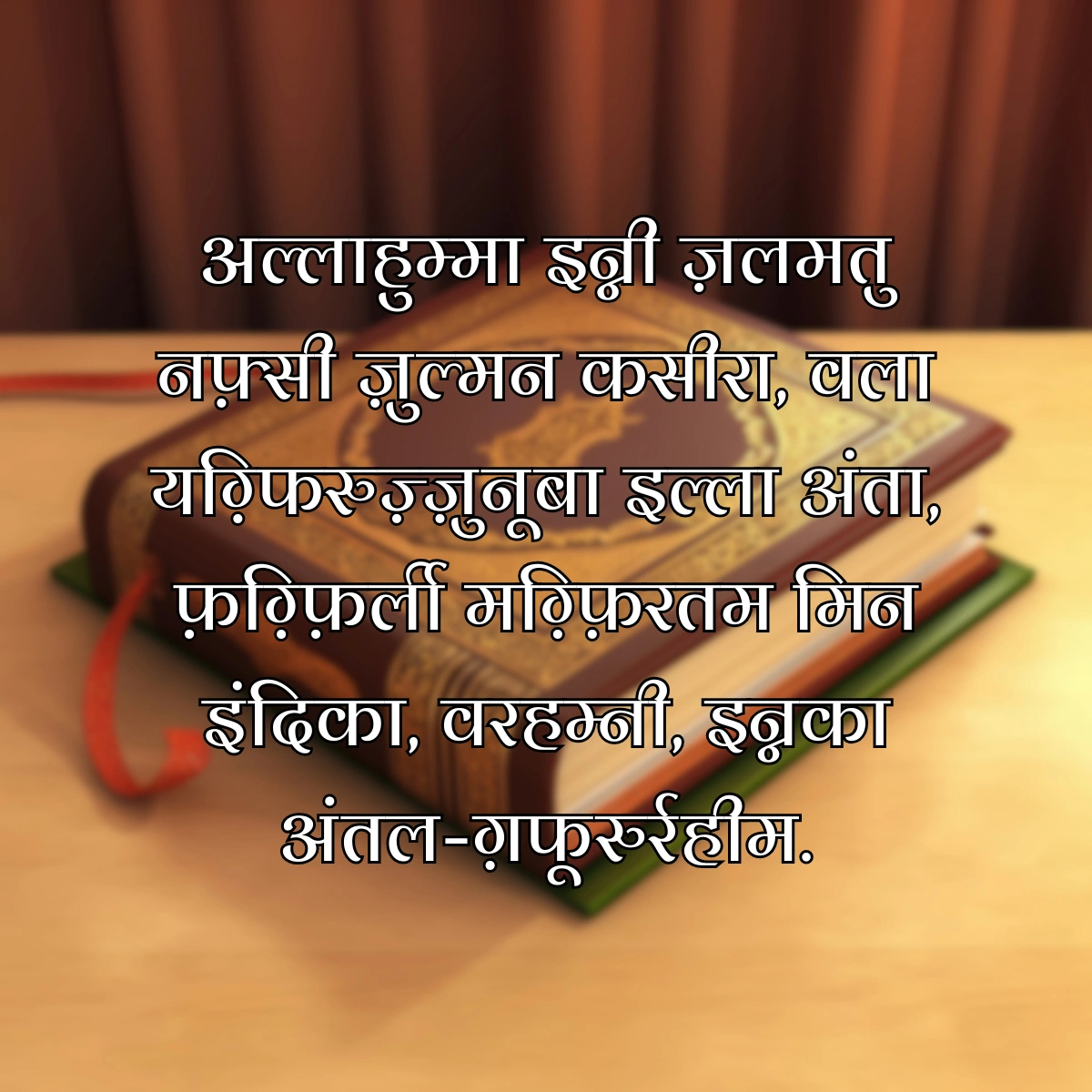
अल्लाहुम्मा इन्नी ज़लमतु नफ़्सी ज़ुल्मन कसीरा, वला यग़्फिरुज़्ज़ुनूबा इल्ला अंता, फ़ग़्फ़िर्ली मग़्फ़िरतम मिन इंदिका, वरहम्नी, इन्नका अंतल-ग़फूरुर्रहीम.
Meaning in Hindi: ऐ अल्लाह! मैंने अपनी जान पर बहुत ज़ुल्म किया है, और तेरे सिवा कोई गुनाह माफ़ नहीं करता। तू अपनी तरफ़ से मुझे बख़्श दे और मुझ पर रहम फ़रमा, बेशक तू ही बख़्शने वाला, रहम करने वाला है।
Dua e Masura in Urdu
The Dua e Masura in Urdu script reads exactly like the Arabic above, since Urdu commonly keeps the Arabic script for duas:
اللّٰہُمَّ اِنِّی ظَلَمْتُ نَفْسِی ظُلْمًا کَثِیرًا، وَلَا یَغْفِرُ الذُّنُوبَ اِلَّا اَنْتَ، فَاغْفِرْ لِی مَغْفِرَۃً مِّنْ عِنْدِکَ، وَارْحَمْنِی، اِنَّکَ اَنْتَ الْغَفُوْرُ الرَّحِیْمُ
The meaning stays the same as the English tarjuma shared above.
Dua e Masura in Bangla and Gujarati
Many readers also search for Dua e Masura Bangla and Dua e Masura in Gujarati versions. Both are simply transliterations of the same Arabic words into local script, so the pronunciation stays close to Arabic while the script changes to match the reader’s own language. Local Namaz booklets in Bangladesh and Gujarat typically print the Arabic on top, with the Bangla or Gujarati transliteration and meaning right underneath — the same layout used above for Hindi and Urdu.
Language Comparison Table
| Language | What You’ll Find |
|---|---|
| Arabic | Original hadith wording |
| Roman English | Easy-to-read transliteration |
| English | Full meaning/translation |
| Hindi | Devanagari transliteration + meaning |
| Urdu | Arabic-script version + meaning |
| Bangla / Gujarati | Local-script transliteration |
Dua e Masura in Namaz: When to Read It
This is probably the number one question people ask: when to read Dua e Masura in Namaz? Here’s the honest, simple timeline of the last sitting (Qa’dah):
- You finish At-Tahiyyat (Tashahhud).
- You recite Durood Ibrahim (sending blessings on the Prophet).
- Right after that — and this is the moment — you recite Dua e Masura.
- Then you turn your head right and left to make Salam, ending the prayer.
So, in short: Dua e Masura Kab Padhi Jati Hai? Right between Durood Ibrahim and Salam, in the final sitting of any prayer that has one (like the 2nd rakah of Fajr, or the last rakah of Zuhr, Asr, Maghrib, and Isha).
If you’re wondering when do we recite Dua e Masura in Namaz for witr prayer specifically, some traditions also include it there, right at the same final-sitting stage — [Verify: check your local maslak’s Witr method with a scholar, as small regional differences exist].
How Many Dua e Masura Are There?
Here’s where a lot of articles get a little sloppy, so let’s be straight about it. How many Dua e Masura are there, exactly? There isn’t one single “official” fixed number written anywhere. What actually happens is this:
- The most widely taught version — the one covered in this article — is the Abu Bakr (RA) dua from Sahih al-Bukhari and Sahih Muslim.
- Some regional Namaz booklets list two or three alternative short duas as options for the same spot, depending on local teaching tradition.
- The Prophet himself also permitted praying “whatever comes to your heart” at this point, in your own words, in addition to the masnoon wording — [Verify: confirm this specific allowance with a hadith scholar, as wording of the permission varies by narration].
So when people ask about how many types of Dua e Masura exist, the honest answer is: there’s one primary, most-taught version, and a small handful of regionally-taught alternatives — not a large official list.
Dua e Masura in Which Para? (Clearing the Confusion)
A surprisingly common search is Dua e Masura in which Para — and here’s the plain truth: it isn’t in any Para at all, because it isn’t from the Quran. It’s from Hadith (a recorded saying of the Prophet), not from the Quranic text, so it has no Surah or Para reference. This mix-up likely happens because people assume anything recited during Namaz must come from the Quran — but plenty of what we say in prayer, including Durood and this dua, comes from the Sunnah instead.
Dua e Masura PDF and Saving It for Practice
Looking for a Dua e Masura PDF? The simplest option is to save this article as a PDF directly from your browser’s print menu, or ask your local Islamic center or mosque for their printed Namaz booklet — most include Dua e Masura with Tarjuma in large, easy-to-read print for beginners and children.
Common Mistakes to Avoid
| Mistake | Why It’s a Problem | Simple Fix |
|---|---|---|
| Skipping it entirely | It’s Sunnah, so your prayer is still valid, but you miss real reward | Try adding it once you’re comfortable with Tashahhud |
| Reciting it before Durood Ibrahim | Wrong order compared to how it’s taught | Always: Tashahhud → Durood → Dua e Masura → Salam |
| Rushing the words | Loses the reflective, sincere feel of the dua | Slow down, even if it takes a few extra seconds |
| Assuming it’s from the Quran | Leads to the “which Para” confusion | Remember: it’s from Hadith, not Quran |
Conclusion
Dua e Masura is one of those small, quiet parts of Namaz that carries a lot of meaning once you actually understand it. It’s a short, sincere plea for forgiveness, taught word-for-word by the Prophet (peace be upon him) to Abu Bakr (RA), recited after Durood Ibrahim and before Salam. It isn’t from the Quran, it isn’t compulsory, and there isn’t one giant official list of versions — just one well-known, well-documented dua that’s easy to learn in Arabic, Roman English, Hindi, Urdu, Bangla, or Gujarati, whichever feels most comfortable to you. Once you’ve practiced the Dua e Masura a few times, it becomes second nature — a small, honest conversation with Allah at the close of every prayer.
FAQs
1. What is Dua e Masura?
It’s a short forgiveness dua taught by the Prophet Muhammad (peace be upon him) to Abu Bakr (RA), recited near the end of Namaz.
2. When to read Dua e Masura?
Right after Durood Ibrahim and just before Salam, in the final sitting of your prayer.
3. How many Dua e Masura are there?
There’s one primary, widely-taught version from Sahih al-Bukhari and Sahih Muslim, with a few regionally-taught alternatives depending on local tradition.
4. Is Dua e Masura compulsory in Namaz?
No, it’s Sunnah (recommended), so your Namaz remains valid even without it — but reciting it is considered rewarding.
5. Dua e Masura in which Para?
It isn’t in any Para, because it’s from Hadith, not from the Quran.
6. Can I recite Dua e Masura in English or Hindi instead of Arabic?
For Namaz itself, the Arabic wording is recommended, but learning the English or Hindi meaning first helps you understand and connect with what you’re saying.
7. Where can I find Dua e Masura with Tarjuma in one place?
This article includes the Arabic, Roman English, English tarjuma, Hindi, and Urdu versions together, along with a downloadable-friendly layout you can print or save as a PDF.
Thank you so much for reading!
Also Read:
Also check out “The Powerful Dua” for more such powerful duas.