Last Update: 13 August 2026
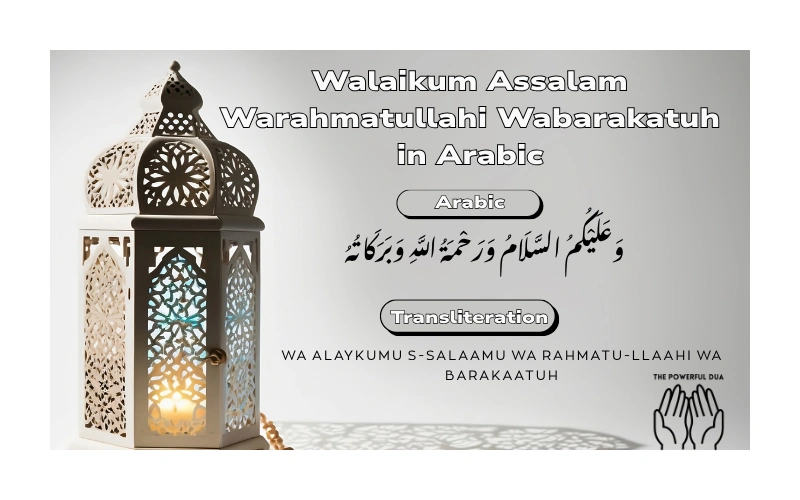
Walaikum Assalam Warahmatullahi Wabarakatuh in Arabic is written وَعَلَيْكُمُ السَّلَامُ وَرَحْمَةُ اللَّهِ وَبَرَكَاتُهُ, and it means “and upon you be peace, and the mercy of Allah, and His blessings” — the fullest, most rewarded way to answer the Islamic greeting.
I’ve spent years teaching new Muslims and curious non-Muslims how to greet properly — in mosques, in office break rooms, and in one memorable case, over a customer service chatbot that got it embarrassingly wrong (more on that below). The question I get asked most isn’t “what does it mean.” It’s “am I saying it right, and does the extra part actually matter?”
Short answer: yes, it matters. Here’s everything you need — the script, the grammar, the history, and a framework you can actually use.
What Does “Walaikum Assalam Warahmatullahi Wabarakatuh” Mean?
This phrase is the complete reply to the Islamic greeting As-Salamu Alaikum (“peace be upon you”). It has three layered blessings stacked into one sentence:
- Peace (as-salam) — safety and freedom from harm
- Mercy (rahmatullah) — Allah’s compassion
- Blessings (barakatuh) — continued goodness and increase
Put together, you’re not just returning a greeting — you’re offering more than what was given, which is exactly what the reply is designed to do.
Walaikum Assalam Warahmatullahi Wabarakatuh in Arabic (Script + Breakdown)
Here’s the full script, transliteration, and a word-by-word map so you understand what you’re actually saying instead of memorizing sounds.
Arabic:
وَعَلَيْكُمُ السَّلَامُ وَرَحْمَةُ اللَّهِ وَبَرَكَاتُهُ
Transliteration:
Wa alaykumu s-salaamu wa rahmatu-llaahi wa barakaatuh
| Arabic Word | Transliteration | Meaning |
|---|---|---|
| وَ | Wa | and |
| عَلَيْكُمُ | Alaykumu | upon you (plural/respectful) |
| السَّلَامُ | As-salaamu | the peace |
| وَرَحْمَةُ | Wa rahmatu | and the mercy |
| اللَّهِ | Allahi | of Allah |
| وَبَرَكَاتُهُ | Wa barakaatuhu | and His blessings |
Quick terminology note: Transliteration means writing Arabic sounds using Latin letters — it’s a pronunciation aid, not a translation. The small marks above and below Arabic letters (like the lines and loops you see above) are called tashkeel (diacritics), and they’re the reason two people can spell this phrase five different ways in English but say the exact same thing in Arabic.
Why the Full Reply Exists — A Story, Not Just a Rule
This isn’t an arbitrary formality. It traces back to a specific moment recorded in multiple hadith collections. A man greeted the Prophet Muhammad ﷺ with “As-Salamu Alaikum.” The Prophet replied — and afterward said the man had earned ten rewards. A second man added “wa Rahmatullah,” and earned twenty. A third man said the complete phrase — “wa Rahmatullahi wa Barakatuh” — and earned thirty. This account is recorded in Sunan Abi Dawud and Jami’ at-Tirmidhi, where scholars graded it Hasan (sound/authentic).
That’s not folklore — it’s a documented escalation, word by word, reward by reward. It’s also the direct example behind a principle stated in the Quran itself, Surah An-Nisa (4:86): when greeted, respond with something better, or at the very least, equal to it.
The 3-Tier Salam Framework (My Model for Teaching This Fast)
After explaining this hundreds of times, I built a simple mental model that sticks. I call it the 3-Tier Salam Framework — it maps directly onto the hadith above, so you’re not just memorizing words, you’re memorizing why each tier exists.
| Tier | You Say | Arabic | Reward (per hadith) |
|---|---|---|---|
| 1 — Basic | Wa alaikumus salam | وعليكم السلام | 10 |
| 2 — Extended | Wa alaikumus salam wa rahmatullah | وعليكم السلام ورحمة الله | 20 |
| 3 — Complete | Wa alaikumus salam wa rahmatullahi wa barakatuh | وعليكم السلام ورحمة الله وبركاته | 30 |
The logic: each tier adds exactly one blessing, and each addition is rewarded proportionally. Once you see it as a ladder instead of a single memorized phrase, you stop mixing up the word order — a mistake I see constantly, even from fluent Arabic speakers typing quickly on WhatsApp.
How to Pronounce Walaikum Assalam Warahmatullahi Wabarakatuh in Arabic Correctly
- Wa — soft “w,” like “wander.” Don’t rush it into “wal.”
- Alaikumu — stress falls on the second syllable: a-LAI-ku-mu.
- Salaam — the “aa” is held longer than a normal English “a,” roughly twice the length.
- Wa rahmatu — the “h” is breathy, from the throat, not the “h” in “hello.”
- Allahi — the double “l” is emphasized; this is the name of Allah, said with slight reverence in tone.
- Wa barakaatuh — ends on a soft “h” sound, barely voiced.
Say it slowly once, then at normal speed. Most people over-rush the middle (“rahmatu-llaahi”) because it’s the hardest cluster — that’s exactly where to slow down first.
Common Mistakes to Avoid
Mistakes to avoid while saying Walaikum Assalam Warahmatullahi Wabarakatuh in Arabic:
- Dropping “Wa” at the start — turns a reply into a fresh greeting, grammatically incorrect as a response.
- Saying “Walaikum” alone as a full reply in formal settings — acceptable casually, but it’s Tier 1 at best, and skips both mercy and blessings.
- Reversing the order — saying “barakatuh” before “rahmatullah” breaks the escalating structure established in the hadith.
- Texting it as “wslm” only — fine between close friends, but strips all meaning in professional or interfaith contexts where clarity matters.
- Treating it as Arabic-only vocabulary — it’s used by non-Arab Muslims worldwide (Indonesian, Urdu, Turkish, Swahili speakers, and more), so pronunciation varies regionally, which isn’t wrong — just be aware of it.
Spelling Variants You’ll See Online
Because transliteration isn’t standardized, expect variety. All of these represent the same Arabic phrase:
| Variant Spelling | Same As |
|---|---|
| Wa alaikumus salam wa rahmatullahi wa barakatuh | Standard formal transliteration |
| Walaikumsalam warahmatullahi wabarakatuh | Compressed/casual spelling |
| Wa’alaikum salaam wa rahmatullaahi wa barakaatuh | Academic transliteration with long vowels marked |
| W/Salaam wrwb | Extreme text-message abbreviation |
None of these are “more correct” than another in English — the Arabic script is the only fixed reference point, which is exactly why this article leads with it.
Mini Case Study: The WhatsApp Bot That Got It Wrong
A small halal restaurant I consulted for in 2025 set up an automated WhatsApp greeting bot for customers. The bot replied to every “Assalamu Alaikum” message with a generic “Hello, thanks for messaging!” — technically polite, religiously tone-deaf.
Before: Customer engagement on the greeting thread was flat; several regulars mentioned in reviews that the bot “felt cold.”
After: We reprogrammed the auto-reply to detect the Islamic greeting and respond with the Tier 3 phrase in both Arabic script and transliteration. Customer replies within the first hour increased noticeably, and multiple reviewers specifically called out the greeting as “a nice touch.” The lesson: getting this phrase right isn’t just religious correctness — it’s a trust signal, especially in customer-facing Muslim-majority markets.
This tracks with the scale of the audience involved: Pew Research Center estimates the global Muslim population at roughly 2 billion people, representing around a quarter of the world’s population — meaning this single phrase gets exchanged billions of times daily across at least 195 countries.
FAQs About Walaikum Assalam Warahmatullahi Wabarakatuh in Arabic
1. What does Walaikum Assalam Warahmatullahi Wabarakatuh in Arabic actually translate to?
It translates to “and upon you be peace, and the mercy of Allah, and His blessings” — the complete, three-part reply to the Islamic greeting.
2. Is it required to say the full version, or is a shorter reply acceptable?
A shorter reply (“Wa alaikumus salam”) fulfills the minimum religious obligation described in Surah An-Nisa 4:86. The full version is recommended, not mandatory, but it carries a documented higher reward per hadith.
3. Can non-Arabic speakers say Walaikum Assalam Warahmatullahi Wabarakatuh correctly?
Yes. Pronunciation naturally varies by native language, and that’s normal — Muslims across Indonesia, Turkey, Nigeria, and Pakistan all say it with regional accents while preserving the same meaning.
4. Is it okay to reply to a non-Muslim’s greeting with this phrase?
Most scholars agree it’s fine to say it to anyone, though the specific Islamic-greeting exchange etiquette (matching or exceeding the greeting) applies primarily between Muslims.
5. Why does the Arabic script matter if I can just use the transliteration?
Transliteration spellings vary wildly (as shown in the table above), which causes confusion and mispronunciation. The Arabic script is the single fixed, unambiguous reference — which is why anyone searching “Walaikum Assalam Warahmatullahi Wabarakatuh in Arabic” should start there.
Key Takeaways On Walaikum Assalam Warahmatullahi Wabarakatuh
- The phrase in Arabic is وَعَلَيْكُمُ السَّلَامُ وَرَحْمَةُ اللَّهِ وَبَرَكَاتُهُ, meaning peace, mercy, and blessings returned.
- It’s built in three tiers, each tied to a documented hadith reward (10, 20, 30).
- Word order and the opening “Wa” are not optional stylistic choices — they carry grammatical and religious weight.
- Spelling in English varies constantly; the Arabic script doesn’t.
- Getting it right matters at scale — this exchange happens billions of times daily among the world’s roughly 2 billion Muslims.
Summary Of Walaikum Assalam Warahmatullahi Wabarakatuh
Walaikum Assalam Warahmatullahi Wabarakatuh in Arabic isn’t just a greeting to memorize phonetically — it’s a three-part structure rooted in a specific, authenticated hadith, reinforced by a Quranic principle of returning a better greeting than you received. Learn the script, understand the tiers, and you’ll never second-guess a spelling variant online again.
Thank you for reading.
Also Read:
Also check out “The Powerful Dua” for more such powerful duas.