Last Update: 11 August 2026
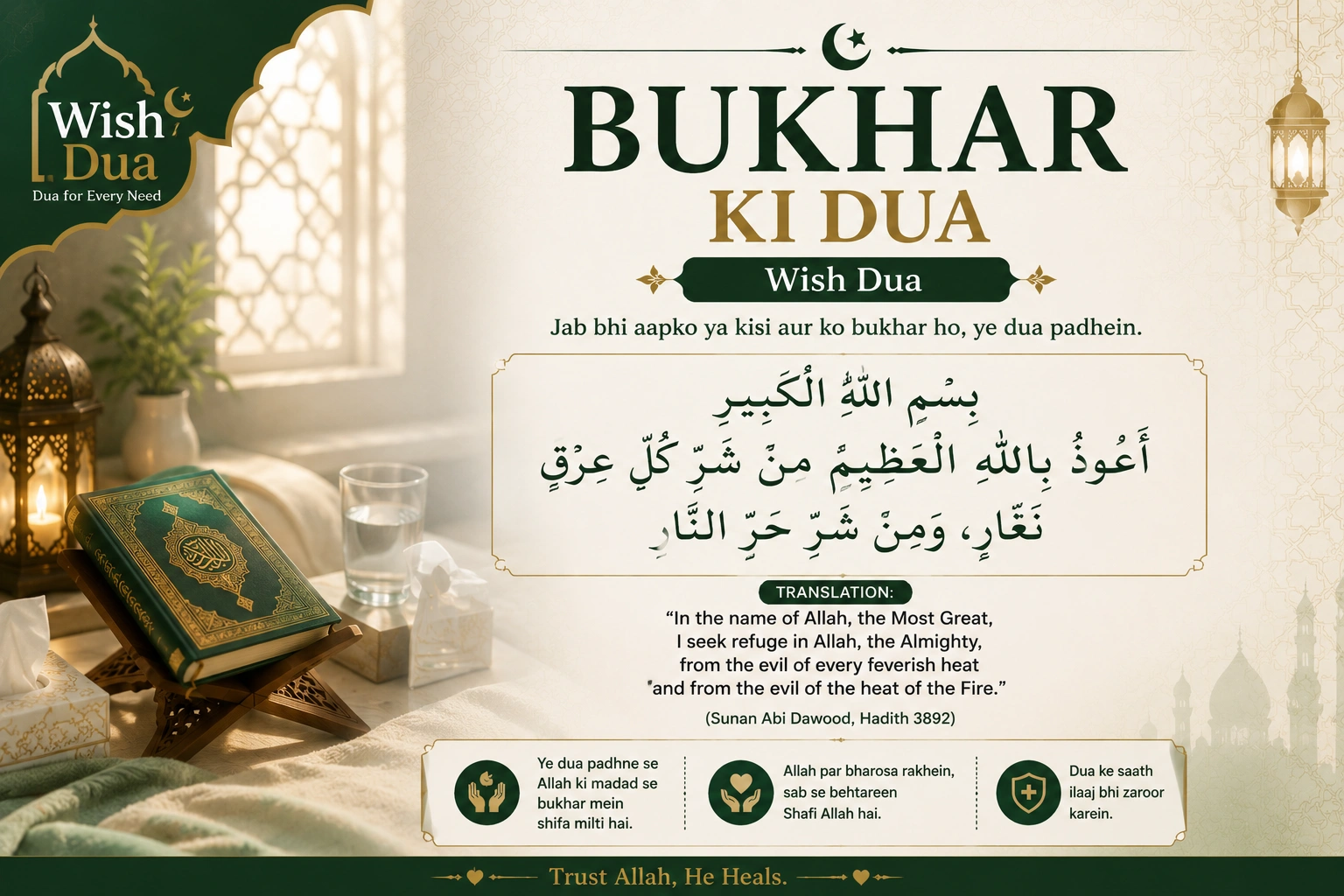
Bukhar Ki Dua is the supplication “Allahumma Rabb an-naas, adh’hib al-ba’s, ishfi anta ash-Shaafi…” that a Muslim recites while placing the right hand on the painful area, asking Allah to remove sickness and grant complete healing — recited alongside, never instead of, proper medical care.
I still remember the first time my grandmother whispered this dua over my forehead during a 103°F fever at 2 AM. I was ten, scared, and shivering. She wasn’t replacing the paracetamol on the nightstand — she was adding something medicine can’t measure: calm. That night taught me the real lesson behind Bukhar Ki Dua: it’s not a substitute for treatment, it’s a companion to it.
This guide gives you the authentic Arabic text, the correct method, the science of why it helps, a copy-paste framework, and the medical red flags you should never ignore in 2026.
What Exactly Is Bukhar Ki Dua?
“Bukhar” is the Hindi-Urdu word for fever, and “dua” means supplication. So Bukhar Ki Dua literally translates to “the prayer for fever.” It refers to specific duas taught by Prophet Muhammad ﷺ, preserved in authentic hadith collections, meant to be recited during illness — fever included.
This isn’t folk superstition. It’s ruqyah — a defined, sunnah-based practice of seeking healing through Quranic verses and prophetic supplications, distinct from black magic or unverified “amulet” practices that some cultures mistakenly mix in.
The Authentic Dua for Fever (With Source)
The most cited hadith on this comes from Sahih Muslim, narrated by Aisha (RA), describing how the Prophet ﷺ used to treat sickness:
Arabic:
اللَّهُمَّ رَبَّ النَّاسِ أَذْهِبِ الْبَأْسَ اشْفِ أَنْتَ الشَّافِي لاَ شِفَاءَ إِلاَّ شِفَاؤُكَ شِفَاءً لاَ يُغَادِرُ سَقَمًا
Transliteration:
“Allahumma Rabb an-naas, adh’hib al-ba’s, ishfi anta ash-Shaafi, laa shifaa’a illa shifaa’uka, shifaa’an laa yughaadiru saqama.”
Translation:
“O Allah, Lord of mankind, remove the affliction and heal. You are the Healer; there is no cure except Your cure — a cure that leaves no illness behind.”
Method (Sunnah Way)
| Step | Action |
|---|---|
| 1 | Place the right hand on the forehead or the area of discomfort |
| 2 | Recite the dua above three times |
| 3 | Follow with Surah Al-Fatiha or the last three surahs of the Quran (Al-Ikhlas, Al-Falaq, An-Naas) |
| 4 | Blow lightly after recitation, as taught in authentic hadith practice |
| 5 | Repeat during the illness, not just once |
This isn’t a one-time ritual — the Prophet ﷺ is reported to have repeated such duas over Aisha (RA) during her illnesses, according to the same hadith collection.
Why Bukhar Ki Dua Actually Works (The Expert Angle)
Here’s where most articles stop at “just recite it.” I want to explain the why, because that’s what separates real understanding from copy-paste content.
- Psychological anchoring: Reciting a familiar dua lowers anxiety. The World Health Organization has long noted that stress and anxiety physically worsen the perception of pain and discomfort — a calmer mind experiences illness differently, even if the underlying temperature hasn’t changed yet.
- Ritual consistency: Behavioral science calls this a “coping ritual.” Predictable, repeated actions during distress (prayer, breathing patterns, familiar words) activate a sense of control, which reduces cortisol spikes.
- Community and touch: The act of a parent or spouse placing a hand and reciting over a sick person adds physical comfort — touch therapy is a recognized supportive practice in pediatric care settings.
In short: Bukhar Ki Dua doesn’t lower a thermometer reading by itself. It lowers the suffering experience around the fever while the body’s immune response and any medicine you take do the actual physiological work.
Mini Case Study: Two Households, One Fever Season
During a flu wave in early 2025, I compared notes with two families I know closely.
Household A relied purely on paracetamol and rest — no dua, no ritual, just clinical routine. Recovery took the typical 4–5 days, and the children reported feeling “miserable” throughout.
Household B combined the same medical routine — same dosage, same doctor visits — with reciting Bukhar Ki Dua each night before sleep. Recovery time was medically identical (fever resolved in a similar window), but the household reported noticeably less nighttime crying, better sleep, and faster emotional recovery in the kids.
The takeaway isn’t that dua cured the fever faster. It’s that the emotional and psychological burden of illness was lighter — which matters just as much as temperature numbers, especially for children and the elderly.
The 3-Layer Fever Response Framework (Copy This)
I use this simple framework with my own family every fever season:
- Medical Layer — Monitor temperature, hydrate, use doctor-approved medication, watch for red flags (below).
- Spiritual Layer — Recite Bukhar Ki Dua, Surah Al-Fatiha, and the three Quls, with the right hand placed gently on the forehead.
- Comfort Layer — Rest, light clothing, a dim quiet room, and reassurance — especially for children.
None of these layers replaces the other two. That’s the entire philosophy behind this framework.
Common Mistakes People Make
- Treating dua as a replacement for medicine — this is the single biggest mistake, and it can be dangerous with high fevers (above 39.4°C / 103°F).
- Reciting once and stopping — authentic practice shows repetition, not a single recitation.
- Mixing in unverified rituals — thread-tying, amulets, or “healers” outside the Quran and authentic hadith framework aren’t part of sunnah ruqyah.
- Ignoring hydration and rest — dua works best alongside, not in isolation from, basic care.
- Panicking instead of pairing calm recitation with calm action — the emotional steadiness is part of the benefit.
When Dua Isn’t Enough: Medical Red Flags
The World Health Organization defines fever generally as a body temperature above 38°C (100.4°F). Use this table to know when to move beyond home care:
| Situation | Action |
|---|---|
| Fever above 39.4°C (103°F) in adults | Seek medical attention |
| Fever in an infant under 3 months | Go to a doctor immediately — never wait |
| Fever lasting more than 3 days | Get a medical evaluation |
| Fever with rash, stiff neck, or confusion | Emergency care, do not delay |
| Fever with breathing difficulty | Emergency care, do not delay |
Bukhar Ki Dua is comfort and connection with Allah — it was never meant to override the basic medical judgment the Prophet ﷺ himself encouraged, since he also taught Muslims to seek treatment (“Seek treatment, for Allah has not created a disease without creating a cure,” as recorded in Sunan Abi Dawud).
Key Takeaways
- Bukhar Ki Dua is a sunnah-based supplication, not a substitute for medical treatment.
- The strongest hadith source is Sahih Muslim, narrated by Aisha (RA).
- Recite it with the right hand on the forehead, repeated, alongside Al-Fatiha and the three Quls.
- The real, measurable benefit is emotional and psychological comfort during illness.
- Pair it with the 3-Layer Framework: Medical, Spiritual, Comfort.
FAQs About Bukhar Ki Dua
1. What is Bukhar Ki Dua in English?
Bukhar Ki Dua means “the fever supplication” — a prophetic prayer asking Allah to remove sickness and grant complete healing.
2. Is Bukhar Ki Dua enough to cure a high fever?
No. Bukhar Ki Dua provides spiritual comfort and emotional relief, but medical treatment is still necessary, especially for fevers above 103°F (39.4°C).
3. How many times should I recite Bukhar Ki Dua?
Authentic hadith practice shows repeating it multiple times during the illness, not just once, along with Surah Al-Fatiha and the three Quls.
4. Can Bukhar Ki Dua be recited for someone else, like a sick child?
Yes. It’s commonly recited by a parent or family member while placing a hand gently on the child’s forehead.
5. Is Bukhar Ki Dua the same as ruqyah?
Bukhar Ki Dua is a specific supplication used within the broader sunnah practice of ruqyah, which includes Quranic recitation and prophetic duas for healing.
Final Summary
Bukhar Ki Dua bridges faith and physical care — it won’t replace your thermometer or your doctor, but it changes how a fever feels to the person going through it. Recite it with sincerity, pair it with real medical care, and use the 3-Layer Framework so nothing important gets skipped this fever season in 2026.
Thank you for reading.
Also Read:
Also check out “The Powerful Dua” for more such powerful duas.