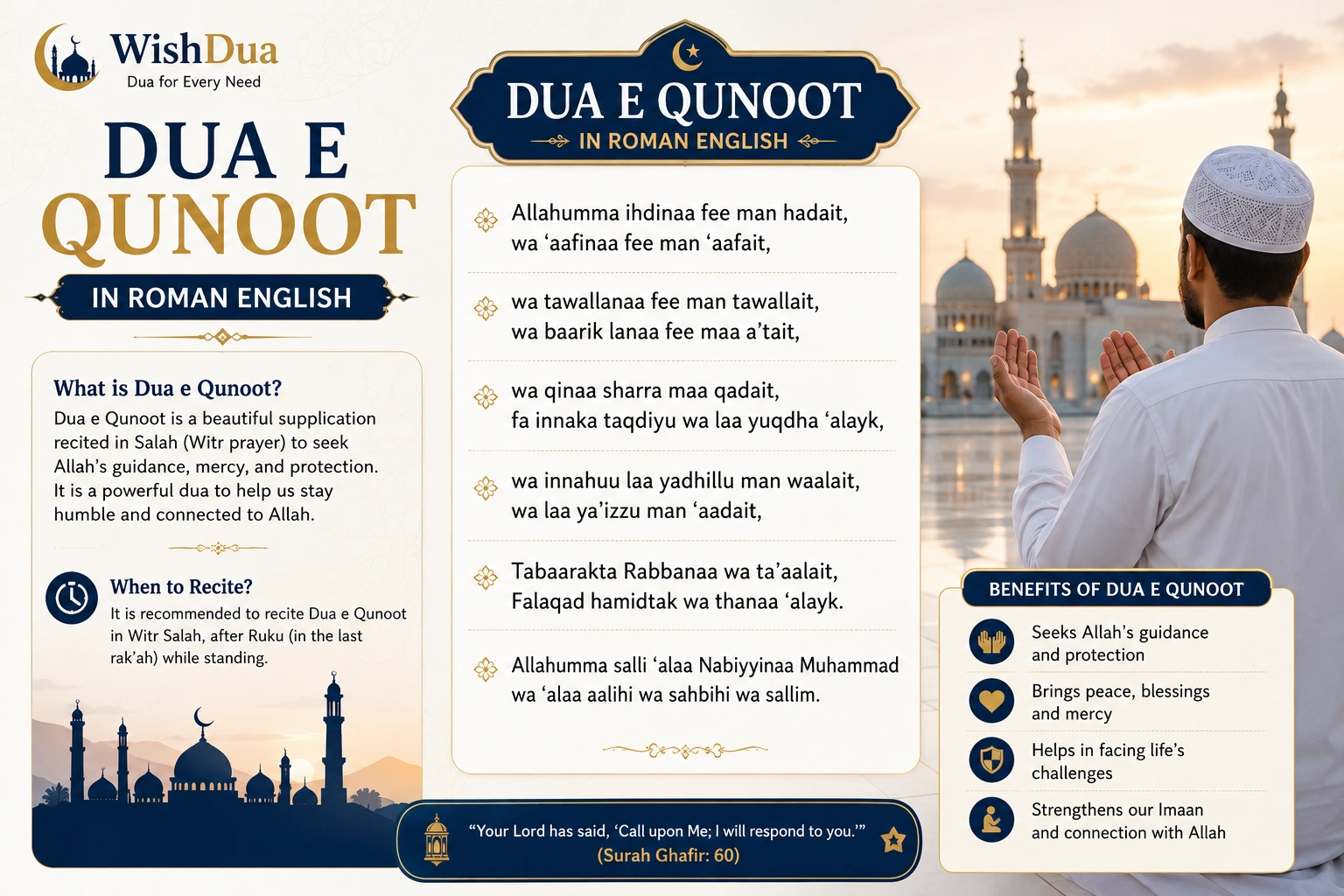
Last Updated: 22 August 2026
Dua e Qunoot in Roman English reads: “Allahumma inna nasta’eenuka wa nastaghfiruka wa nu’minu bika…” — the short supplication Muslims recite while standing in the third rak’ah of Witr prayer, right after reciting Qur’an and just before bowing into ruku.
That’s the direct answer. Now let’s get into the part most guides skip: the why behind every line, the mistakes almost every beginner makes, and a simple method to actually memorize it instead of just reading it off a screen every night.
What Is Dua e Qunoot? (Quick Definition)
Qunoot (قنوت) literally means devout obedience or standing in humble submission. In practice, “Dua e Qunoot” refers to a specific supplication recited standing during prayer — most commonly in Witr salah, the odd-numbered prayer offered after Isha.
It’s short — six sentences — but it packs in praise, gratitude, repentance, and a plea for mercy in a way few other daily duas do. That density is exactly why it’s worth learning properly instead of mumbling through it.
When Do You Recite Dua e Qunoot in Roman English?
Timing depends on which school of Islamic jurisprudence (madhab) you follow. Here’s the breakdown:
| Madhab | When Qunoot Is Recited | Status |
|---|---|---|
| Hanafi | Every night, 3rd rak’ah of Witr, after Qira’ah, before ruku | Wajib (obligatory) |
| Shafi’i | Fajr prayer year-round; Witr only in the last half of Ramadan | Sunnah mu’akkadah |
| Maliki | Generally not in Witr; optional in Fajr for some scholars | Recommended (varies) |
| Hanbali | Witr, especially the last ten nights of Ramadan | Sunnah |
Why this matters: if you learned this dua from a friend who follows a different madhab, don’t panic if your practice looks slightly different from theirs. Both can be correct — they’re just following different, equally valid scholarly traditions.
Full Dua e Qunoot in Roman English (Transliteration)
Here’s the complete Dua e Qunoot in Roman English, broken into two halves for easier memorization:
Allahumma inna nasta’eenuka wa nastaghfiruka wa nu’minu bika wa natawakkalu ‘alaika wa nuthni ‘alaikal khair wa nashkuruka wa la nakfuruka wa nakhla’u wa natruku man yafjuruk.
Allahumma iyyaka na’budu wa laka nusalli wa nasjudu wa ilaika nas’aa wa nahfidu wa narjoo rahmataka wa nakhshaa ‘adhabaka inna ‘adhabaka bil kuffari mulhiq.
Dua e Qunoot Meaning: Phrase-by-Phrase Breakdown
| Roman English Phrase | Meaning |
|---|---|
| Allahumma inna nasta’eenuka | O Allah, we seek Your help |
| wa nastaghfiruka | and we seek Your forgiveness |
| wa nu’minu bika | and we believe in You |
| wa natawakkalu ‘alaika | and we place our trust in You |
| wa nuthni ‘alaikal khair | and we praise You in the best manner |
| wa nashkuruka wa la nakfuruka | we thank You and do not disbelieve in You |
| wa nakhla’u wa natruku man yafjuruk | we disown and abandon whoever disobeys You |
| iyyaka na’budu wa laka nusalli wa nasjudu | You alone we worship, to You we pray and prostrate |
| wa ilaika nas’aa wa nahfidu | to You we hasten and strive to serve |
| wa narjoo rahmataka wa nakhshaa ‘adhabaka | we hope for Your mercy and fear Your punishment |
| inna ‘adhabaka bil kuffari mulhiq | Your punishment will surely reach the disbelievers |
Full English translation:
“O Allah, we seek Your help, seek Your forgiveness, and believe in You. We trust in You, we praise You in the best way, and we thank You. We do not disbelieve in You, and we forsake and turn away from whoever disobeys You. O Allah, You alone we worship, and to You we pray and prostrate. To You we hasten to serve, and we hope for Your mercy and fear Your punishment. Indeed, Your punishment will surely overtake the disbelievers.”
Where Does This Dua Come From?
This isn’t a modern composition — the wording traces back to a hadith narrated by Al-Hasan ibn Ali, the grandson of the Prophet Muhammad ﷺ, who reported that he was taught these exact words to recite in Witr. The narration appears across multiple classical hadith collections, including Sunan Abu Dawud and Jami’ at-Tirmidhi, with minor wording variations between chains.
That lineage is part of why the dua feels different from a typical memorized prayer — you’re reciting words with a documented chain going back roughly 1,400 years, not a generic modern translation.
A quick example worth sitting with: picture someone who’s prayed Witr for years but only ever recited Qunoot in Arabic script, phonetically, without ever checking the meaning. The moment they finally see the translation — “we disown whoever disobeys You” — the dua stops being a memorized sound and starts being a sentence they mean. That shift, from recitation to comprehension, is the entire point of learning it in Roman English first.
The 3-R Framework: How to Actually Memorize It
Most people try to memorize Dua e Qunoot in Roman English by repeating the whole thing on loop and hoping it sticks. It rarely does. A better approach — the one that actually works for short Arabic supplications — is what I’d call the 3-R Method:
- Read — Read the full transliteration slowly, out loud, five times, focusing only on pronunciation. Don’t try to memorize yet.
- Repeat in chunks — Split it into the two halves shown above. Memorize Part 1 completely before touching Part 2. Six short phrases are far easier to retain than one long block.
- Recite from memory, then check — Try reciting without looking, then immediately check against the text. Fix only the phrase you got wrong, not the whole dua.
Most people who follow this get both halves solid within 3–5 days of five-minute daily practice — far faster than brute-force repetition.
Common Mistakes to Avoid In Dua e Qunoot in Roman English
- Rushing the “kh” and “dh” sounds — treating khair like “care” or adhabaka like “adabaka” changes the meaning slightly and the pronunciation noticeably.
- Skipping Part 2 because Part 1 is longer — both halves are roughly equal in religious weight; don’t neglect the second one.
- Reciting without raising the hands — in the Hanafi tradition, Qunoot is recited with hands raised as in regular dua, not folded as in normal salah posture.
- Learning only the Arabic script and never the meaning — this is the single biggest gap between reciting and actually understanding.
- Assuming one madhab’s timing applies to everyone — as the table above shows, this isn’t universal.
Quick Checklist Before You Pray Witr
I can recite Part 1 from memory without hesitation
I can recite Part 2 from memory without hesitation
I know when my madhab recites it (see table above)
I understand what each phrase means, not just the sound
I raise my hands for Qunoot per Hanafi practice (if applicable)
FAQs About Dua e Qunoot in Roman English
1. What is Dua e Qunoot in Roman English?
It’s the transliterated (non-Arabic-script) version of the Qunoot supplication, written using Latin letters so non-Arabic readers can pronounce it accurately — starting with “Allahumma inna nasta’eenuka…”
2. Is Dua e Qunoot in Roman English the same as reciting it in Arabic?
The meaning and pronunciation guide are the same; Roman English is simply a phonetic aid for reading, not a substitute for eventually learning the Arabic script if possible.
3. Do I have to recite Dua e Qunoot in every Witr prayer?
This depends on your madhab. Hanafis recite it every night in Witr; Shafi’is and Hanbalis generally limit it mostly to Ramadan or Fajr, per the table above.
4. Can I recite Dua e Qunoot in Roman English if I don’t know Arabic script yet?
Yes — many teachers recommend starting with a reliable Roman English transliteration precisely so beginners can recite correctly while they continue learning to read Arabic script.
5. What happens if I forget Dua e Qunoot mid-prayer?
In most schools of thought, you can substitute any other short dua or a phrase like “Rabbana atina fid-dunya hasanah” if you forget the exact wording, rather than stopping the prayer.
Key Takeaways On Dua e Qunoot in Roman English
- Dua e Qunoot in Roman English begins with “Allahumma inna nasta’eenuka…” and is recited in Witr prayer.
- Timing and obligation status vary by madhab — Hanafi treats it as wajib every night; others limit it mostly to Ramadan or Fajr.
- The dua traces back to an authentic hadith via Al-Hasan ibn Ali, recorded in Abu Dawud and Tirmidhi.
- The 3-R Method (Read, Repeat in chunks, Recite-then-check) memorizes it faster than blind repetition.
- Understanding the meaning, not just the sound, is what turns recitation into genuine supplication.
Summary Of Dua e Qunoot in Roman English
Dua e Qunoot in Roman English is a short, historically rooted supplication recited in Witr prayer — six sentences that move from seeking help and forgiveness to declaring worship and hoping for mercy. Whether you follow it nightly like the Hanafi tradition or mainly during Ramadan, the goal is the same: recite it accurately, understand it fully, and let the words mean something every time you pray.
Thank you for reading Dua e Qunoot in Roman English!
Also Read:
Also check out “The Powerful Dua” for more such powerful duas.