Last updated: August 25, 2026
Dua e Ganjul Arsh is a popular devotional supplication — its name means “the treasure of the Throne” — that many South Asian Muslims recite for provision, protection, and peace of mind, though scholars note its exact wording is not traced to the Quran or a verified authentic hadith.
Quick Facts Table
| Detail | Information |
|---|---|
| Name meaning | “Treasure/Prayer of the Throne” |
| Popular tradition | Said to have been taught by Angel Jibril to Prophet Muhammad ﷺ |
| Scholarly authentication | Not traced to Quran or a verified hadith chain; treated by many scholars as an unverified/weak narration |
| Core content | Names and attributes of Allah, request for forgiveness, relief from worry (hamm), and provision |
| Common languages sought | Arabic, Dua E Ganjul Arsh in Hindi, Dua E Ganjul Arsh in English, Roman English |
| Typical recitation time | After Fajr or Isha prayer |
| Popularity | Widely shared across South Asia via booklets, PDFs, and devotional websites |
Dua e Ganjul Arsh — Opening Lines (Arabic, Transliteration & Translation)
Here are the verified opening lines, consistent across multiple published versions, so you can start reciting Dua e Ganjul Arsh correctly right away:
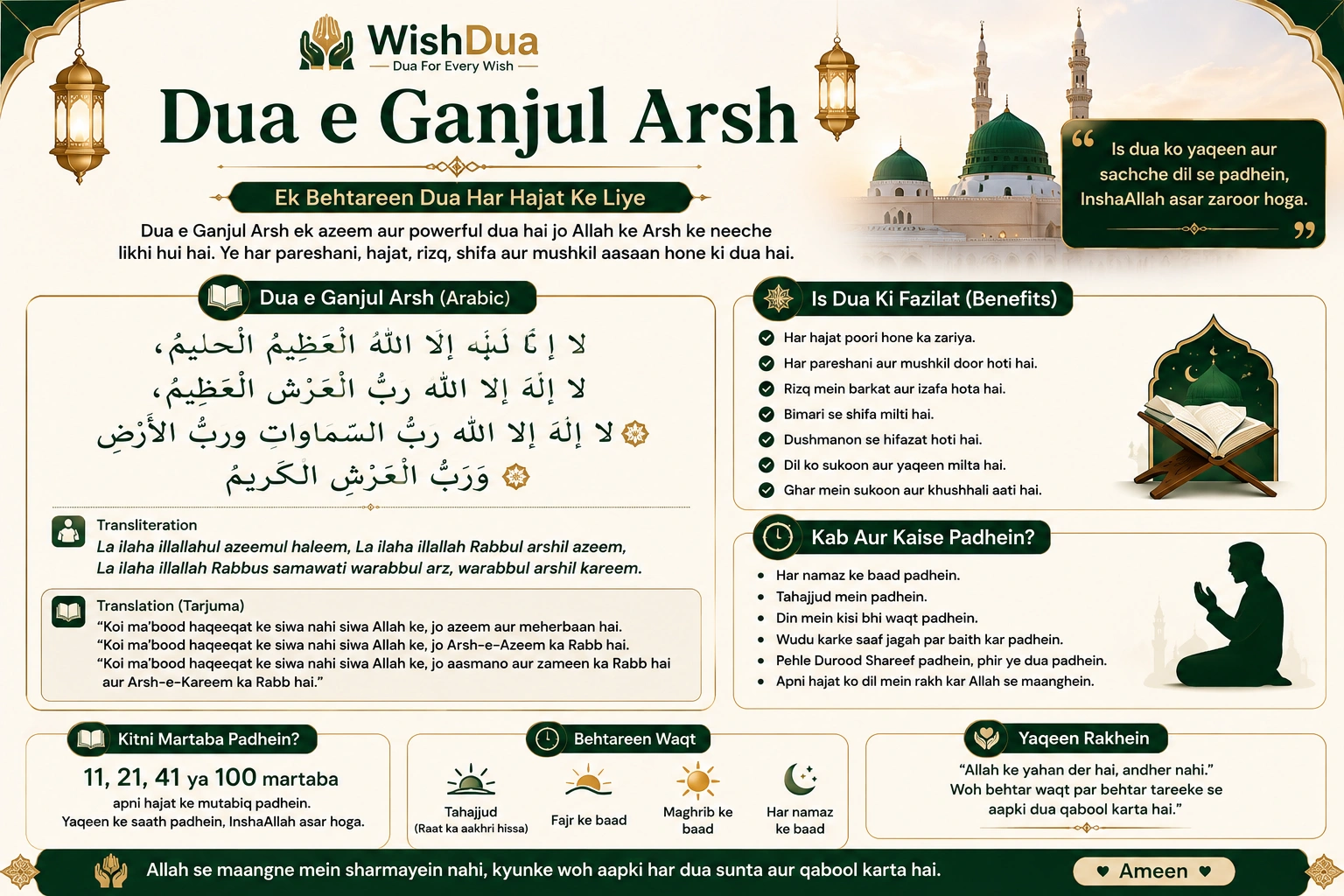
Dua E Ganjul Arsh in Arabic –
بِسْمِ اللّٰهِ الرَّحْمٰنِ الرَّحِيمِ
لَا إِلٰهَ إِلَّا اللّٰهُ سُبْحَانَ الْمَلِكِ الْقُدُّوسِ
لَا إِلٰهَ إِلَّا اللّٰهُ سُبْحَانَ الْعَزِيزِ الْجَبَّارِ
Transliteration –
Bismillahir Rahmanir Raheem
La ilaha illallahu, Subhanal Maalikil Quddus
La ilaha illallahu, Subhanal Azeezil Jabbar
Translation –
In the Name of Allah, the Most Gracious, the Most Merciful
There is none worthy of worship but Allah — Glory be to the Sovereign, the Most Pure
There is none worthy of worship but Allah — Glory be to the Almighty, the Compeller
From here, the dua continues in the same rhythm — “La ilaha illallah, Subhana [one of Allah’s names]” — repeated across roughly 99 phrases, before closing with Durood (blessings) on the Prophet ﷺ. Full wording differs slightly between publishers, so for the complete text, use a booklet or app checked by a local scholar rather than the first search result — see the “What Does It Actually Say” and “In Hindi, English & Roman English” sections below for more on this.
What Is Dua e Ganjul Arsh?
Let’s start simple. Dua e Ganjul Arsh is a long supplication built almost entirely from the beautiful names of Allah — the kind of prayer that doesn’t ask “give me this” in a direct way, but instead calls on God’s qualities: the Ever-Living, the Self-Sustaining, the All-Aware. In devotional literature, it’s introduced as Complete Full Dua E Ganjul Arsh, meaning the whole set of phrases recited together as one prayer, rather than a single short line.
People search for Dua E Ganjul Arsh PDF and Dua E Ganjul Arsh Full PDF because it’s usually shared as a printed booklet — often with the Arabic text, a transliteration, and a translation side by side, so a reader can pronounce it correctly without knowing Arabic script.
Where Does Dua e Ganjul Arsh Come From?
Here’s where honesty matters most, and it’s the part many articles skip.
In popular devotional stories, Dua e Ganjul Arsh is described as a gift from Angel Jibril (Gabriel) to Prophet Muhammad ﷺ while he sat with his companions. It’s a lovely story, and it’s part of why the prayer has been copied, printed, and shared for generations across South Asia.
But when Islamic researchers have gone looking for this exact wording in the Quran or the major, checked hadith collections (like those of Bukhari or Muslim), they haven’t found it there. Several scholarship platforms have specifically flagged Dua e Ganjul Arsh as a narration whose chain cannot be verified — sometimes described as weak, sometimes as unauthenticated folk tradition. (This is a statement that needs independent verification from a qualified scholar before you treat it as settled — we’re flagging it here rather than presenting it as our own final judgment.)
That doesn’t mean reciting it is forbidden, and it doesn’t make anyone sinful for doing so. It simply means the specific guaranteed outcomes often attached to it — like promised wealth or a promised cure — aren’t backed by the same level of evidence as, say, reciting Surah Al-Fatiha or an authentic hadith-based dua.
What Does Dua e Ganjul Arsh Actually Say?
Rather than reproducing a full line-by-line Arabic and English text here (translations vary between booklets, and getting even one word wrong in a sacred phrase is a real risk), it’s more useful to explain the shape of the prayer.
Dua e Ganjul Arsh, as commonly printed, moves through a few recognisable sections:
- Praise of Allah’s names — including “Ya Hayyu Ya Qayyum” (O Ever-Living, O Self-Sustaining), a phrase whose meaning is directly rooted in the Quran.
- A request for forgiveness — asking Allah to forgive sins, big and small.
- A request for relief — asking for hamm (worry), ghamm (sorrow), and karb (distress) to be lifted.
- A request for provision — asking for rizq (sustenance) from sources the person could never have expected, a hope that echoes the general Quranic promise in Surah At-Talaq (65:3) that Allah provides for those who rely on Him.
- Salawat (Durood) — sending blessings on the Prophet ﷺ, which is itself always a well-established, encouraged act regardless of the rest of the prayer’s status.
Where to See the Arabic Text
You’ll find the verified opening lines — Arabic script, transliteration, and translation — near the top of this article, right after the Quick Facts table. I’ve deliberately stopped at those opening lines rather than typing out all 99 phrases: the full wording differs slightly from one publisher’s booklet to the next, and a sacred text is exactly the wrong place for me to guess at the remaining lines from search snippets. For the exact Dua E Ganjul Arsh in Roman English or Dua E Ganjul Arsh Hindi wording, it’s best to use a booklet or app that has been checked by a local scholar, since transliteration errors change pronunciation and, sometimes, meaning.
Benefits People Associate With Dua e Ganjul Arsh
These are traditional beliefs, not scientifically or religiously “proven” outcomes — we’re listing them because they’re exactly what people are searching for, and because understanding why something is popular is part of understanding it honestly.
| Believed Benefit | What People Say |
|---|---|
| Provision from unexpected sources | Recited by those hoping for financial relief |
| Protection from harm | Seen as a shield against difficulty or ill intention |
| Relief from worry and sorrow | Recited for peace of mind during hard times |
| Help with health concerns | Some recite it alongside dua for the sick, not instead of treatment |
| Success in a search for work | Paired with genuine job-hunting effort, not as a substitute for it |
| Closeness to Allah | Valued simply for the act of praising His names |
This is often summarised online as the Dua E Ganjul Arsh Benefits, and it’s the single most-searched angle on the topic — which is exactly why the authenticity note above matters so much.
How to Recite Dua e Ganjul Arsh
- Make wudu (ablution) — like before any prayer.
- Face the Qibla if possible, though it isn’t a strict requirement for dua.
- Read from a checked source — a booklet, app, or Dua E Ganjul Arsh PDF Download that has translation and transliteration reviewed by someone knowledgeable, not just copied from an unverified website.
- Recite after Fajr or Isha — the most commonly mentioned times in devotional practice.
- Follow it with your own dua, in your own words and language, for whatever you’re going through.
Dua e Ganjul Arsh in Hindi, English & Roman English
This is one of the most common searches — people want the Complete Full Dua E Ganjul Arsh in English or a Hindi version they can read comfortably. A few honest pointers:
- Translations differ slightly between publishers — that’s normal for devotional literature, not a red flag on its own.
- If you want to Dua E Ganjul Arsh Read Online, cross-check the Arabic against more than one source before memorising it.
- We’re not providing a downloadable file here, since the exact wording needs to come from a source your local scholar has reviewed — that’s a safer way to source your Dua E Ganjul Arsh Full Image or printed copy than trusting the first search result.
Frequently Asked Questions
1. What is Dua e Ganjul Arsh?
It’s a popular supplication made up mostly of Allah’s names, requests for forgiveness, relief from worry, and unexpected provision — widely recited in South Asian Muslim communities.
2. Is Dua e Ganjul Arsh in the Quran?
No. Certain individual phrases inside it (like “Ya Hayyu Ya Qayyum”) echo Quranic language, but the dua as a complete, compiled text is not itself a Quranic passage.
3. Is Dua e Ganjul Arsh authentic (sahih)?
Many scholars describe its chain of narration as unverified or weak. This is a point worth confirming with your own local scholar rather than taking any single website’s word for it — including this one.
4. Can I recite Dua e Ganjul Arsh even if it isn’t fully authenticated?
Praising Allah’s names and asking for forgiveness is always encouraged. The caution scholars raise is mainly about treating the specific promised outcomes as guaranteed.
5. Where can I find a reliable Dua E Ganjul Arsh PDF in Hindi?
Look for booklets published by established Islamic publishers or verified by a local alim, rather than the first unverified download link you find.
6. What is the Dua E Ganjul Arsh Transliteration used for?
It helps readers who can’t read Arabic script pronounce the words correctly by spelling the Arabic sounds out in Roman letters.
Conclusion
Dua e Ganjul Arsh has genuinely comforted people for generations — that part is real, whatever its documentation status. What’s also real is that its exact wording isn’t traced to the Quran or a verified hadith, and the specific benefits attached to it are traditional beliefs, not guarantees. The most balanced way to approach the Complete Dua E Ganjul Arsh is with sincerity, a checked translation, and a quick conversation with a local scholar if you want certainty about its status — while never treating it as a replacement for the well-established, authentic duas of the Quran and Sunnah.
Author: Gaurav, Reviewed for accuracy against publicly available Islamic scholarship sources as of August 2026.
Disclaimer: This article is written for general informational purposes only. It is not a religious ruling (fatwa). Matters of authenticity, correct recitation, and religious practice should always be confirmed with a qualified Islamic scholar (alim) or a trusted local mosque. Statements below that are traditional beliefs rather than verified facts are clearly marked as such.
Thank you for reading!
Also Read:
Also check out “The Powerful Dua” for more such powerful duas.