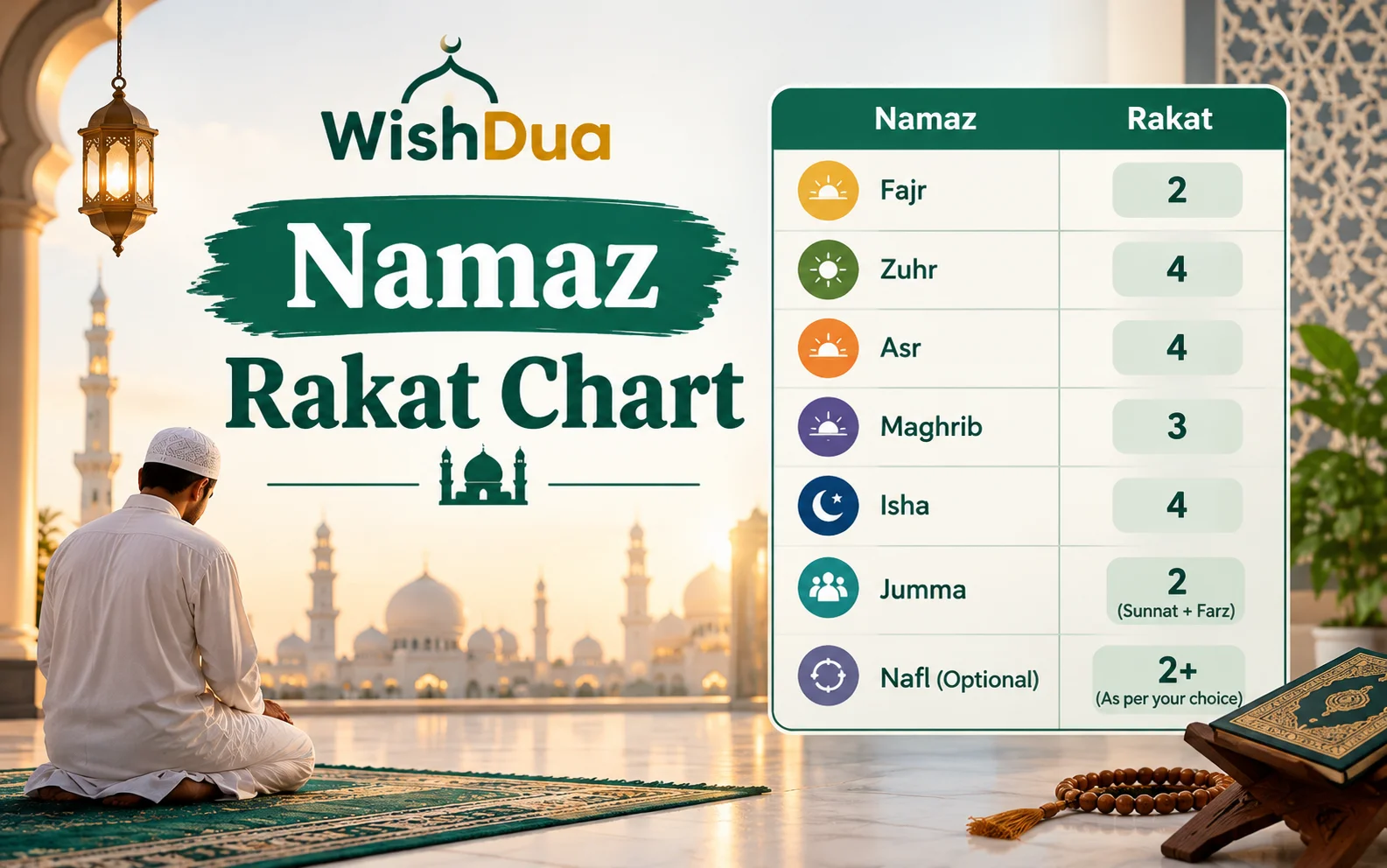
A Sunni (Hanafi) Muslim prays 17 fard rakat a day across five prayers. Add 3 rakat of Witr and 12 rakat of Sunnah Muakkadah, and the core daily total is 32 rakat. The chart below shows how that number is built for each prayer.
Most Namaz rakat charts online mix up fard, wajib, sunnah and nafl in one block of numbers, which is why people end up confused. This article separates them, so namaz rakat chart you can see what is required, what is strongly recommended, and what is optional.
What Is a Rakat?
A rakat is one complete unit of prayer: standing, bowing (ruku), and two prostrations (sajdah). Every prayer is built from these units, and the number of rakat changes by prayer time.
Four terms decide how you read any chart:
- Fard: obligatory. Missing it on purpose is a sin, and it must be made up (Qaza).
- Wajib: required, just below fard in rank. Witr is the main example in the Hanafi school.
- Sunnah Muakkadah: the confirmed practice of the Prophet (peace be upon him), which he almost never left.
- Sunnah Ghair Muakkadah and Nafl: the less emphasised and voluntary rakat. They are rewarded, but there is no blame for leaving them.
5 Time Namaz Rakat Chart (Hanafi)
| Prayer | Sunnah before | Fard | Sunnah after | Witr | Core total |
|---|---|---|---|---|---|
| Fajr (ফজর) | 2 Muakkadah | 2 | None | None | 4 |
| Zuhr (যোহর) | 4 Muakkadah | 4 | 2 Muakkadah | None | 10 |
| Asr (আসর) | 4 Ghair Muakkadah (optional) | 4 | None | None | 4 (8 with Sunnah) |
| Maghrib (মাগরিব) | None | 3 | 2 Muakkadah | None | 5 |
| Isha (এশা) | 4 Ghair Muakkadah (optional) | 4 | 2 Muakkadah | 3 Wajib | 9 (13 with optional Sunnah) |
Core daily total: 17 fard + 3 Witr + 12 Sunnah Muakkadah = 32 rakat.
Many charts also list optional nafl of 2 rakat after Zuhr, after Maghrib, and after Isha, plus 2 more after Witr. Counting every optional rakat gives the total Namaz rakat chart figure of 48 per day. According to an Askimam.org fatwa, that comes to 4 for Fajr, 12 for Zuhr, 8 for Asr, 7 for Maghrib and 17 for Isha. Treat 32 as your daily baseline and the rest as a bonus.
Why Fard Count Is Always 17
Fajr has 2, Zuhr 4, Asr 4, Maghrib 3 and Isha 4. That adds up to 17, and this number is the same in every Sunni school. Only the Sunnah and Witr rakat change between schools.
Namaz Rakat Chart With Time
Rakat count tells you what to pray. Timing tells you when. These windows are the same in every city, but the clock times are not:
| Prayer | Time window |
|---|---|
| Fajr | From true dawn until just before sunrise |
| Zuhr | After the sun passes its highest point until Asr begins |
| Asr | From Asr start until sunset. Hanafi: when an object’s shadow is twice its length. Other schools: once its length |
| Maghrib | From sunset until the red twilight fades |
| Isha | From the end of twilight until Fajr (best before midnight) |
Do not pray nafl at sunrise, at the exact moment the sun is at its zenith, or at sunset. A Hanafi fatwa on Askimam.org also advises no nafl after Fajr until 10 to 15 minutes after sunrise. Use your local mosque timetable or a prayer-times app for exact clock times, since they shift daily.
Witr, the Rakat People Forget
Witr is 3 rakat after Isha. In the Hanafi school it is wajib, so skipping it is a real gap in your daily prayer. You pray all three with one salam, and in the third rakat you recite a surah after Al-Fatiha, then say Takbeer and read Dua Qunut before bowing. Other Sunni schools treat Witr as a strongly recommended Sunnah and allow different counts.
Safar Qasar Namaz Rakat Chart (Travel Prayer)
When you travel, the 4-rakat fard prayers are cut to 2. The Hanafi rule has three parts:
- Distance: a journey of about 48 miles (roughly 77 km) or more counts as travel. Sources such as Jamia Binoria and Tafseer Raheemi give this figure.
- Stay length: if you plan to stay somewhere for less than 15 days, you keep shortening. At 15 days or more, you pray in full.
- Which prayers: only Zuhr, Asr and Isha are shortened. Fajr and Maghrib stay the same, and Witr, Sunnah and nafl are not shortened.
| Prayer | Resident fard | Travel (Qasr) fard |
|---|---|---|
| Fajr | 2 | 2 |
| Zuhr | 4 | 2 |
| Asr | 4 | 2 |
| Maghrib | 3 | 3 |
| Isha | 4 | 2 |
| Total | 17 | 11 |
You still pray Witr (3) while travelling. Scholars say to pray the Sunnah rakat too when you are settled and not in a hurry, and to try never to drop the Fajr Sunnah, even on a journey. Many readers get this wrong by shortening everything, including Maghrib.
Qaza Namaz Rakat Chart (Missed Prayers)
Qaza means making up a prayer whose time has passed. There is no separate chart of rakat. You repeat the same fard count of the prayer you missed.
| Missed prayer | Qaza rakat |
|---|---|
| Fajr | 2 |
| Zuhr | 4 |
| Asr | 4 |
| Maghrib | 3 |
| Isha | 4 |
| Witr | 3 |
| One full day | 20 |
Two points matter in practice:
- Order and state: in the Hanafi view, a prayer missed while travelling is made up as 2 rakat, even if you pray it later at home. A prayer missed at home is made up as 4, even if you pray it later while travelling.
- Fajr Sunnah: if you miss Fajr and make it up before the sun passes its zenith the same day, you can pray the Sunnah with it. After that time, the Sunnah of Fajr is not made up, according to a FatwaCentre.org answer.
For a long backlog, many scholars suggest making a written count and praying a set number of Qaza prayers each day. If you have a large number to repay, ask a local scholar how to plan it.
Tahajjud Namaz Rakat Chart
Tahajjud is the voluntary night prayer, prayed after waking from sleep and best in the last third of the night. It is not the same prayer as Tarawih.
- Minimum: 2 rakat.
- Commonly recommended: 8 rakat, prayed in sets of 2.
- Reported from the Prophet: a Hanafi source on Muftisays.com notes that his night prayer was reported as 7, 9 or 11 rakat including Witr, with the maximum being 13 including Witr.
If you plan to pray Tahajjud, many scholars say you can delay Witr until after it, so Witr closes your night.
Tarabi Namaz Rakat Chart (Tarawih in Ramadan)
Tarawih is prayed after Isha during Ramadan. The count is 20 rakat, prayed as 10 sets of 2 (often grouped as 5 sets of 4 with short rests). A Seekersguidance answer states that 20 is the confirmed Sunnah across all four Sunni schools. Some communities, including many Ahl-e-Hadith, pray 8 plus 3 Witr instead.
Witr is prayed after Tarawih, usually in congregation. If 20 feels like too much, the advice from that same scholar is to shorten the recitation rather than the count.
Namaz Rakat Chart for Women
The rakat count is the same for women. The differences are in other areas:
- Women may pray all five prayers at home, and it is preferred over the mosque in most Hanafi guidance.
- Jumu’ah is not obligatory for women. If they skip it, they pray Zuhr with its normal 4 fard.
- During menstruation and postnatal bleeding, prayer is not required and is not made up afterwards. Fasting, however, is made up.
- Posture differs slightly in some schools, such as keeping the arms closer to the body.
Namaz Rakat Chart for Kids
Namaz Rakat Chart children are not yet obligated to pray, but teaching starts early. A well-known hadith recorded in Abu Dawud advises parents to tell children to pray at age 7 and to be firmer about it by age 10.
A realistic way to start:
- Begin with Fajr and Maghrib. They are the shortest (2 and 3 fard).
- Add one more prayer every week or two.
- Use a wall chart with stickers, so the child can see the rakat count per prayer.
- Teach fard first. Add Sunnah once the routine is stable.
| Age | Suggested goal |
|---|---|
| 4 to 6 | Pray beside you. No rakat count pressure |
| 7 to 9 | Pray the fard of 2 to 3 prayers daily |
| 10 and up | All five fard daily, then Sunnah |
Sunni Schools: Where the Charts Differ
All four Sunni schools agree on 17 fard rakat. The differences appear in the extras:
| Topic | Hanafi | Other Sunni schools (general) |
|---|---|---|
| Witr | 3 rakat, wajib | Sunnah, often 1 to 11 rakat |
| Sunnah before Zuhr | 4 Muakkadah | Often 2, with extra rakat optional |
| Tarawih | 20 | 20 (36 in older Maliki practice) |
| Asr time starts | Shadow twice its length | Shadow once its length |
If your family follows a different school, check with your own scholar, and use this table as a starting point only.
Namaz Rakat Chart PDF: What a Good One Needs
If you want a printable version, make sure it includes:
- The five prayers in time order, with fard, Sunnah and Witr in separate columns
- A line saying which school (madhab) it follows
- A travel column for Qasr
- Space to add local prayer times, since they change by city and date
Common Mistakes to Avoid
- Counting Sunnah as fard. Missing a Sunnah is not the same as missing a fard prayer.
- Shortening Maghrib while travelling. Maghrib stays at 3 fard.
- Forgetting Witr. In Hanafi practice it is wajib.
- Mixing up Tahajjud and Tarawih. They are separate prayers with different times and counts.
- Using a chart from a different school without knowing it. Check the madhab first.
FAQs about Namaz rakat chart
Is the 32 rakat total mandatory?
No. Only the 17 fard (and, in Hanafi practice, the 3 Witr) are required. The 12 Sunnah Muakkadah are strongly recommended.
Can I pray Sunnah while sitting?
Voluntary prayers may be prayed sitting by those with a valid reason, but fard should be prayed standing if you can. See a scholar for your exact situation.
How many rakat are in Jumu’ah?
The Friday congregational prayer replaces Zuhr and has 2 fard. A common Hanafi pattern adds 4 Sunnah before, then 4 and 2 after, for 12 core rakat. Some charts list 14 by adding 2 optional rakat.
How do I remember the chart?
Learn the fard first: 2, 4, 4, 3, 4. Then add Sunnah in the order of Fajr, Zuhr, Maghrib, Isha.
Thank you for reading
Also check out “The Powerful Dua” for more such powerful duas.