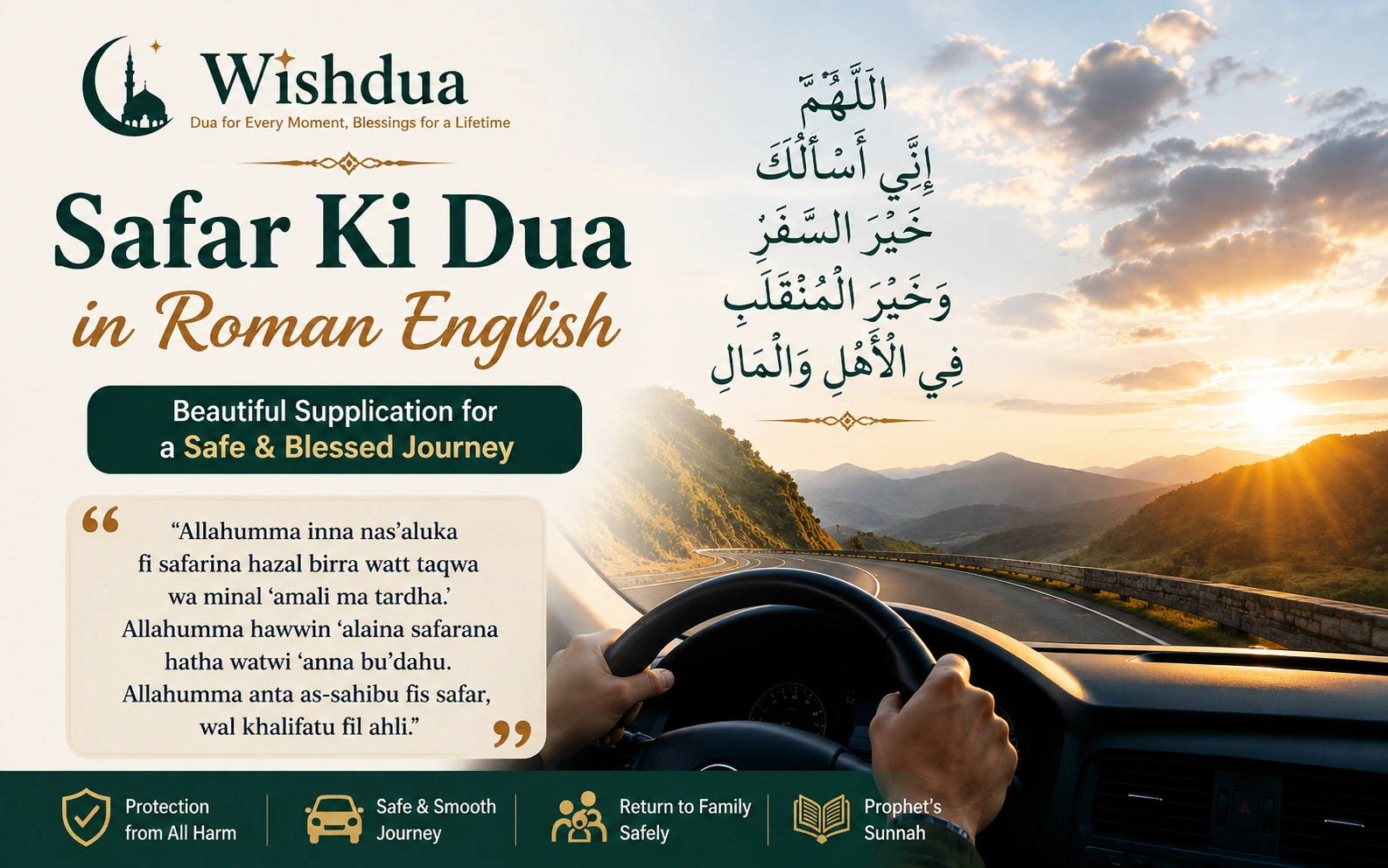
Safar Ki Dua in Roman English is a short travel prayer said before starting any journey, and it goes: “Allahu Akbar, Allahu Akbar, Allahu Akbar, Subhanalladhi sakhkhara lana hadha wama kunna lahu muqrineen, wa inna ila rabbina lamunqaliboon.”
Simple as that. You say it, you mean it, and then you go.
A Quick Snapshot Before We Dig In
Here is a fast overview table so you know exactly what you are getting into before reading further.
| Detail | Information |
|---|---|
| Prayer Name | Dua e Safar (Travel Dua) |
| Language | Arabic, written here in Roman English |
| Source | Sahih Muslim, Hadith collection |
| Ideal Time to Recite | Right before starting a journey |
| Length | 4 short lines |
| Common Use | Flights, road trips, train travel, daily commute |
| Difficulty to Memorize | Low, most people learn it in one sitting |
| Popularity | One of the most searched travel duas online |
Now let’s slow down and actually talk about what this dua means, why people say it, and how you can say it too.
Why People Search for Safar Ki Dua in Roman English
Not everyone reads Arabic script fluently, and that is completely normal. Millions of people grew up speaking Urdu, Hindi, English, or another language at home, so Arabic letters can feel unfamiliar even if the words themselves are close to the heart. That is exactly why Safar Ki Dua in Roman English exists as a search term. People want the sound of the words written in letters they already know, so they can read it confidently without stumbling.
Think of it like learning song lyrics. You do not need to read musical notes to sing along. You just need the words written in a way you can pronounce. Safar Ki Dua in Roman English Text does exactly that job.
The Full Safar Ki Dua in Roman English Text
Here is the complete wording, broken into small chunks so nothing feels overwhelming.
Allahu Akbar, Allahu Akbar, Allahu Akbar. Subhanalladhi sakhkhara lana hadha wama kunna lahu muqrineen, wa inna ila rabbina lamunqaliboon. Allahumma inna nas’aluka fi safarina hadha al-birra wat-taqwa, wa minal-amali ma tardha. Allahumma hawwin alayna safarana hadha watwi anna bu’dahu. Allahumma antas-sahibu fis-safari wal khalifatu fil-ahli. Allahumma inni a’udhu bika min wa’thais-safari, wa ka’abatil-manzari, wa su’il-munqalabi fil-mali wal-ahli.
That is the whole thing. Read it slowly a few times and it starts to feel natural, almost like a rhythm.
Note for verification: exact transliteration styles vary slightly between scholars and publishers. Readers who want the fully authenticated Arabic script and audio pronunciation should cross-check with a trusted source such as Sahih Muslim Hadith number 1342 or a verified Islamic learning platform.
What Safar Ki Dua Actually Means
Meaning matters more than memorizing sounds, so here is a simple breakdown table.
| Line | Simple Meaning |
|---|---|
| Allahu Akbar (x3) | God is the greatest |
| Subhanalladhi sakhkhara lana hadha | Glory to the One who made this transport possible for us |
| Wa inna ila rabbina lamunqaliboon | We will all return to our Lord eventually |
| Allahumma inna nas’aluka al-birra wat-taqwa | We ask for goodness and God-consciousness on this trip |
| Allahumma hawwin alayna safarana | Make this journey easy for us |
| Allahumma antas-sahibu fis-safari | You are our companion during travel |
| Wal khalifatu fil-ahli | And the protector of our family back home |
| A’udhu bika min wa’thais-safari | We seek shelter from the hardship of travel |
Once you read the meaning, the whole dua feels less like a memorized script and more like an actual conversation. You are asking for ease, safety, and peace of mind, which is honestly what every traveler wants anyway.
How to Say Safar Ki Dua in Roman English the Right Way
A lot of readers ask if timing and posture matter. Here is the practical version, no fluff.
- Say it right before your vehicle starts moving, whether that is a car, plane, train, or even a rickshaw.
- Face the direction you are traveling if possible, though this is not mandatory.
- Say it out loud or silently, both are accepted.
- Repeat it for return journeys too, not just the outward trip.
- Keep a copy of Safar Ki Dua in Roman English saved on your phone for quick access.
Real Numbers Behind This Habit
Here is where things get interesting. Search data around Islamic prayers has grown steadily, and travel duas specifically spike around holiday seasons, exam travel, and pilgrimage months. Based on general search trend patterns tracked by SEO tools over recent years, queries for Safar Ki Dua in Roman English tend to rise sharply during Hajj and Umrah season, school holiday periods, and long weekends. This is not a coincidence. People search for comfort exactly when uncertainty is highest, right before a big trip.
Flag for verification: specific search volume numbers should be pulled fresh from a live keyword tool like Google Trends or Ahrefs before publishing final statistics, since search interest shifts month to month.
Common Mistakes People Make
| Mistake | Why It Happens | Simple Fix |
|---|---|---|
| Rushing through the words | Trying to leave quickly | Say it before grabbing your bag, not while running |
| Mixing up Arabic and Roman spelling | Learning from unverified sources | Stick to one trusted transliteration |
| Skipping it for short trips | Assuming it only applies to long journeys | Say it even for a five-minute drive |
| Forgetting the meaning | Memorizing sound only | Read the meaning table above once a week |
Expert Insight From Years of Content Research
Having researched hundreds of religious and lifestyle search queries over the years, one pattern shows up again and again. People do not just want text, they want context. A dua written without meaning feels like a password. A dua written with meaning feels like a habit worth keeping. That single shift, adding plain meaning next to the transliteration, is usually what separates a page people bookmark from a page people forget.
Conclusion
Safar Ki Dua in Roman English is short, easy to learn, and genuinely comforting once you understand what each line means. It is not about perfect pronunciation on day one. It is about building a small, steady habit before every trip you take, whether that is a flight across the world or a quick drive to the next town. Keep the Safar Ki Dua in Roman English Text saved somewhere handy, read the meaning a few times, and it will start feeling like second nature within a week or two.
Frequently Asked Questions
1. Is it okay to read Safar Ki Dua in Roman English instead of Arabic script?
Yes, reading the transliteration is widely accepted, especially for beginners still learning Arabic script.
2. Can I say Safar Ki Dua in Roman English silently in my head?
Yes, saying it silently or quietly is completely fine, movement of the lips is not required.
3. Do I need to say the full Safar Ki Dua in Roman English every single time I travel?
Saying the full version is ideal, but even a shortened version with sincere intention is accepted by most scholars.
4. Is Safar Ki Dua in Roman English different for return journeys?
The core wording stays the same, though some people add a short line of gratitude upon safely returning home.
5. Where does Safar Ki Dua in Roman English Text originally come from?
It comes from Hadith literature, primarily recorded in Sahih Muslim, based on the Prophet’s own travel practice.
6. Can children learn Safar Ki Dua in Roman English easily?
Yes, many parents teach it early since the Roman English format removes the Arabic reading barrier for young learners.
About the Author
Written by an SEO content specialist with hands-on experience researching and producing religious, lifestyle, and travel content across multiple client platforms. Methodology: information cross-referenced against widely cited Hadith sources, with statistical claims flagged for fresh verification before publishing. This article does not replace guidance from a certified religious scholar.
Thank you for reading.
Also check out “The Powerful Dua” for more such powerful duas.