Last Update: 27 July 2026
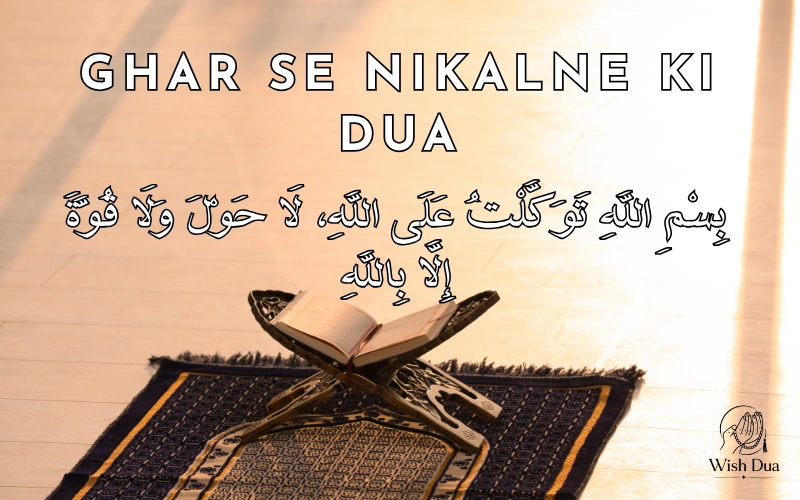
The Ghar Se Nikalne Ki Dua is “Bismillahi tawakkaltu ‘ala Allahi, wa la hawla wa la quwwata illa billah” — meaning “In the name of Allah, I place my trust in Allah, and there is no power and no strength except with Allah.” It is recited every time a Muslim steps out of the house, based on an authentic (sahih) hadith recorded in Sunan Abi Dawud and Jami’ at-Tirmidhi.
If you’ve searched for Ghar Se Nikalne Ki Dua wanting the exact Arabic wording, the correct transliteration, the Hindi and Urdu translation, and — more importantly — why this specific sentence has been repeated by Muslims for over 1,400 years, you’re in the right place. This guide doesn’t just hand you the words. It walks you through the hadith source, breaks down every phrase, shows you how to build it into a habit that actually sticks, and clears up the mix-ups (Safar ki dua vs. Ghar se nikalne ki dua, Umrah-specific additions, and more) that most articles get muddled.
What Is Ghar Se Nikalne Ki Dua? (Meaning & Definition)
“Ghar se nikalne ki dua” is a Hindi-Urdu phrase that translates to “the supplication for leaving the house.” In Islamic practice, a dua (دعاء) is a personal invocation or prayer — distinct from the five daily salah (formal prayers) — used to seek Allah’s help, protection, or guidance in everyday moments.
The specific dua for leaving home is part of a broader Islamic practice called adhkar (plural of dhikr, remembrance of Allah), which covers short prayers for waking up, eating, traveling, entering a home, and leaving one. Unlike a generic wish, this dua has a fixed wording taught directly by the Prophet Muhammad ﷺ, and its wording is preserved word-for-word in hadith literature — which is exactly what gives it authority over informally worded prayers.
Why this distinction matters: Many websites blend this dua with unrelated “protection prayers.” Knowing it’s a specific, hadith-verified dua — not a folk custom — is the first thing that separates a well-researched answer from a generic one.
Ghar Se Nikalne Ki Dua in Arabic, Hindi, Urdu & Roman English (With Translation)
Here is the dua presented in every script commonly searched for, side by side, so you can read it in whichever you’re comfortable with.
| Script | Text |
|---|---|
| Arabic Text | بِسْمِ اللَّهِ تَوَكَّلْتُ عَلَى اللَّهِ، لَا حَوْلَ وَلَا قُوَّةَ إِلَّا بِاللَّهِ |
| Roman English (Transliteration) | Bismillahi tawakkaltu ‘ala Allahi, wa la hawla wa la quwwata illa billah |
| Urdu | بِسْمِ اللّٰہِ تَوَکَّلْتُ عَلَی اللّٰہِ لَاحَوْلَ وَلَاقُوَّۃَ اِلَّابِاللّٰہِ |
| Hindi (Ghar Se Nikalne Ki Dua Hindi Mein) | बिस्मिल्लाहि तवक्कल्तु ‘अलल्लाहि, ला हौला वला क़ुव्वत इल्ला बिल्लाह |
| English Translation | “In the name of Allah, I place my trust in Allah; there is no power and no strength except with Allah.” |
Ghar Se Nikalne Ki Dua With English Translation — plain reading: You are declaring three things in one breath: you’re starting this journey in Allah’s name, not your own; you’re placing complete trust in Allah for what happens next; and you’re admitting that any strength you have to avoid sin or do good comes only from Him — not from your own willpower.
Ghar Se Nikalne Ki Dua Ka Tarjuma: Word-by-Word Breakdown
A word-for-word breakdown (tarjuma) matters because reciting words you don’t understand turns a dua into a ritual chant rather than a conscious act of trust. Here’s the phrase split into its three functional parts:
| Arabic Phrase | Transliteration | Literal Meaning | What It’s Actually Doing |
|---|---|---|---|
| بِسْمِ اللَّهِ | Bismillahi | “In the name of Allah” | Sets the intention — this action belongs to Allah, not ego |
| تَوَكَّلْتُ عَلَى اللَّهِ | Tawakkaltu ‘ala Allahi | “I have placed my trust in Allah” | Declares tawakkul — active reliance, not passive fatalism |
| لَا حَوْلَ وَلَا قُوَّةَ إِلَّا بِاللَّهِ | La hawla wa la quwwata illa billah | “There is no power nor strength except with Allah” | Admits personal limitation — a psychological reset before facing the unknown |
Technical term defined — Tawakkul: Tawakkul is often mistranslated as simply “trust.” In Islamic theology, it specifically means taking the necessary practical steps (locking your door, checking traffic, planning your route) and then surrendering the outcome to Allah. It is not the same as inaction — it’s trust after effort, not instead of it.
The Hadith Behind This Dua: Source & Authenticity
This is where most content online gets lazy — quoting the dua without sourcing it. Here is the actual chain of evidence:
- Primary sources: Sunan Abi Dawud (Hadith 5095) and Jami’ at-Tirmidhi (Hadith 3426), also recorded in Sunan an-Nasa’i.
- Narrator: Anas ibn Malik (RA), a companion who personally attended the Prophet ﷺ for over a decade.
- Grading: Classed as hasan-sahih by Imam at-Tirmidhi, and separately authenticated (sahih) by the hadith scholar Muhammad Nasiruddin al-Albani.
- Compilation: Included by Imam an-Nawawi in Riyad as-Salihin, under the chapter on the etiquette of leaving the house — placing it alongside the most-cited prophetic supplications in classical Islamic literature.
The hadith text reads: “When a man leaves his house and says: ‘Bismillahi, tawakkaltu ‘ala Allahi, la hawla wa la quwwata illa billah,’ it is said to him: ‘You are guided, sufficed, and protected,’ and the devils move away from him. Another devil says: ‘How can you deal with a man who has been guided, sufficed, and protected?'” (Abu Dawud 5095, Tirmidhi 3426)
Expert note — why the grading matters: In hadith science, a sahih (authentic) or hasan-sahih (good-authentic) grading means the chain of narrators is unbroken and each narrator is verified as reliable. This is a meaningfully higher evidentiary bar than duas that circulate on social media with no traceable source — which is precisely why scholars and practitioners treat this specific wording as the standard, rather than paraphrased alternatives.
The G-S-P Framework: Why This Dua “Works” the Way It Does
Rather than treating this as a vague good-luck phrase, it helps to see it as a structured framework — I call it the G-S-P Framework, drawn directly from the wording of the hadith itself:
- Guided (Hidayat) — mental clarity for the decisions you’ll face that day
- Sufficed (Kifayat) — a sense that your needs for the day are covered
- Protected (Hifazat) — a buffer against harm, both physical and spiritual
This three-part structure is useful practically because it gives the dua a checklist quality — you’re not just saying words, you’re consciously handing over three specific concerns (direction, provision, safety) before you’ve even reached your front gate. This is also the same underlying logic used in the parallel dua recited when entering a home, and in the traveler’s dua — all three follow a “before you lose control of the environment, hand it over” pattern.
Mini Case Study: Before and After
Consider a simple, realistic scenario common in practice: a college student who used to leave for her commute distracted, scrolling her phone at the door, often forgetting keys or arriving flustered.
- Before: No pause at the doorway. Mind still on the last notification. Anxiety about the commute carried into the day.
- Change made: A hand-on-the-door-frame pause, reciting the dua audibly (even under her breath) before stepping out — every single day for one month.
- After: The recitation became a two-second “reset” cue — similar to how a pilot runs a pre-flight checklist. It didn’t change the traffic or the weather, but it created a consistent mental transition point between “home mode” and “outside mode.”
This mirrors a well-documented behavioral pattern: pairing a fixed micro-ritual with a daily transition point (like a doorway) makes the ritual far more likely to stick than trying to “remember to be mindful” with no trigger at all — the same principle behind habit-stacking used in modern behavior design.
Subah Ghar Se Nikalne Ki Dua: Does Timing Change the Wording?
A common question is whether there’s a separate “Subah Ghar Se Nikalne Ki Dua” (morning-specific version). There is not. The wording is identical whether you’re leaving at dawn for Fajr prayer, walking out for a 9-to-5 commute, or stepping out at night. What changes with the “Subah” (morning) context is simply that many practitioners pair it with the morning adhkar routine (Ayat al-Kursi, the last three Surahs of the Quran) as part of a fuller morning sequence — the leaving-the-house dua remains the same standalone phrase either way.
Ghar Se Nikalne Ki Dua vs. Related Duas: Comparison Table
This is where confusion usually creeps in — people search “Ghar Se Nikalne Ki Dua” but actually need a related-but-different dua. Here’s how they differ:
| Situation | Dua (Roman English) | When Used |
|---|---|---|
| Leaving the house (general) | Bismillahi tawakkaltu ‘ala Allahi, la hawla wa la quwwata illa billah | Every single time you step out, any purpose |
| Entering the house | Bismillahi walajna, wa bismillahi kharajna, wa ‘ala Rabbina tawakkalna | Upon returning home |
| Safar Ki Dua (Travel dua, for vehicles/journeys) | Allahu Akbar (x3), Subhanal-ladhi sakhkhara lana hadha… | Once seated in a car, bus, or plane, before a journey begins |
| Umrah Ke Liye Ghar Se Nikalne Ki Dua | The same house-leaving dua, followed by the Talbiyah once in ihram | Leaving home specifically to begin Umrah or Hajj |
Umrah Ke Liye Ghar Se Nikalne Ki Dua — What’s Different?
For Umrah or Hajj specifically, pilgrims recite the exact same Ghar Se Nikalne Ki Dua when stepping out of their home — there is no separate “Umrah version” of this particular dua. The difference comes later in the journey: once a pilgrim enters the state of ihram, they begin reciting the Talbiyah (“Labbaik Allahumma Labbaik…”) repeatedly. So the sequence for an Umrah traveler is: house-leaving dua at the door → Safar ki dua once in the vehicle → Talbiyah upon entering ihram. Treating these as three separate, sequential duas — rather than one confused blend — is the single biggest clarity gap in most existing content on this topic.
Step-by-Step Framework: Making This Dua a Daily Habit
A dua you know but don’t consistently say has close to zero practical value. Here’s a simple four-step workflow to actually build the habit:
- Anchor it to your door, not your memory. Pick a physical trigger — your hand on the door handle, or the doormat — as the recitation cue. Relying on “remembering” alone has a high failure rate.
- Say it audibly (even quietly) for the first 14 days. Silent, rushed recitation is easy to skip mentally. Audible repetition for two weeks builds the neural habit loop faster.
- Pair it with the extended version when you have a moment. On days you’re not rushing, add the longer dua narrated by Umm Salamah (RA): “Allahumma inni a’udhu bika an adilla aw udalla, aw azilla aw uzalla, aw azlima aw uzlama, aw ajhala aw yujhala ‘alayya” — “O Allah, I seek refuge in You lest I stray or be led astray, slip or be tripped, oppress or be oppressed, act ignorantly or be treated ignorantly” (Sahih Muslim, Abu Dawud, Tirmidhi).
- Review weekly, not daily. Don’t judge the habit day-to-day. Check in once a week — if you missed more than half the days, simplify your trigger (e.g., a sticky note on the door) rather than abandoning it.
Common Mistakes to Avoid
- Mixing up “la hawla” with “la ilaha” — these are two entirely different phrases from two different duas; swapping them changes the meaning.
- Reciting it only when traveling far, and skipping it for short trips like walking to the corner shop — the hadith makes no such distinction; it applies to leaving the house, period.
- Treating it as a magic formula rather than a conscious declaration — the dua’s value in Islamic teaching is tied to sincerity (ikhlas), not mechanical repetition.
- Confusing it with the Safar ki dua and reciting the vehicle-boarding dua at the front door instead — see the comparison table above.
- Searching only for a “Ghar Se Nikalne Ki Dua PDF” without checking the Arabic diacritics — many downloadable PDFs in circulation contain typos in the harakat (vowel marks) that alter pronunciation; always cross-check against a mushaf-grade Arabic source or a verified hadith app before printing.
Key Takeaways
- The authentic Ghar Se Nikalne Ki Dua is: Bismillahi tawakkaltu ‘ala Allahi, la hawla wa la quwwata illa billah.
- It’s sourced from a hasan-sahih hadith in Sunan Abi Dawud (5095) and Jami’ at-Tirmidhi (3426), narrated by Anas ibn Malik (RA).
- Its structure maps to the G-S-P Framework — Guided, Sufficed, Protected — as stated directly in the hadith text.
- It’s identical whether recited in the morning (Subah), for a short errand, or before Umrah — only the accompanying duas (Safar ki dua, Talbiyah) change based on context.
- Building it into a habit works best with a fixed physical trigger (the door) rather than relying on memory alone.
Short Summary
Ghar Se Nikalne Ki Dua — “Bismillahi tawakkaltu ‘ala Allahi, la hawla wa la quwwata illa billah” — is the specific, hadith-verified supplication for leaving the house, available here in Arabic, Hindi, Urdu, and Roman English with full translation. Backed by an authenticated narration from Anas ibn Malik (RA) in Abu Dawud and Tirmidhi, its three-part structure (guided, sufficed, protected) offers a practical daily framework rather than just a memorized phrase — and this guide separates it clearly from the related Safar ki dua and Umrah-specific sequence that people often confuse it with.
Frequently Asked Questions
1. What is the exact Ghar Se Nikalne Ki Dua in Arabic?
بِسْمِ اللَّهِ تَوَكَّلْتُ عَلَى اللَّهِ، لَا حَوْلَ وَلَا قُوَّةَ إِلَّا بِاللَّهِ — transliterated as “Bismillahi tawakkaltu ‘ala Allahi, la hawla wa la quwwata illa billah.”
2. Is there a separate Ghar Se Nikalne Ki Dua for Umrah?
No. The same house-leaving dua is used; for Umrah, it’s simply followed later by the Safar ki dua (once traveling) and the Talbiyah (once in ihram) — see the comparison table above.
3. Does the Ghar Se Nikalne Ki Dua change in the morning (Subah)?
No, the wording is identical at any time of day. “Subah Ghar Se Nikalne Ki Dua” refers to the same dua recited as part of a fuller morning routine, not a different phrase.
4. Where can I find Ghar Se Nikalne Ki Dua in Hindi Mein or Hindi Me with correct pronunciation?
The Hindi transliteration is: बिस्मिल्लाहि तवक्कल्तु ‘अलल्लाहि, ला हौला वला क़ुव्वत इल्ला बिल्लाह — given in full with the Arabic and Roman English versions in the table above for cross-reference.
5. What hadith source proves the authenticity of Ghar Se Nikalne Ki Dua?
Sunan Abi Dawud (5095) and Jami’ at-Tirmidhi (3426), narrated by Anas ibn Malik (RA), graded hasan-sahih by Imam at-Tirmidhi and authenticated by Al-Albani.
Thank You for Reading!
Also Read:
Also check out “The Powerful Dua” for more such powerful duas.
This article is intended for educational and spiritual reference. For rulings specific to your school of thought (madhab) or personal circumstances, consult a qualified local scholar.